 Guide On Map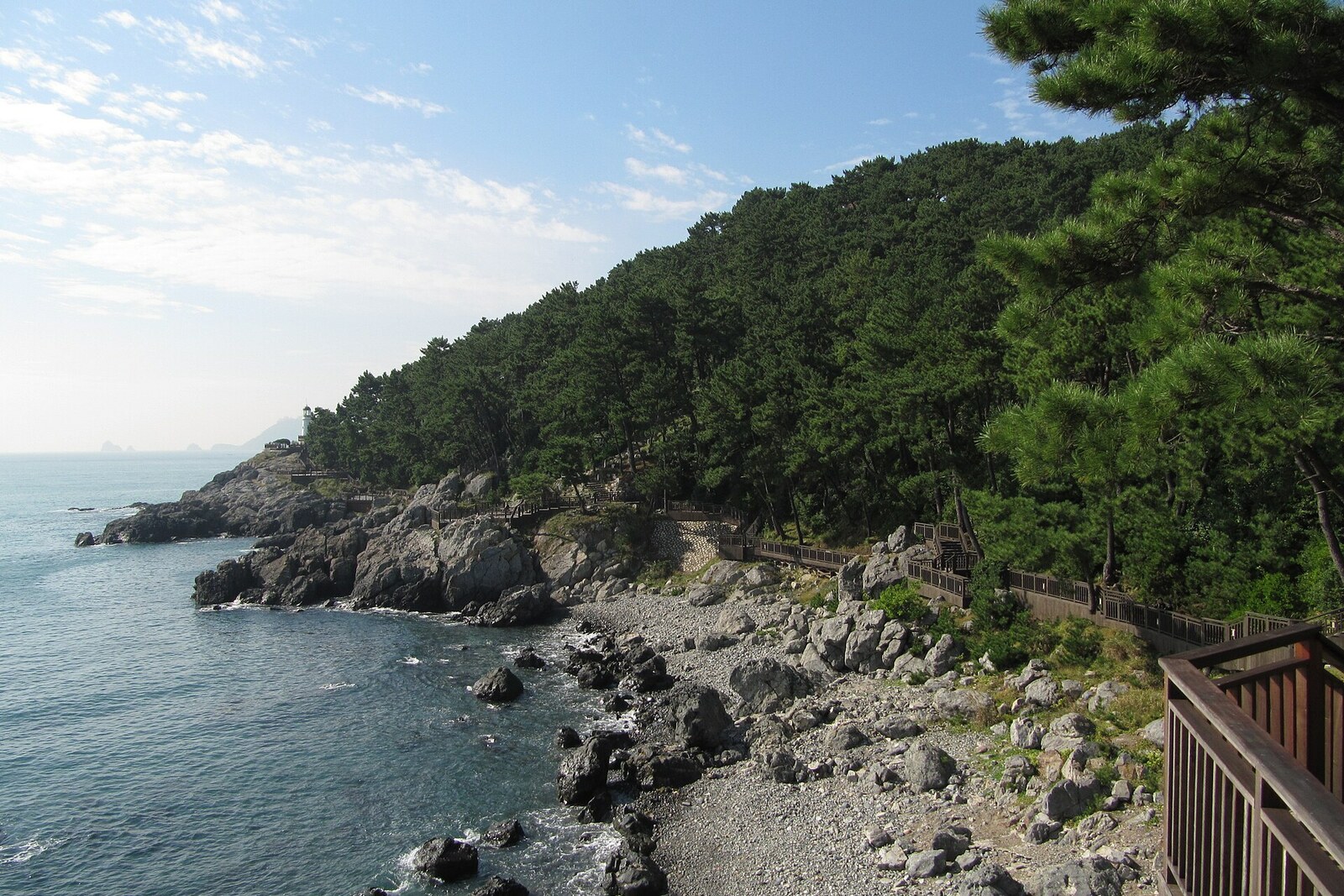
Look around first
What to notice
- Camellias along the entrance road
- Maritime pine crowns
- The rocky slope of the former island
The story of the place
The road to Dongbaekseom Island runs through a place where you would expect to see a strait. It has been gone for about five thousand years. Chuncheon Stream carried sand, clay, and pebbles down from Jangsan Mountain; the sediment gradually formed a bar between the shore and a separate rocky rise. Geographers call this kind of landform an island connected to the mainland by a sand spit. That is why the ending “seom”—“island”—is more accurate here than it may seem: the road was laid across ancient sediment, not a modern bridge or causeway.
The first part of the name, “dongbaek,” means camellia. These trees were once so numerous that they gave their name to the entire rise. A legend survives: in winter and spring, fallen flowers lay in a layer about ten centimeters deep, and passersby with their horses trampled them into the ground. Today, the crowns of maritime pines are more noticeable above the slopes. Below, camellias are crowded out by the evergreen sasyrepi shrub, especially where gardeners do not thin the thickets.
By two thousand nineteen, the mismatch had become too obvious: Camellia Island greeted people with pines. The leaders of Haeundae-gu invited Yang On-bo, the seventy-seven-year-old creator of a large camellia garden on Jeju. He examined the trees for two hours and explained to officials that the camellias had been planted too densely, were suffering from pests, and were losing out to neighboring species; the leaves on some trees were already turning yellow from a lack of magnesium. Restoration required thinning, treatment, and new plantings.
The local Busan Bank offered to pay one billion won for the trees and the work. City landscapers set aside one hectare near the island entrance for the new forest. By December, they had planted one thousand two hundred ornamental sasanquas—another species of camellia—and fifty-seven Japanese camellias. At the same time, specialists counted all the trees on Dongbaekseom Island for the first time: twenty-one thousand eighty-six specimens of twenty-five species. There were six thousand seven hundred eighty Japanese camellias, three thousand nine hundred sasanquas, and two thousand six hundred maritime pines.
The camellias along the entrance road appeared here during that planting. Beneath them lies the sand spit brought by Chuncheon Stream, and beyond it begins the rocky part of the former island.
Useful on site
Open around the clock, free entry
Checked: June 28, 2026. Check the official source before visiting.Stay on the laid paths, and do not look for the former shoreline among the vegetation: the island's transformation took place gradually and left no single clear boundary.