 Guide On Map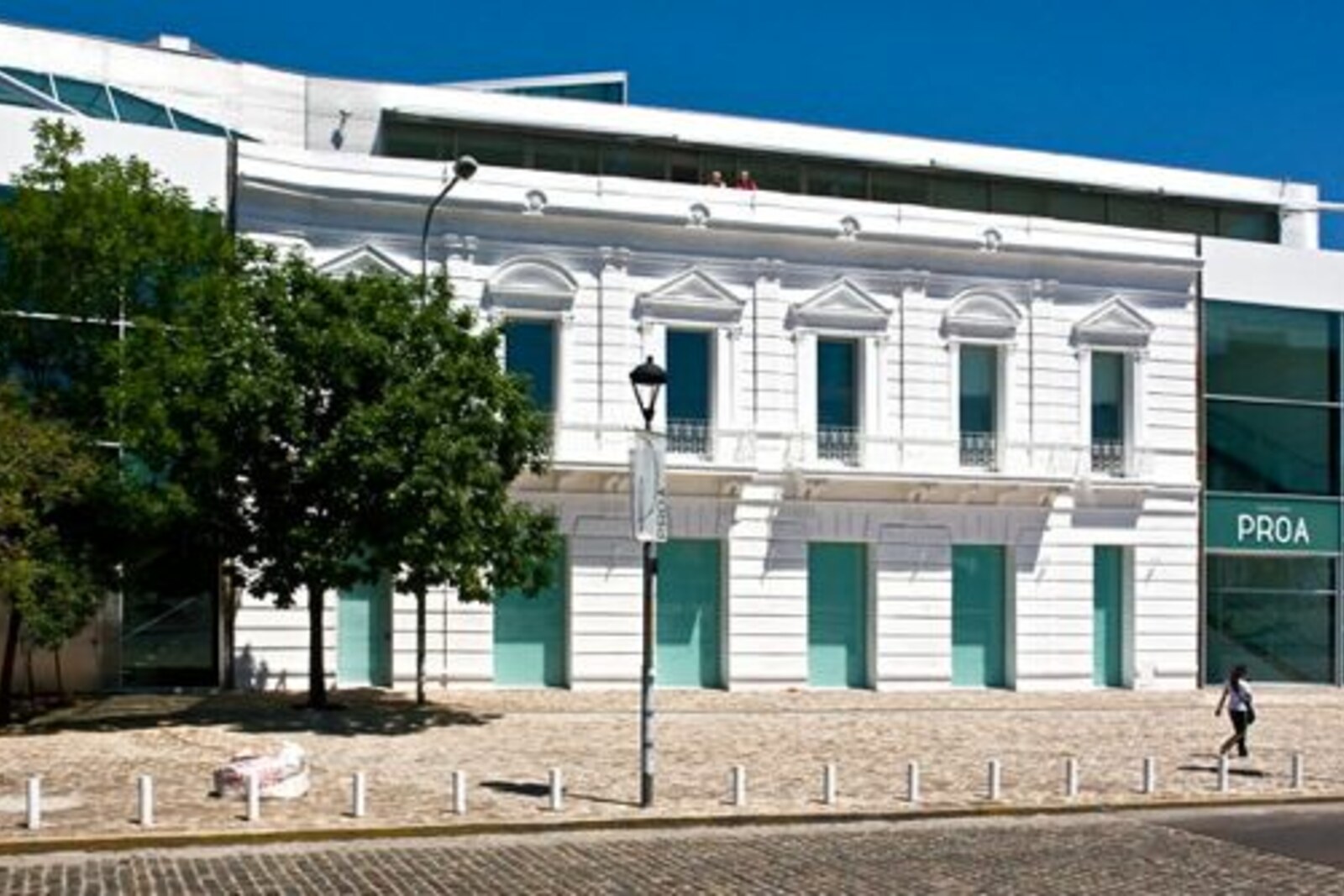
Look around first
What to notice
- White Italian façade
- Glass side planes
- Old transporter bridge
- Terrace above the river
The story of the place
The old Italian façade remained in the middle of the building, while glass walls rose on both sides of it. Inside are four galleries, an auditorium, and a bookstore; the terrace café faces the river and the motionless iron truss of the old bridge. There is no permanent collection here: works arrive for several months, then the spaces are cleared for another exhibition. In Spanish, “proa” is the name for the bow of a vessel, with which it enters unfamiliar water.
In nineteen ninety-six, gallery owner and curator Adriana Rosenberg conceived the idea of opening an internationally ranked contemporary art center. The funding came from the private industrial Techint Group. But Rosenberg chose not the north of Buenos Aires, where the established galleries were then located, but La Boca—a neighborhood that exhibition-going audiences were reluctant to visit and where floods still occurred.
On the corner near Caminito stood an Italian house from eighteen ninety-five. Rosenberg commissioned the Milan-based Caruso Torricella firm to adapt it for temporary exhibitions: it needed galleries capable of hosting works from major foreign collections. The first exhibition here was a retrospective of the Mexican artist Rufino Tamayo. Rosenberg then began bringing to La Boca exhibitions that Argentina had not seen before, accompanying them with lectures, catalogs, and classes for neighborhood schools. She had to persuade international museums to entrust works to the foundation, while also persuading the capital's public to travel south for art.
Ten years later, the team already had more than fifty exhibitions behind it. Rosenberg decided to celebrate the anniversary outside—on the old Nicolás Avellaneda Transporter Bridge opposite the building. Lighting artist Gonzalo Córdova and set designer Horacio Pigozzi were given the task of bringing the abandoned iron structure back into the city's view. On December fifteenth and sixteenth, two thousand six, they attached about six hundred fluorescent and moving light fixtures to the bridge. The colors came on one after another along the trusses; for two evenings, the exhibition itself occupied the structure across the river.
After the first trials, La Boca residents asked for the lighting to remain permanent and for the bridge to operate again. The artists could not promise that. The fixtures were removed, and the bridge remained standing without moving; the anniversary work did not present a temporary artistic action as a repair. But it precisely showed what the foundation does: its staff do not assemble one permanent collection, but bring in temporary exhibitions and let artists transform a particular space—a gallery, a façade, or, as then, the port structure in front of it.
The success of the early years allowed Rosenberg to close the cramped original venue in order to expand. The same Milan architects joined the neighboring houses, preserved the old Italian façade in the middle, and placed glass planes on either side of it. In two thousand eight, four exhibition galleries, an auditorium, a bookstore, and a café with a terrace facing the river and the bridge opened here.
The name “Proa” was also chosen for this address. It was the name of one of the early Latin American modernist literary magazines; in Spanish, “proa” means the bow of a vessel, the part that enters unknown water. The colored tubes are no longer on the bridge. From the first building, the white façade remains between the glass wings, and behind the glass they still assemble exhibitions designed to last several months, before the galleries empty again and receive other works.
Useful on site
Fundación Proa: Tue–Sun 11:00–19:00; check exhibitions and tickets before your visit.
Checked: June 28, 2026. Check the official source before visiting.You can hear the story from outside. The exhibition galleries and terrace require a separate visit, so check access in advance and allow extra time for them.