 Guide On Map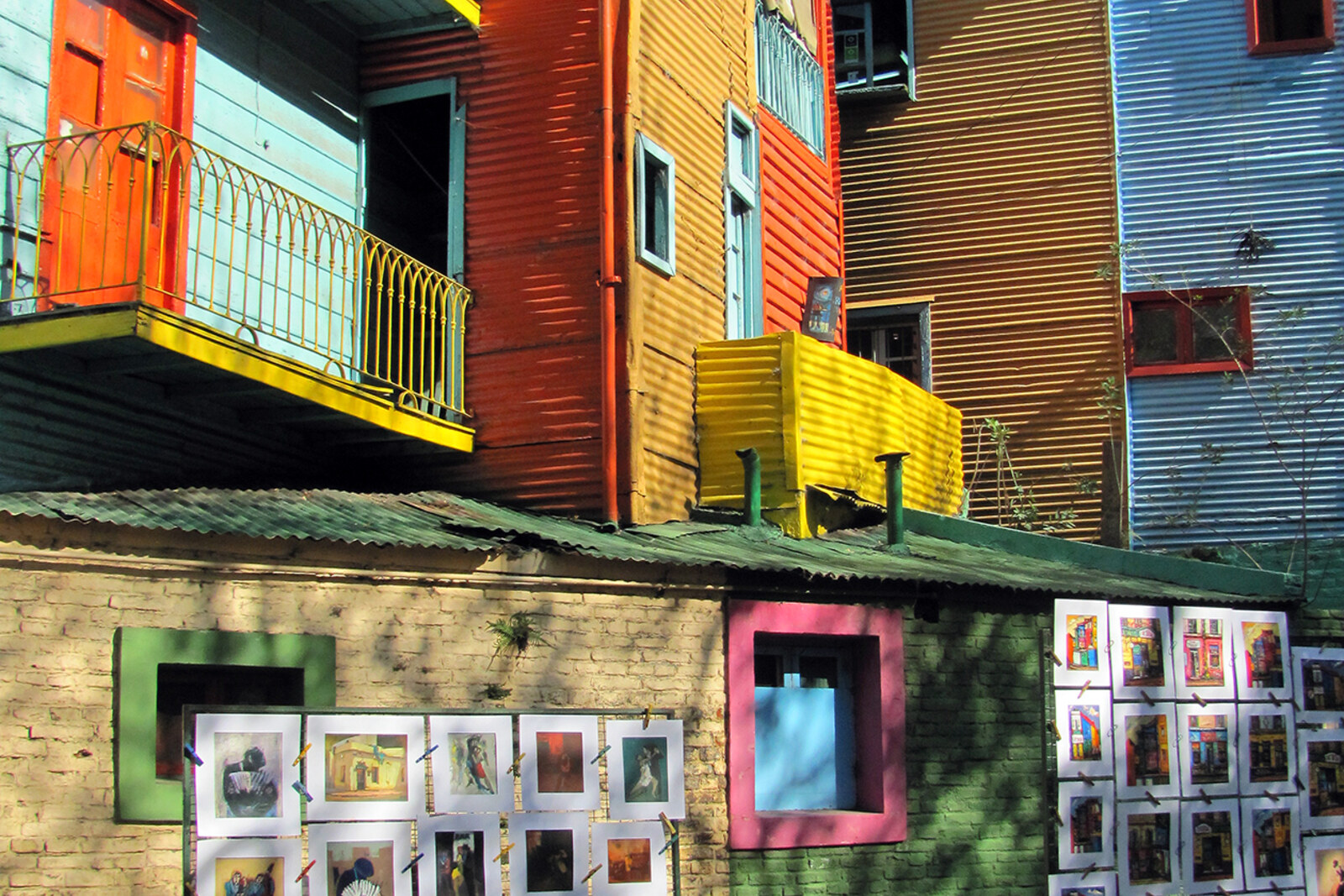
Look around first
What to notice
- The street’s diagonal curve
- Colorful back walls of houses
- Sculptures and ceramic panels
- Iron posts with chains
The story of the place
Caminito runs diagonally through the neighborhood, following the route of the former freight line to the La Boca docks. On both sides stand house walls that once remained backyards: they were not allowed to have entrances facing the railway. The rails were dismantled long ago, and the stone paving appeared much later; only the curve of the former route remains here. At the ends of the short stretch, iron posts with chains mark its boundary, while ceramic panels, sculptures, and reliefs stand among the brightly painted walls.
In nineteen fifty-four, a cart came in here and dumped a heap of spoiled cheese. The passage had already served as an informal dump, but this discovery exhausted the patience of brothers Arturo Carrega and Aníbal Carrega. Across the way, they ran a shop selling ship supplies, hardware, and paint—they made their living from trade with the port, while the abandoned plot began right outside their door.
The plot still belonged to the railway at the time. In eighteen sixty-six, a freight branch line to the La Boca docks was laid here. The tracks crossed the neighborhood diagonally, so locals called the place La Curva—“the Curve.” Neighboring houses faced the trains with their backyards and blank walls: they were not allowed to make entrances onto railway land. Trains stopped running in nineteen twenty-eight, and when the tracks began to be removed, pits, weeds, and trash were left behind.
Arturo Carrega brought in workers from his shop. They hauled away waste, leveled the ground, filled in potholes, and set up posts at both ends of the passage so that carts and cars could no longer enter. That was how the future pedestrian street was first fenced off from becoming another dump. The land did not belong to the brothers, so this work had no legal protection on paper yet.
Aníbal Carrega turned to Benito Quinquela Martín, a La Boca artist who had campaigned for schools, a museum, and studios for the neighborhood. Quinquela persuaded railway workers to remove the remaining tracks and level the rail bed, and the city mayor to continue the improvements and lay asphalt. He then began placing sculptures and reliefs by Argentine artists here and directing the painting of the houses.
The present-day riot of color appeared at precisely that time. Quinquela chose combinations of rich colors and supported the work with money and materials. The transformation was entirely deliberate: the back walls along the former tracks became the façades of an open-air museum. It was an authored composition of the mid-twentieth century, not the accidentally preserved paintwork of an old port neighborhood.
The name, too, appeared before the street itself. Quinquela wanted to support his seriously ill friend, the composer Juan de Dios Filiberto. According to Filiberto’s recollections, the melody of the tango “Caminito” arose from a memory of this curve. In his youth, he earned a living as a mechanic and, when there was no work, as a dockworker on ships. Returning home through La Curva, he saw a girl waiting for him on a balcony; they never spoke to one another. Many years later, Filiberto came back beneath that balcony and wrote down the melody that came to him.
The lyrics were written by the poet Gabino Coria Peñaloza. His “caminito”—a little path—was far from here, in La Rioja Province. The lyrics and the music told of two different paths. The melody belonged to La Boca.
In nineteen fifty-four, Aníbal Carrega wrote the name “Caminito” and an explanation about Filiberto’s song by hand on a pine board. The sign was hung without an official decision, and a newspaper soon reported that a street with that name had appeared in La Boca. While officials were preparing the documents, the name had already entered common use.
Arturo Carrega died in January nineteen fifty-five and did not see the result. His brother continued the work with Quinquela. On October eighteenth, nineteen fifty-nine, the city officially received the former railway land and opened the open-air museum. Aníbal signed the act as a witness, Filiberto himself conducted a performance of “Caminito,” Coria Peñaloza came from La Rioja Province, and Arturo was named from the stage as the first person to take on this passage.
Today, Caminito’s permanent exhibits—sculptures, reliefs, and ceramic panels—stand alongside a fair where artists have exhibited and sold their work since nineteen seventy-seven. There is no point looking for old rails beneath the paving: they were removed before the museum opened, and the paving appeared only in the late nineteen eighties. The diagonal curve is all that remains of the railway. Iron posts with chains at its ends replaced the first barrier that the Carrega brothers set up after the cart of spoiled cheese.
Useful on site
Open pedestrian street; visit during the day and stay within the busy tourist core.
Checked: June 28, 2026. Check the official source before visiting.This is an open and usually lively stop. For a quieter listen, step away from the dance areas and do not block the narrow passage.