 Guide On Map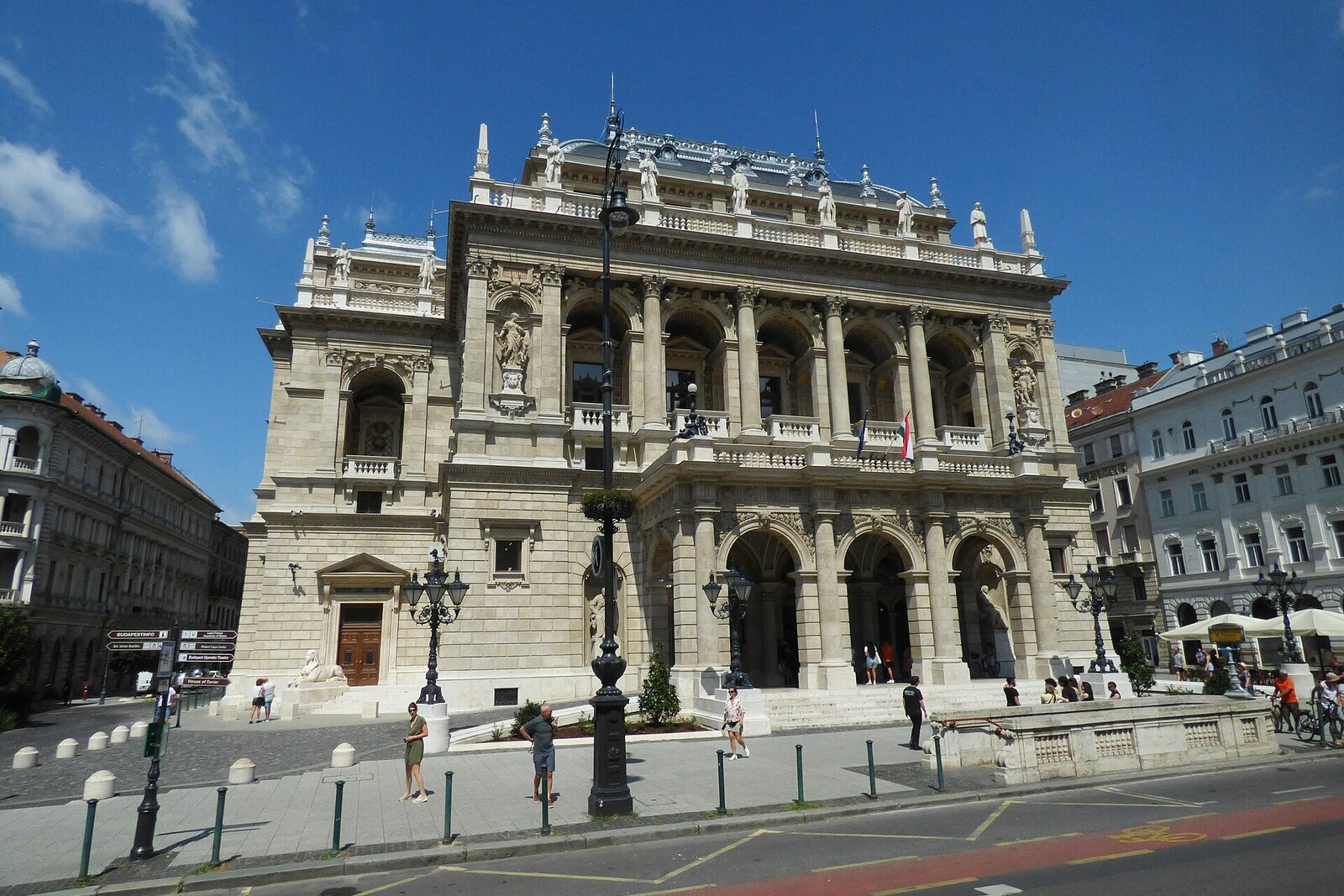
Look around first
What to notice
- The theater façade
- Service entrance
- Mahler's bronze bust
- The building opposite the service entrance
The story of the place
The façade on the avenue conceals a separate opera house, created after the former National Theatre could no longer accommodate both drama and opera. Soloists, a chorus, an orchestra, and a ballet work here permanently; throughout the season, they gather here for dozens of performances. And the working life extends beyond these walls: on the eighth floor of the building opposite the artists' entrance, the chorus rehearses in a separate hall.
A permanent opera company works behind this façade: its own soloists, chorus, orchestra, and ballet put on dozens of performances each season. They needed a separate home because the former National Theatre could no longer manage drama and opera at the same time. In eighteen eighty-four, the Royal Hungarian Opera House opened on Sugár Avenue—the name Andrássy Avenue had at the time.
Four years later, the lavish building was in far better shape than its company. The previous manager was dismissed, and twenty-eight-year-old Gustav Mahler, a conductor from Bohemia who spoke almost no Hungarian, was invited to save the young theater. The appointment was kept secret until the last moment. Mahler was offered an enormous salary for the time—ten thousand florins a year—and a ten-year contract.
This was his job, not an honorary post. Mahler's compositions brought in almost nothing; he earned his living by conducting. During his second season in Budapest, his parents died, and Mahler became head of the family, responsible for four younger brothers and sisters. He had much to lose by giving up a guaranteed ten-year salary.
The theater was called Hungarian, but different languages could be sung on one stage, and leading roles were often given to visiting performers. Supporters of national opera demanded their own repertoire and their own company. The German-speaking Mahler understood that this was exactly how he would be judged. He announced that he would make the theater Hungarian in language and personnel, and that he would take the podium himself for the first time once local artists had prepared two Richard Wagner operas—Das Rheingold and Die Walküre—in Hungarian.
Both parts of Der Ring des Nibelungen were performed at the end of January eighteen eighty-nine, on two successive evenings. The company had never performed them before. Mahler conducted himself and directed the production; the singers had to learn the Hungarian text for one of the most difficult scores of its time. The success was such that even hostile newspapers admitted that the theater had managed on its own. These performances secured Mahler's place as director and brought Wagner into the Hungarian repertoire.
In December of the following year, Mahler's Don Giovanni was performed here. Almost the entire cast sang in Hungarian; only the invited German star Lilli Lehmann was allowed to sing the role of Donna Anna in Italian. Johannes Brahms, one of Europe's leading musical authorities, was in the audience. His friends had long urged him to come: Brahms insisted that he would rather read the score at home and drink cold beer, because he would not hear a good Don Giovanni anyway. After the first act, he ran onto the stage and embraced Mahler. Later, Brahms's support helped the former Budapest director obtain the top post at the Vienna Court Opera.
By then, Mahler was already conducting secret negotiations with the theater in Hamburg. At the beginning of eighteen ninety-one, a new intendant was appointed above him—a manager who controlled the director. The composer and pianist Count Géza Zichy wanted to determine the Opera's artistic direction himself and immediately curtailed Mahler's authority.
Mahler had seven and a half years left on his costly contract, while the agreement with Hamburg was already in his pocket. He agreed to leave on the condition that he be paid twenty-five thousand florins—two and a half annual salaries. Zichy paid. Two days after the resignation was announced, Lohengrin was performed here. Mahler did not conduct, but the audience interrupted the first act, calling his name; detectives restored order in the gallery. At the end of March, he began work in Hamburg.
Mahler's name does not appear on the façade. His bronze bust stands inside, by the door to Bertalan Székely Hall. And on the eighth floor of the building opposite the service entrance, the chorus of the Hungarian State Opera House rehearses in Mahler Hall.
Useful on site
The exterior is accessible as a city landmark; the official OperaTour and performances follow a separate schedule, which is best checked on the day of your visit.
Checked: June 28, 2026. Check the official source before visiting.You can listen to this story from the avenue; plan a visit to the auditorium and other interiors separately.