 Guide On Map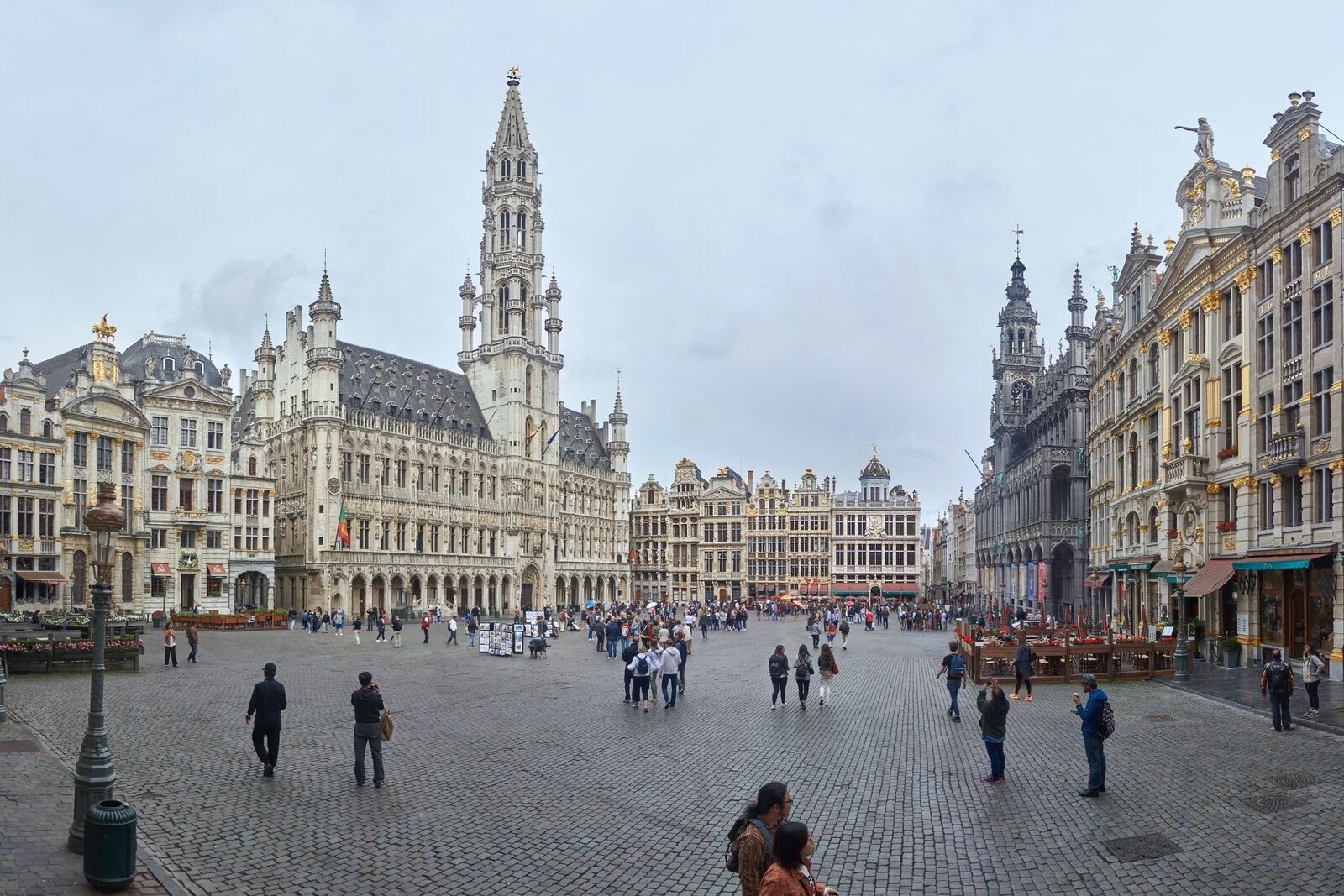
Look around first
What to notice
- The façade of Brussels Town Hall
- King's House opposite Brussels Town Hall
- The bronze plaque at the entrance to King's House
- City signs with the square’s two names
The story of the place
The city signs around the square use two names. The French “Grand-Place” means Great Square, while the Dutch “Grote Markt” means Great Market. In the twelfth century, townspeople called this place the Lower Market. People traded here, announced decisions of the city council, welcomed rulers, and held processions. Today, the same open space is used for the flower carpet, the historical Ommegang procession, concerts, and the Christmas tree.
The city court sat in Brussels Town Hall, while sentences were carried out outside, before the townspeople. The best-known execution took place here on June fifth, fifteen sixty-eight.
King Philip II of Spain also ruled the Habsburg Netherlands at that time, which included present-day Belgium. He demanded the persecution of Protestants and restricted the local nobility’s participation in government. Lamoral, Count of Egmont, served him as royal governor of Flanders and Artois. He commanded the royal troops, defeated the French at Gravelines, and received those provinces to govern in return. Philip de Montmorency, Count of Horn, was an admiral and a member of the Council of State. His position and salary also depended on the king.
Both remained Catholics. Egmont condemned Calvinist attacks on churches and suppressed their armed detachments. Together with Horn, he sought to ease the religious persecution and preserve local customs. Egmont even traveled to Spain to persuade Philip II in person. The king listened to him but kept the previous course.
After the destruction of church images, Philip sent Duke of Alba to the Low Countries—a military commander charged with suppressing resistance. Alba invited Egmont and Horn to Brussels, supposedly for consultations. Horn came and even gave the new governor a horse. On September ninth, fifteen sixty-seven, both men were arrested.
The extraordinary court established by Alba accused the counts of treason and supporting Protestants. Their former service to the king, Catholic faith, and high titles did not change the verdict. Egmont’s estates were confiscated; his wife sought shelter in a convent with their eleven children.
The counts spent their last night in the building opposite Brussels Town Hall. In the morning, they were led to a scaffold set up before the entrance to that building and beheaded. Alba expected the public execution of two of the king’s most noble servants to intimidate his opponents. Instead, engravings depicting the scaffold spread across Europe, and outrage in the Low Countries grew. The armed uprising had already begun, and the deaths of Catholics loyal to the king gave it two well-known martyrs.
At the entrance to King's House, the building opposite Brussels Town Hall, hangs a small bronze plaque in French and Dutch. It was installed where the scaffold was erected for Egmont and Horn.
Useful on site
The open square is accessible at all times; city events may temporarily alter access routes, the visibility of façades, and crowd density.
Checked: July 1, 2026. Check the official source before visiting.First step back to the edge of the square to see the whole perimeter, then walk up to L'Étoile. It can be crowded by the relief; you can examine it without touching the surface.