 Guide On Map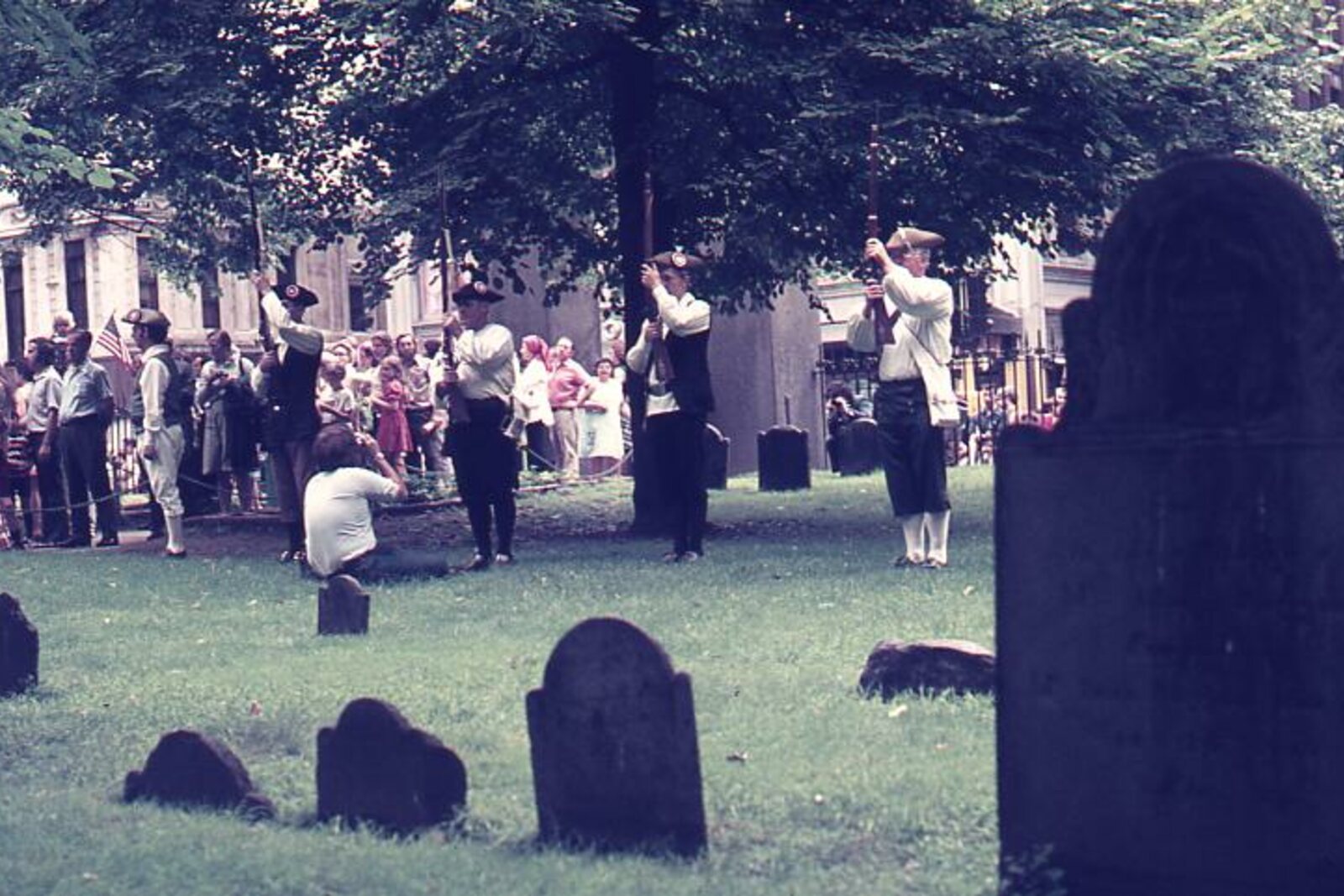
Look around first
What to notice
- Gray memorial slab
- Names on the stone
- Park Street Church
The story of the place
The burial ground holds more than individual gravestones: beneath the ground are brick and stone vaults designed for several burials at once. One of them became the shared grave of five people who had previously had no connection through work, home, or kinship. Among the graves, a gray memorial stone stands out, erected in the early twentieth century; it lists five names and the name of one more boy. Beyond the fence stands Park Street Church, which took over the neighboring corner of this old city block.
The burial ground's name recalls a building that has long been gone. In sixteen sixty, the city set aside part of Boston Common for burials: the old King's Chapel Burying Ground was already overcrowded. At first the site was called the South Burying Ground, later the Middle Burying Ground. In seventeen thirty-seven, the city's grain store—the granary—was moved to the neighboring corner. Park Street Church now stands in its place, while the name remained with the burial ground.
Below ground are brick and stone vaults designed for many burials. In seventeen seventy, one of them was needed not by a family, but by the entire city.
Eleven days before the Boston Massacre, the minor customs official Ebenezer Richardson fired from his house into a crowd and killed the boy Christopher Seider. Samuel Adams, one of the leaders of Boston's resistance, wanted to present Seider's death as the result of a conflict between the townspeople and the British administration. He arranged a funeral attended by more than two thousand people. The procession ended here.
After the shooting on the fifth of March, Adams repeated this tactic on a larger scale. The dead came from different walks of life and under ordinary circumstances would have received separate funerals. The rope maker Samuel Gray made his living by his trade and was laid out in his brother's home. The seventeen-year-old apprentice turner Samuel Maverick was laid out in the home of his widowed mother. The sailors James Caldwell and Crispus Attucks found themselves in Boston without family or a home of their own, so their bodies were placed in Faneuil Hall.
Their relatives agreed to bury the four together. On the eighth of March, four hearses set out from different places and joined where the shooting had occurred, on King Street (now State Street). Most shops closed, and bells rang in Boston and neighboring towns. There were so many people that they walked six abreast. The procession was led here, to the Middle Burying Ground, and the four bodies were placed in one vault.
Patrick Carr was still alive then. He later died of his wound, and seven days later he was buried in the same vault. Thus, five people with different occupations, families, and fates came to share one grave.
The gray slab above it does not date from the colonial era. The Boston chapter of the Sons of the American Revolution installed it in nineteen oh six. The stone lists Gray, Maverick, Caldwell, Attucks, and Carr, and below them adds Seider—the boy whose crowded funeral first brought Samuel Adams and his procession to this vault.
Useful on site
Seasonal outdoor site; check the gates on site or listen from the street.
Checked: June 28, 2026. Check the official source before visiting.Walk only on permitted paths and do not touch the fragile gravestones; if the gates are closed, you can listen to the story from outside.