 Guide On Map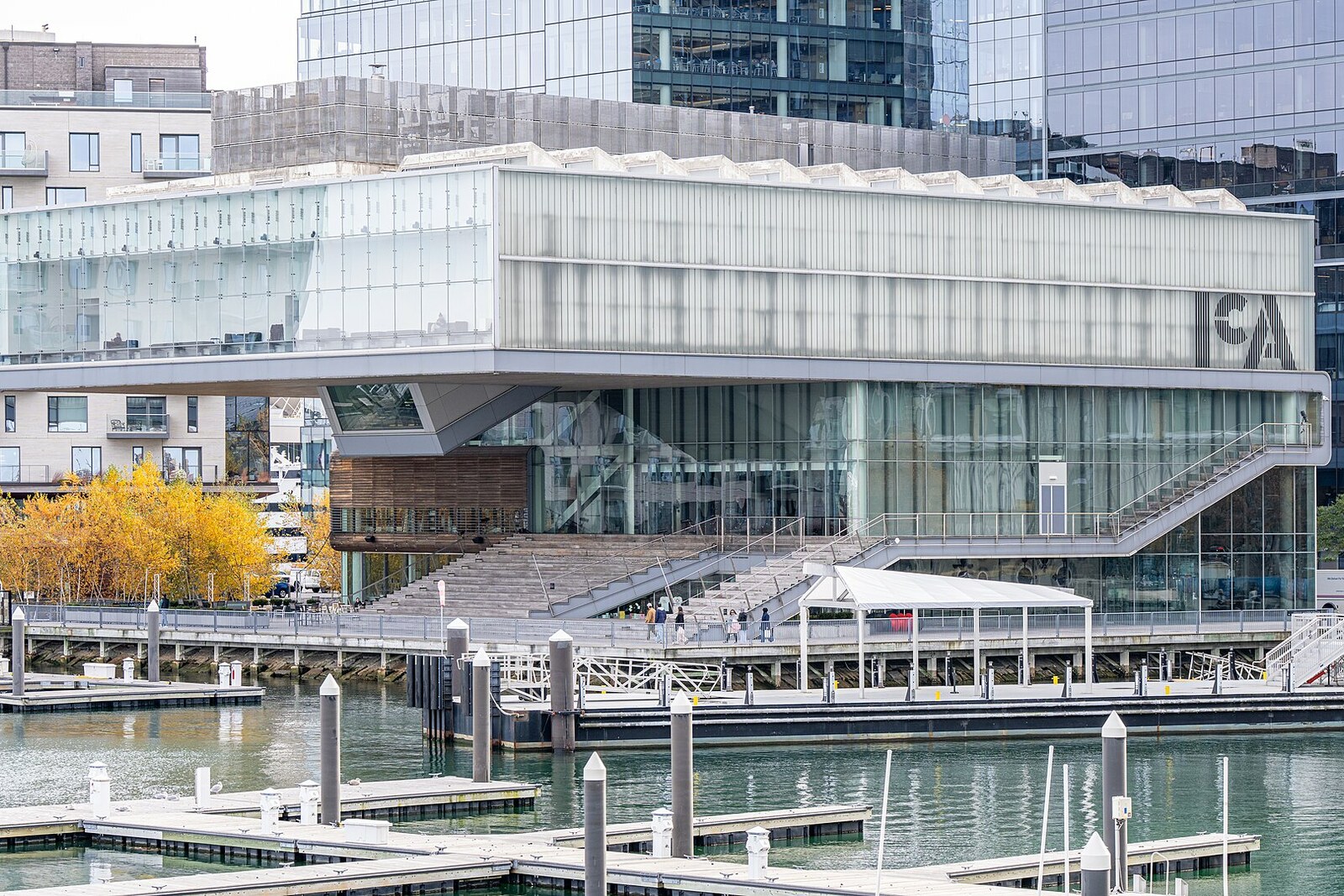
Look around first
What to notice
- Projecting gallery floor
- Wooden steps
- Plaza beneath the overhang
- Glass facade
The story of the place
The architects called the upper floor, which projects over the waterfront, the “tray.” Jill Medvedow, director of the Institute of Contemporary Art / Boston, chose this design immediately from among four options. She was being asked to entrust the institution’s main building to people who had never before built independent buildings at all.
When Medvedow took over the institute in nineteen ninety-eight, it occupied a former police station on Boylston Street. The galleries were cramped, there was no permanent collection, and about twenty thousand visitors came each year. According to Medvedow, the old station had been designed to keep people outside, and it passed the same habit on to the museum. The director had almost no money or influential supporters, but she was looking for a place where contemporary art could be shown to a large audience.
The site at Fan Pier came through an agreement between the city and the Pritzker family, which planned to develop the waterfront with hotels, housing, and offices. The developers received the right to make their buildings larger and, in return, set aside three-quarters of an acre by the water for a cultural institution. The winner was promised a ninety-nine-year lease for one dollar a year. A theater and a concert hall also sought the land.
The institute entered the competition last. On Thursday, Medvedow first told the commission about a museum on the waterfront; by Tuesday, they expected a complete proposal from her. She scraped together five thousand dollars for an architectural model and prepared the application with the staff. For an institution with twenty thousand visitors, it looked like an attempt to obtain a building of a kind that had not been built for art in Boston for almost a century. In November nineteen ninety-nine, the commissioners unanimously awarded the site to the institute.
The victory brought a new challenge. The desired single exhibition floor was wider than the site where construction was permitted: the public Harborwalk, a pedestrian waterfront path along the harbor, ran beside it. Medvedow gave the project to the New York firm of Elizabeth Diller, Ricardo Scofidio, and Charles Renfro. The firm had well-known exhibition installations but not a single completed building. The boldest of the four proposals was that very “tray”—a gallery floor projecting over the waterfront.
The architects reached an agreement with city planners: the galleries would be allowed to project over public land, and beneath the overhang there would be a weather-protected plaza accessible without a museum ticket. They continued the Harborwalk’s wooden decking upward in broad steps, then led it inside—through a stage and an auditorium—and back outside beneath the ceiling of the overhang.
Before the opening, the Pritzker family withdrew from the development of Fan Pier, the construction company had to be replaced a few months before the end of the work, and Medvedow continued raising tens of millions of dollars. On December tenth, two thousand six, the building received more than eight thousand people in a single day. In its first year, about two hundred eighty thousand visitors came here. That same year, the institute began collecting a permanent collection for the first time. For Diller Scofidio + Renfro, this building became its first major American commission; later, the firm designed New York’s High Line and the expansion of the Museum of Modern Art.
The upper “tray” is still occupied by galleries with movable walls, while plays, dance performances, and concerts take place below. The wooden steps by the water officially bear Jill Medvedow’s name.
Useful on site
Tue–Wed 10:00–17:00; Thu–Fri 10:00–21:00; Sat–Sun 10:00–17:00; Mon closed. On the first Friday of the month, regular admission closes at 17:00.
Checked: June 30, 2026. Check the official source before visiting.The main architectural idea can be understood from outside; the exhibition galleries require a separate museum visit.