 Guide On Map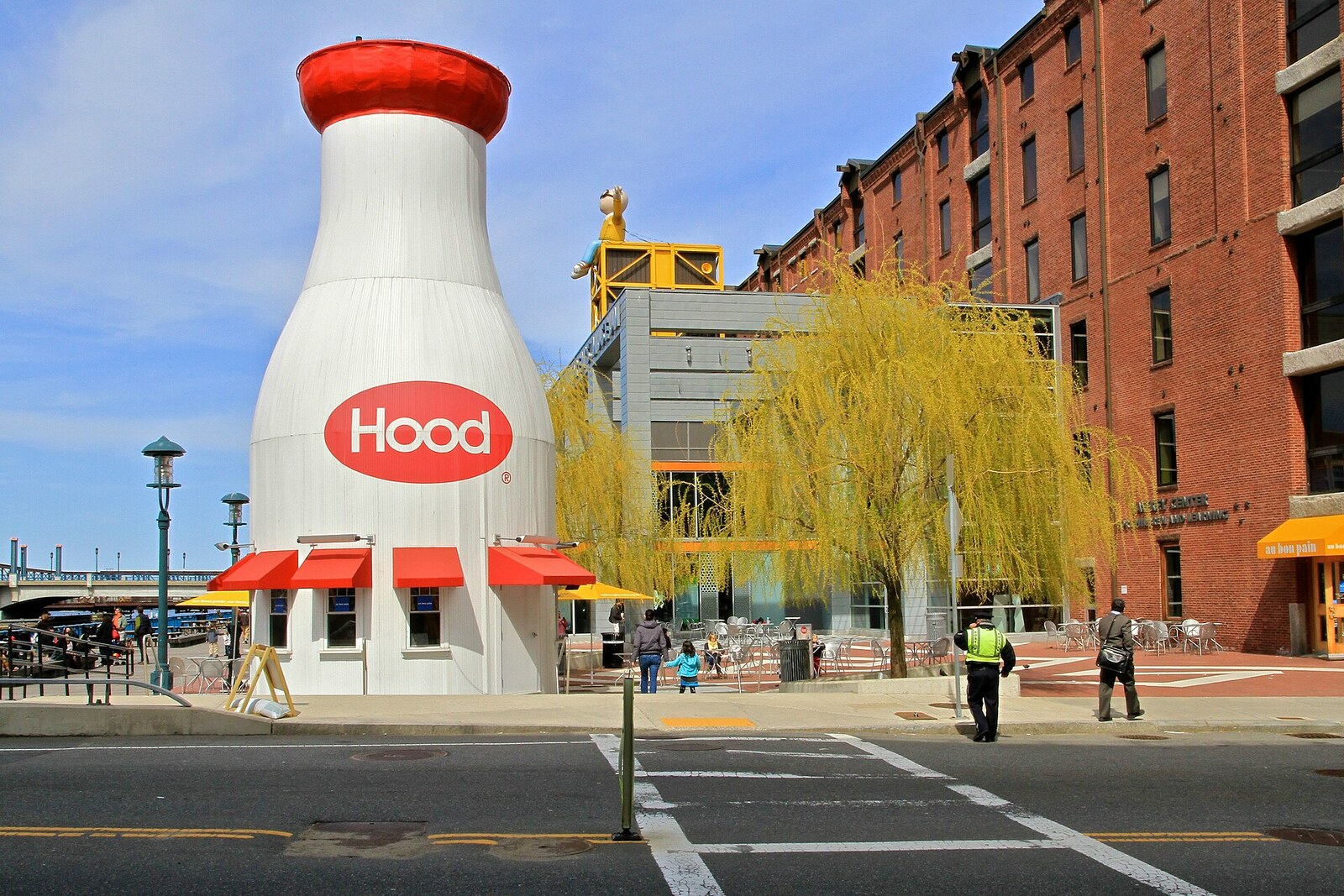
Look around first
What to notice
- The red-and-white Hood Milk Bottle
- The counter windows in its base
- The museum's brick building
- The pier by the channel
The story of the place
Beside Fort Point Channel, a brick wool warehouse has long been Boston Children's Museum, with spacious floors for galleries where exhibits may be handled, tested, and turned into experiments. The museum moved here from a small house near Jamaica Pond when there were no longer enough rooms for this way of working with the collection. On the pier beside the brick building stands a red-and-white bottle, and windows from the former sales counter remain in its broad base. Its silhouette long served as a landmark for people looking for the museum.
The name “Hood” appeared on the red-and-white bottle much later than the bottle itself. In nineteen thirty-three, it was built by Arthur Gagner, an ice cream seller from Taunton. His income depended on motorists traveling along Route 44. So that drivers would have time to notice the shop and turn off the road, Gagner turned the shop itself into an advertisement: he assembled a twelve-meter bottle from pine boards and sold ice cream through windows in its base.
Ten years later, Gagner sold his establishment to the Sankey family. After the war, new highways began diverting cars around Taunton, customers became fewer, and in nineteen sixty-seven the Sankeys closed the shop. For almost a decade, the wooden bottle stood empty beside the road.
In January nineteen seventy-six, clothing designer Carol Scofield was driving past. She collected and studied roadside architecture—buildings shaped like the products whose owners used them to attract motorists. Scofield bought the bottle for two and a half thousand dollars, although she did not yet know where to move it. She then called John Sloan, director of urban design at the Boston Redevelopment Authority, and asked him to find it a new use.
Sloan proposed placing the bottle in the plaza in front of Boston City Hall and selling ice cream from it in summer and hot chocolate in winter. Hood, the dairy company, agreed to pay for the restoration in exchange for the right to open a frozen-yogurt counter inside. But Gerhard Kallmann, the architect of Boston City Hall, considered the giant bottle incompatible with the dignity of his building, and city hall staff rejected the plan.
Sloan then approached the board of Boston Children's Museum. Its staff were just preparing to move from a cramped mansion near Jamaica Pond to a former wool warehouse beside Fort Point Channel. The then-deserted pier needed a conspicuous landmark, and for a children's museum, the bottle needed no explanation. The board agreed. Workers took it to Quincy, stripped off fourteen layers of old paint, and restored the counter with Hood's money.
On April twentieth, nineteen seventy-seven, the bottle was placed on a barge. Two fireboats escorted it through Boston Harbor, and at this pier a crane lifted the fifteen-thousand-pound structure off the deck. The bottle arrived two years before the museum opened and became its first signpost: later, city signs needed only its silhouette and an arrow.
The move itself was needed by director Michael Spock, who worked to ensure that children acted for themselves in the museum. When Spock came here in nineteen sixty-two, attendance was falling and the collections stood behind glass. Spock and his staff removed the bans on touching: children were allowed to handle objects, try out devices, and conduct experiments. The rooms of the old mansion proved too small for such exhibits. In the warehouse by the channel, the museum's area doubled, and in its first year almost half a million people came here.
Today, children inside still touch the exhibits and test them in action. The ice-cream-counter windows remain in the bottle's base. Above them is written “Hood”—the name of the company that paid for the restoration and delivery, not the surname of the man who built this roadside shop.
Useful on site
In summer, daily from 9:00 to 16:00; on the first Saturday of the month, opening from 10:00. It is better to book tickets in advance.
Checked: June 30, 2026. Check the official source before visiting.The bottle is easy to see without entering the museum; the indoor exhibits and Japanese house are part of a separate visit.