 Guide On Map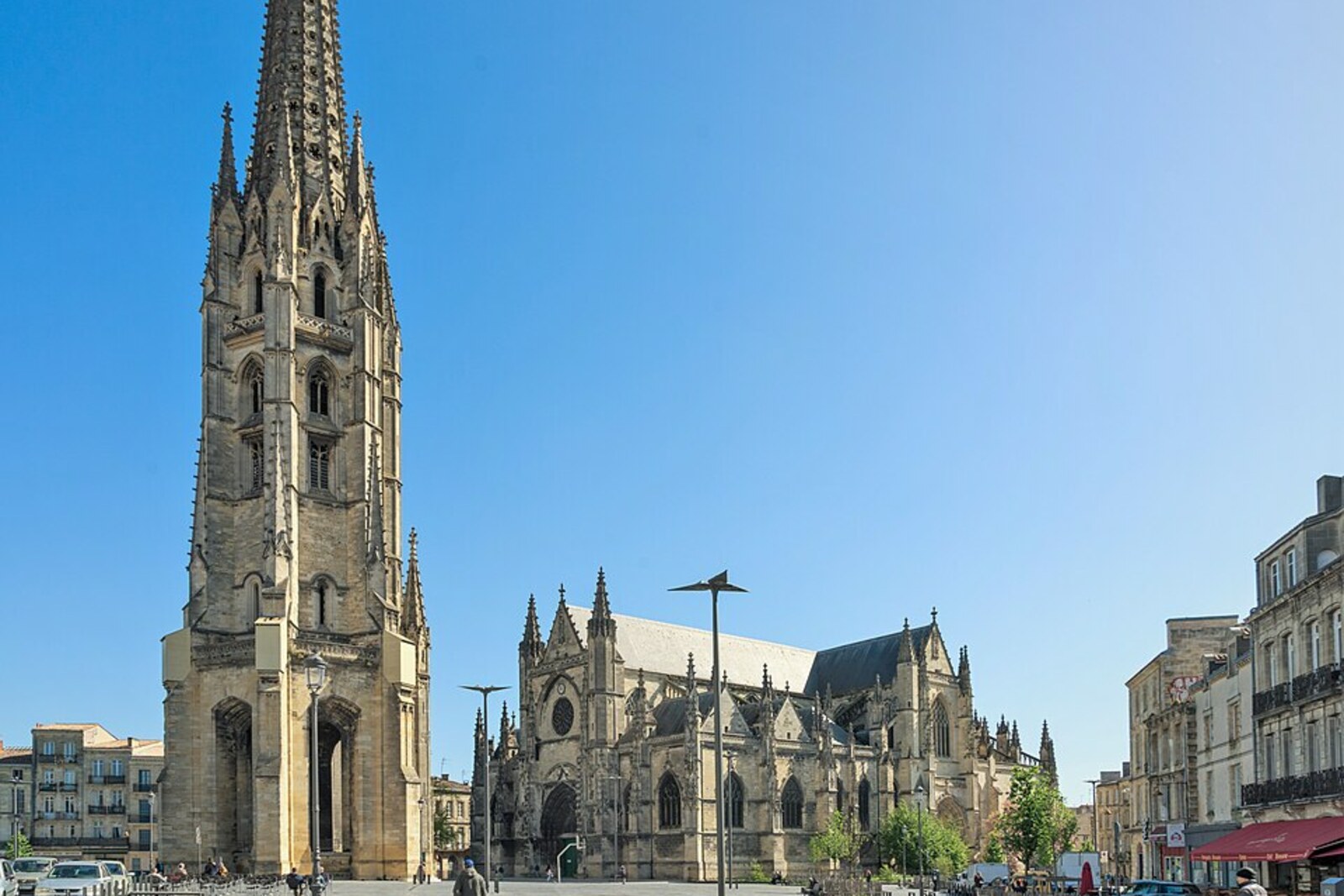
Look around first
What to notice
- The blue sign with the square’s name
- Smooth paving
- The base of the bell tower
- Market stalls
The story of the place
On market days, rows of stalls selling food and secondhand goods spring up around the freestanding Saint-Michel bell tower, and afterward a broad, evenly paved square remains. A churchyard once stood crowded here. When it was closed, the remains were moved to the crypt beneath the bell tower, the ground was leveled, and trade occupied the freed space. Nothing above ground now recalls the site’s former purpose.
Meynard on the blue sign is the surname of Jean-Baptiste Meynard, the long-serving parish priest of Saint-Michel Basilica. In eighteen seventy-one, he conceived the idea of opening a school for parish children and secured the transfer to Bordeaux of Brother Joseph-Marie Marsan, an experienced teacher whom they did not want to release from his former post. The school was housed nearby, on Rue de la Crèche; Marsan led it for twenty-two years. After Meynard’s death in eighteen eighty-five, the city gave the square the priest’s surname. This was how Saint-Michel parishioners expressed their gratitude to a man who cared not only for worship but also for the education of children in the neighborhood.
The square itself appeared before it acquired its present name. In seventeen ninety-one, the departmental administration of revolutionary France ordered the closure of the parish cemetery around the church. At that time, burials near churches were being removed from cities for sanitary reasons. Here, land also had to be freed in the densely built-up neighborhood.
Workers opened the graves, moved the bones to the crypt beneath the freestanding Saint-Michel bell tower, and covered the square with earth. During the clearing, they found about seventy bodies that the soil had preserved almost intact. They were not reburied. The bodies were set upright along the walls of the crypt, and visitors were admitted to see them.
No one knew their real names, so guides invented biographies for the dead. One was called a general killed in a duel, another a porter crushed by an excessive load, and a third someone buried alive. These were legends created for the public. What is reliably known is something else: the people buried in the parish cemetery stood beneath the bell tower as a city attraction for nearly two centuries.
The exhibition brought the bodies a second, much slower death. Air, microorganisms, and visitors’ touch gradually destroyed the tissue. In nineteen seventy-nine, the municipal council, at the initiative of Mayor Jacques Chaban-Delmas, closed the crypt to the public. In nineteen ninety, the remaining fragments were buried at Chartreuse Cemetery.
After the old cemetery was cleared, the ground was leveled. A market had existed nearby as early as the eighteenth century, when this side of Saint-Michel was called Place du Marché-Neuf; the freed space allowed trading rows to occupy the area around the church. Now, on market days, stalls selling food and secondhand goods are set up here again, then removed, leaving smooth paving.
There are no traces of the graves on the surface. When archaeologists dug two exploratory test pits in the square in two thousand eleven, both reached the old cemetery. Beneath the paving lay a leveling layer in which human bones were mixed with pebbles, charcoal, roof tiles, and animal bones. After the study, the test pits were filled in. Place Meynard once again remained on the site of the cemetery.
Useful on site
The square is open around the clock; markets and flea-market stalls vary by day, so check the main time slots on the city’s page before visiting.
Checked: June 30, 2026. Check the official source before visiting.The archaeological finds lie beneath the modern square and are usually not visible. Do not look for marked graves: here, it is more important to compare the calm surface with the disturbed layers below.