 Guide On Map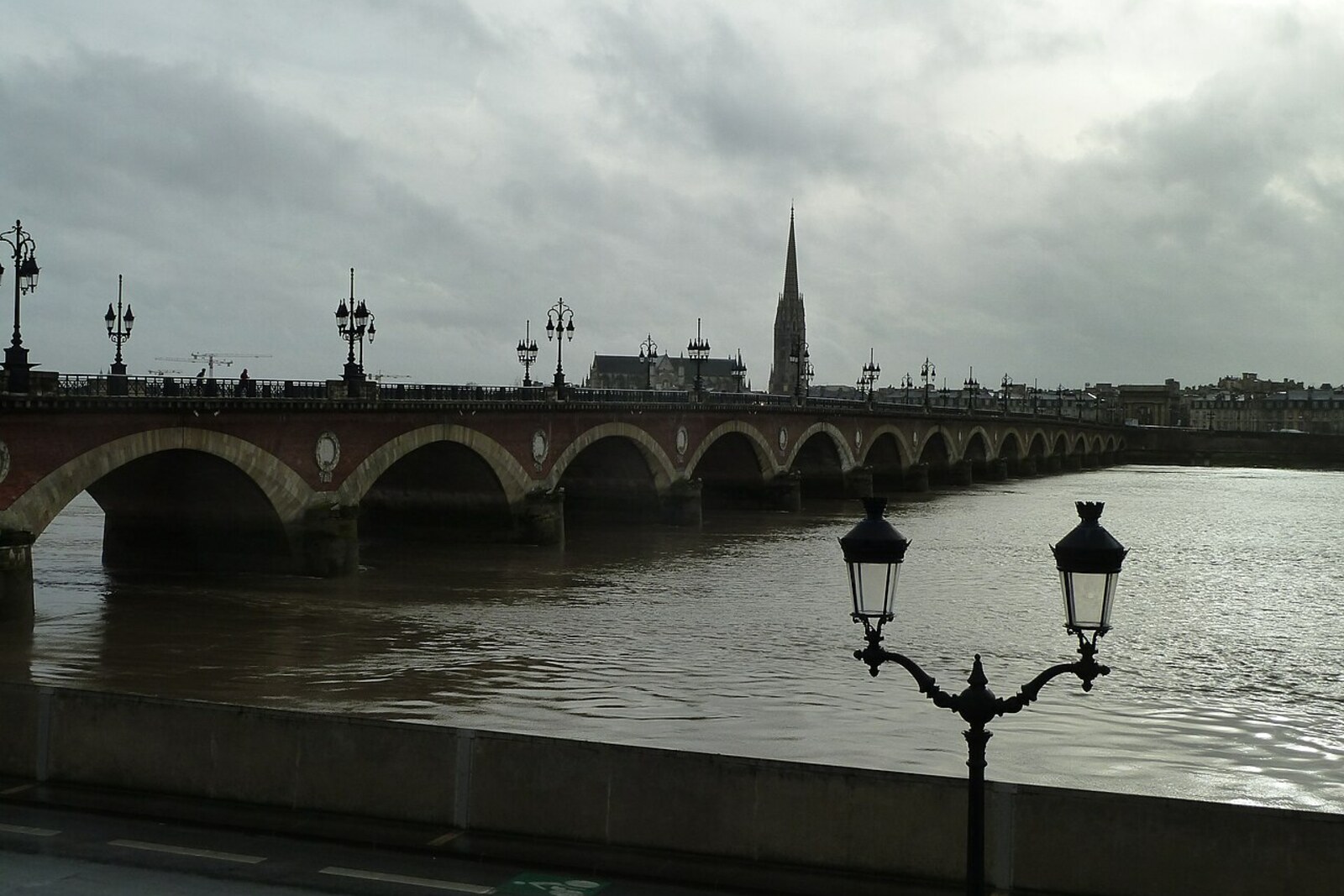
Look around first
What to notice
- Seventeen arches
- Stone piers
- Brick vaults
The story of the place
Six empty longitudinal galleries are hidden beneath this bridge’s roadway: from outside it is stone, but its vaults are built of brick. The seventeen arches rest on stone piers set on the silty bed of the Garonne, where the tide reverses the current. According to tradition, the name “Stone Bridge” became established to distinguish it from a temporary wooden crossing that stood nearby.
Before eighteen twenty-two, Bordeaux had no bridge at all across the Garonne. Boat crossings ran between La Bastide and the Sainte-Croix port. In eighteen oh seven, Emperor Napoleon I, who was fighting beyond the Pyrenees and seeking to move the army quickly into Spain, ordered a permanent crossing built here. The alignment was chosen opposite Porte de Bourgogne: a new road from Paris led to it on the right bank, and beyond the gate the route continued south.
Napoleon's order nearly remained unfinished piers. An extraordinary flood in eighteen thirteen swept away the construction piles and damaged the foundations of five piers. Napoleon then abdicated, state funding ceased, and the work was halted. The emperor for whose soldiers it had all been begun never saw the completed bridge.
The bridge and road engineer Claude Deschamps was to complete the crossing on a silty riverbed where the current changes direction with the tide. He rejected earlier designs with a wooden span and a movable section. To reduce pressure on the foundations, Deschamps built stone piers, brick vaults, and a hollow road deck. But the engineering solution could not replace money.
It was found by the Bordeaux merchant and shipowner Pierre Balguerie-Stuttenberg. He traded in cloth, wine, and colonial goods, outfitted ships, and wanted to bring the bridge to completion on terms favorable to investors. The company of merchants and shipowners he assembled offered the state two million francs. This was capital, not a donation: in return, the company demanded a ninety-nine-year concession for the bridge and the right to charge tolls.
The state agreed. On May first, eighteen twenty-two, people, carts, and riders began crossing over the seventeen arches. A pedestrian paid five centimes; a rider with a horse paid thirty-five. Balguerie-Stuttenberg himself died three years after the opening, but the company continued collecting money. Only in eighteen sixty-three did the municipality buy out the right of free passage, long before the promised concession expired.
The name Pont de Pierre means “Stone Bridge.” It is believed that townspeople used it to distinguish the bridge from a temporary wooden bridge that stood nearby during construction. Stone is clearly visible from outside, but the vaults contain much brick, and six empty longitudinal galleries run beneath the roadway. The four booths at the entrances, where the company recouped its invested millions, are gone: they were demolished when the bridge was widened in nineteen fifty-four.
Useful on site
The public crossing is open; as of the check date, summer work in 2026 maintained pedestrian and bicycle access, but interrupted trams across the bridge until the end of August.
Checked: June 30, 2026. Check the official source before visiting.Stop where you do not obstruct pedestrians and cyclists. To see the rhythm of the arches as a whole, move toward the riverbank: from the bridge deck, what you mainly see are the river and the direction of the crossing.