 Guide On Map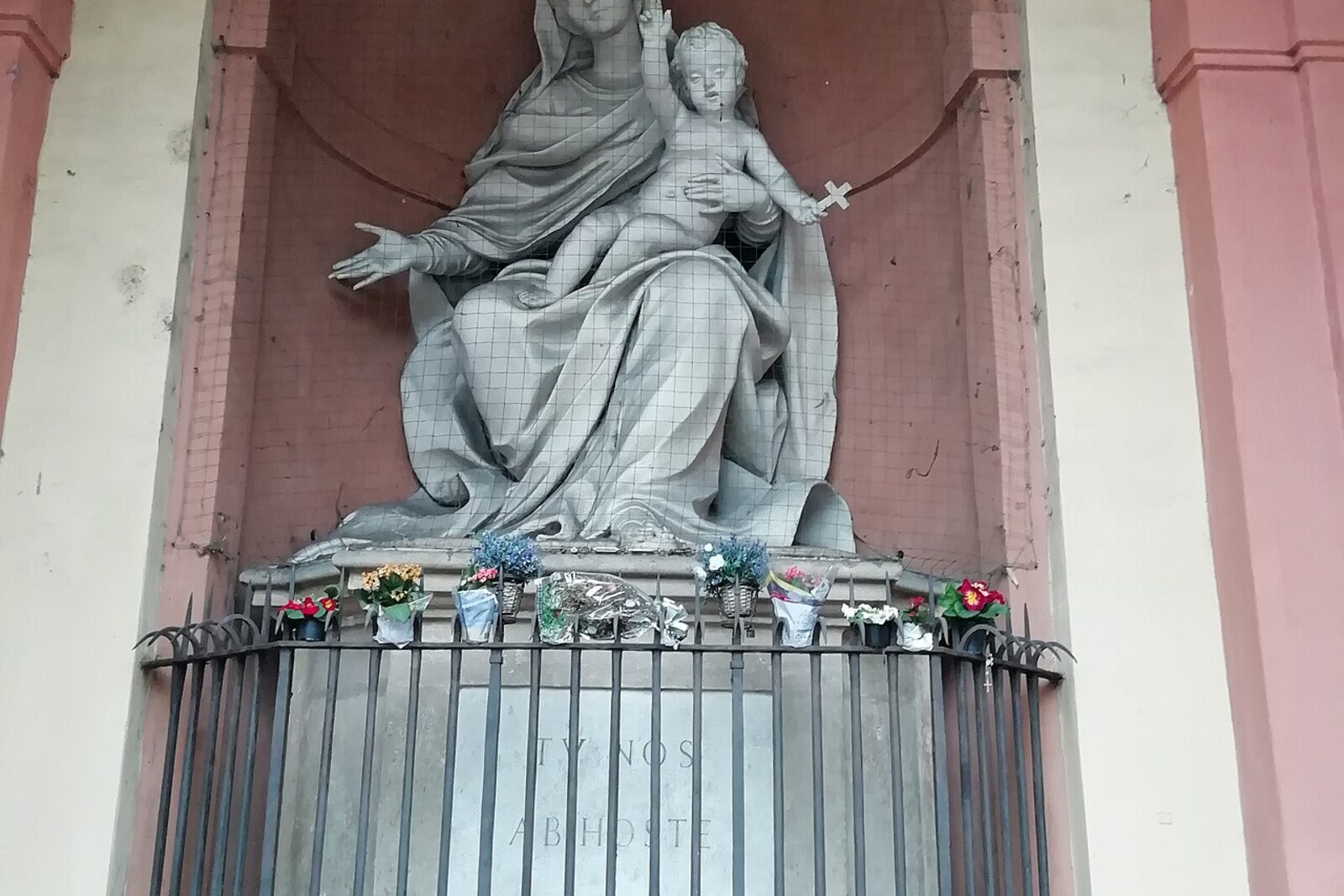
Look around first
What to notice
- The chapel's grille
- The seated figure of the Madonna with the Child
- The statue's broad cloak
- The prayer inscription on the base
The story of the place
Here, a row of identical bays is interrupted by an enlarged arch with a small chapel behind a grille. Seven neighboring arches were once paid for by one wealthy Bolognese family, which created its own place of prayer on the pilgrimage road. It belonged to the route of the annual procession between the city and the sanctuary on the hill: the portable icon was carried onward, while the images in the niches remained along the way. Deep inside, you can see a large seated Madonna with the Child and broad folds of a cloak; a short protective prayer survives on the stone base.
On November eleventh, seventeen oh two, the Monti Bendini brothers drew up a private document. It was addressed to their brother, Marquis Francesco Maria. They demanded that he put “in proper order” the chapel their father Ferdinando had begun to build in one of the portico's bays, and place there the long-planned statue of the Madonna.
Ferdinando Monti Bendini was one of the wealthy Bolognese who paid for the covered road in sections. His family took responsibility for seven bays. At the center, Ferdinando created an enlarged arch with a niche, with three ordinary bays on either side, but he did not manage to finish the family chapel. For his sons, the empty niche on the road to the Sanctuary of the Madonna di San Luca remained an unfinished paternal obligation—visible every time a procession passed here.
Francesco Maria lived on the income of a noble family and spent it on religious and architectural commissions. In seventeen oh six, he was elected prior of the Confraternity of Santa Maria della Morte. This confraternity was responsible for the Madonna di San Luca while it was carried through Bologna, and organized the external part of the ceremonies. That is why the marquis commissioned the figure precisely on this road: it was to remain in the niche when the portable icon went into the city or returned to the hill.
The work was entrusted to the Bolognese sculptor and architect Andrea Ferreri. The exact contract with him has not been found, and the year of installation remains disputed. Yet the family document confirms the essential point: the statue was commissioned to complete the chapel begun by Ferdinando. Ferreri seated the Madonna on a massive base, arranged a broad cloak around her, and placed the Child on her lap. The result was a figure noticeably larger than the usual roadside images.
In the eighteenth century, it was called Madonna Grande—the Large Madonna. The Bolognese themselves later changed the name: in a manuscript from eighteen twenty-three, Madonna Grassa already appears, literally the Fat Madonna. The popular name outlived both the patrons and the official dedication.
The family chapel itself is complete, but the Monti Bendini coat of arms, once painted on its wall, has almost disappeared. Behind the grille remains the figure for which the brothers reminded Francesco Maria of his duty to his father. A short prayer addressed to the Madonna by the processional road survives on the base: “Protect us from the enemy.”
Useful on site
The niche with the statue is accessible around the clock.
Checked: June 28, 2026. Check the official source before visiting.View the niche while staying at the edge of the passage: the portico here still functions as an ordinary pedestrian route. It is best not to touch the sculpture's old surface.