 Guide On Map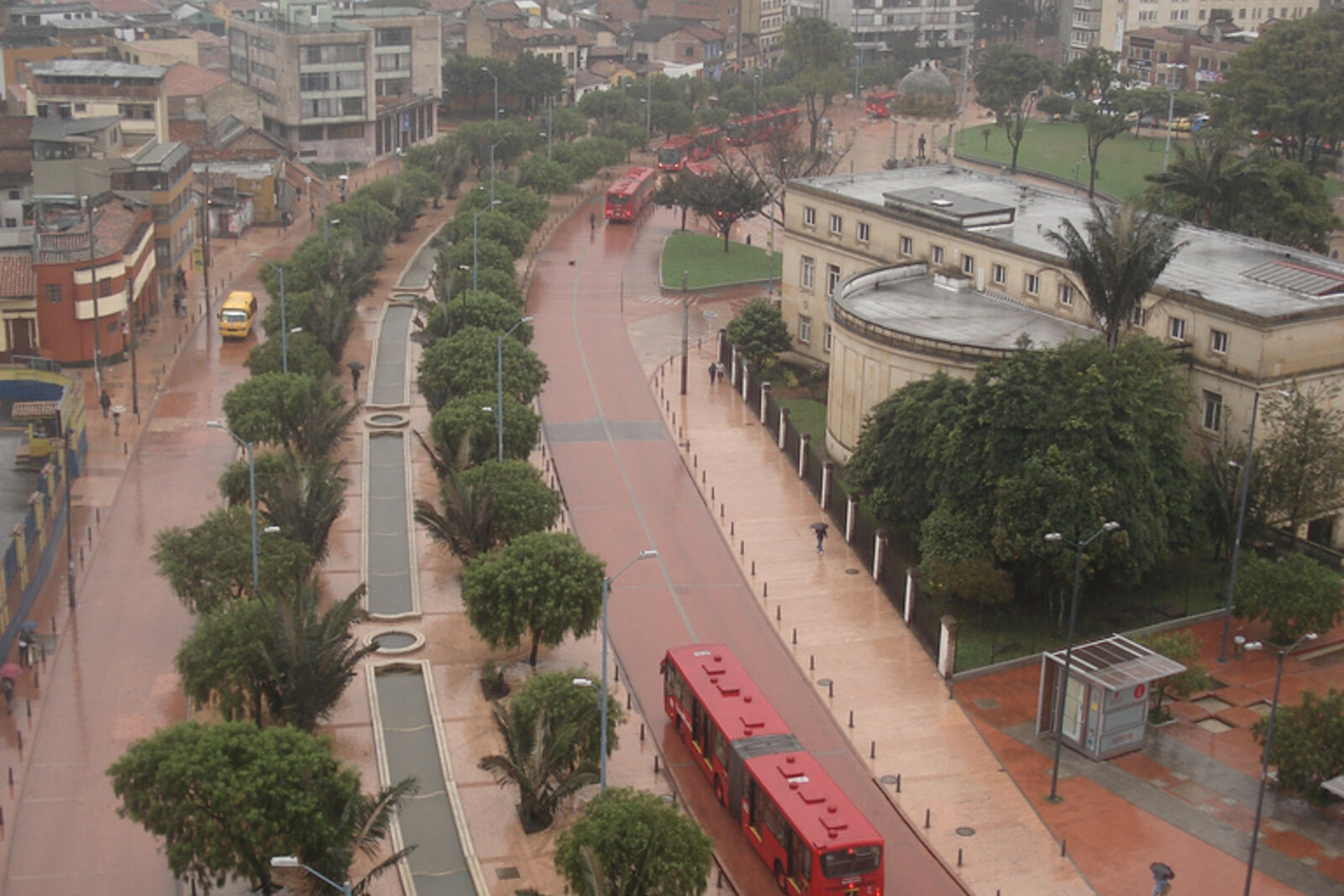
Look around first
What to notice
- Brick paths
- Shallow water channel
- Cascade basins
The story of the place
The promenade runs above the Vicachá River, whose main channel is hidden in an underground conduit. Above ground, a narrow branch of water diverted at a water intake near Quinta de Bolívar remains: it runs through a shallow channel and descends through cascade basins. The street's natural slope helps the water move from the center toward the foot of Monserrate. The brick paths occupy only the central section of what was once a much longer plan.
In March fifteen fifty-seven, the Royal Audiencia—the colonial court that governed Bogotá at the time—tried to protect the city's water. The judges prohibited the construction of new mills upstream of the bridge, the washing of laundry, and the disposal of waste. They were referring to the Vicachá River: the Muisca called it “nighttime radiance.” After a Franciscan monastery appeared on its bank, the Spanish renamed the river the San Francisco River.
The ban brought into conflict people who needed the same water. People drank from the river; its current turned the wheels of eight flour mills; and laundresses earned a living washing clothes on its banks. Later, waste from homes, workshops, and the city slaughterhouse entered the river here. Laundresses and millers depended on access to the riverbed, while residents depended on water that they themselves polluted. Repeated orders could not separate these activities into different places.
By the early nineteen hundreds, the San Francisco River was regarded as a source of disease and an obstacle to the expansion of the city center. In nineteen fifteen, the Congress of Colombia ordered the river to be enclosed in a conduit. The owners of neighboring plots were required to help pay for the work: in return, they were promised a broad street and more valuable land.
Construction stretched out for almost twenty years. Workers enclosed the water in an underground conduit, filled in the riverbed, and dismantled the bridges. The mills stopped, and the laundresses disappeared from the banks. In nineteen thirty-eight, Avenida Jiménez de Quesada opened above the river, named after Bogotá's Spanish founder, Gonzalo Jiménez de Quesada. Its curves, unusual for the city center, followed the course of the filled-in riverbed.
Half a century later, the architects Rogelio Salmona and Luis Kopek received a city commission to turn this avenue into a pedestrian promenade. They wanted to lead people from the center to the foot of Monserrate and bring water back to the surface. They did not open up the conduit itself. At a water intake near Quinta de Bolívar, the architects diverted part of the San Francisco River into a separate shallow channel and used the street's natural slope: in the project, the water was to fall in small cascades every few meters.
Salmona and Kopek conceived a much longer route, but between nineteen ninety-eight and two thousand, the city built only its central section. The brick paths and basins before you belong to this shortened project. Water diverted from the San Francisco River flows through them; the main flow of the Vicachá River still runs in the conduit beneath the promenade.
Useful on site
Open urban promenade; more comfortable during the day.
Checked: June 28, 2026. Check the official source before visiting.Do not mistake the decorative channel for the old river in the open: the real flow runs below, beneath the city's surface.