 Guide On Map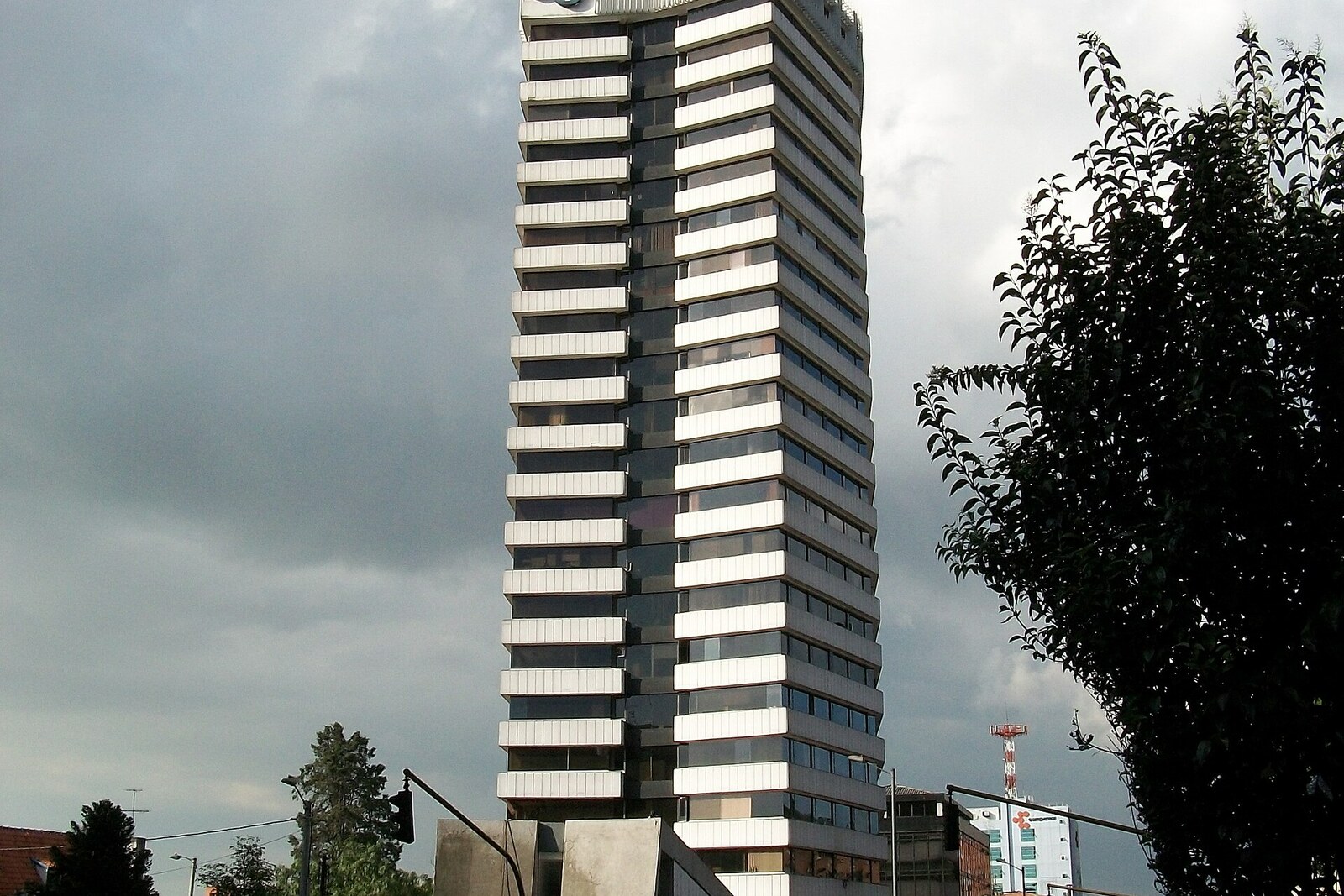
Look around first
What to notice
- Façade steel tension rods
- Steel trusses at the top
- Central concrete core
- Commercial ground floor
The story of the place
The narrow site between the avenue and the river was once occupied by a private house and a gas station, and was then given over to an income-producing office building. Above the commercial ground floor, steel tension rods run up the façade and converge at the roof trusses; because of them, the office floors are almost uninterrupted by interior columns. Banks and financial institutions occupied the building from the beginning, and the name on the tower outlasted the company that received it.
At the corner of Carrera 13 and Fortieth Street stands the twenty-two-story UGI Building. Commercial premises occupy the ground floor, with offices above and two levels of parking underground. The elevators, stairs, and restrooms are grouped in a central reinforced-concrete core. Around it are open floors with almost no interior columns.
In nineteen seventy-one, the family home of industrialist Aurelio Ramos Henao, owner of a cardboard manufacturing business, still stood here. He had inherited the house from his parents and did not want to demolish walls tied to family memories. Architect and developer Hernando Vargas Rubiano proposed replacing the house with an income-producing office tower. His firm earned money through design and construction, while partners usually contributed the plots. Ramos agreed when Vargas promised to name the future building after his family.
The adjoining lot, with a closed Esso gas station, was added to the house, but the site between Carrera 13 and the Arzobispo River was still narrow and elongated. Ordinary supports would have taken up parking spaces and split up the offices. Then a bookseller came into Vargas's office. In an album about high-rise construction bought from her, the architect and his son, the young engineer Hernando Vargas Caicedo, found a building in Hamburg with floors suspended from a roof structure.
Vargas Caicedo worked at his father's firm and had to determine whether this system could be repeated in Bogotá. In nineteen seventy-two, he made it to Hamburg, tracked down engineer Fritz Rafainer, who had described the German project, and showed him the drawings for the future tower. Rafainer considered the idea feasible. Two Colombian calculation specialists whom the Vargases consulted after returning refused: making the load travel upward first and then descend to the foundation seemed costly and illogical to them.
The structural calculations were undertaken by engineer Guillermo González Zuleta. The professional reputation of the whole team was at stake. In April nineteen seventy-four, González, Vargas Rubiano, and the head of the construction firm accepted written responsibility for the structure before the city department.
The workers first raised the central reinforced-concrete core. A slipform was moved upward by thirty-four manually operated hydraulic jacks; the whole core took a month. Steel trusses were installed at the top, and tension rods were lowered from them down the façade. Then, from a suspended platform, they poured the upper slab, connected its inner edge to the central core and its outer edge to the rods, and lowered the platform another level. That is how the floors appeared from top to bottom. The completed slabs shielded people from the rain, so finishing work could begin while the structure was still being assembled below.
The money also had to be assembled in parts. The development company took out two mortgages totaling twenty million pesos of the time. Suppliers of brick, stone, and steel structures received space in the future offices instead of part of their payment. A major buyer was Unión General de Inversiones—“General Union of Investments.” Vargas offered it the twentieth floor, a commercial space, and the name of the entire tower. According to Vargas Caicedo's recollections, Aurelio Ramos sold his name for one million pesos: during years of frequent kidnappings, he feared that his surname on the façade would make criminals take him for the building's sole owner.
In nineteen seventy-five, the first banks and financial institutions moved into the tower. Four years later, the developers paid off both mortgages. The UGI company was later liquidated, but the name it had purchased remained. The suspended system itself also survives: façade tension rods hold the outer edge of every office slab and lead to the steel trusses at the top; from there, the load descends through the central concrete core to the foundation.
Useful on site
The street is open around the clock; check Ciclovía/closures and transportation conditions against the current situation in the city.
Checked: June 28, 2026. Check the official source before visiting.View the building from a safe spot, and do not stand at the edge of the busy roadway. The story can be read from outside; there is no need to enter the offices.