 Guide On Map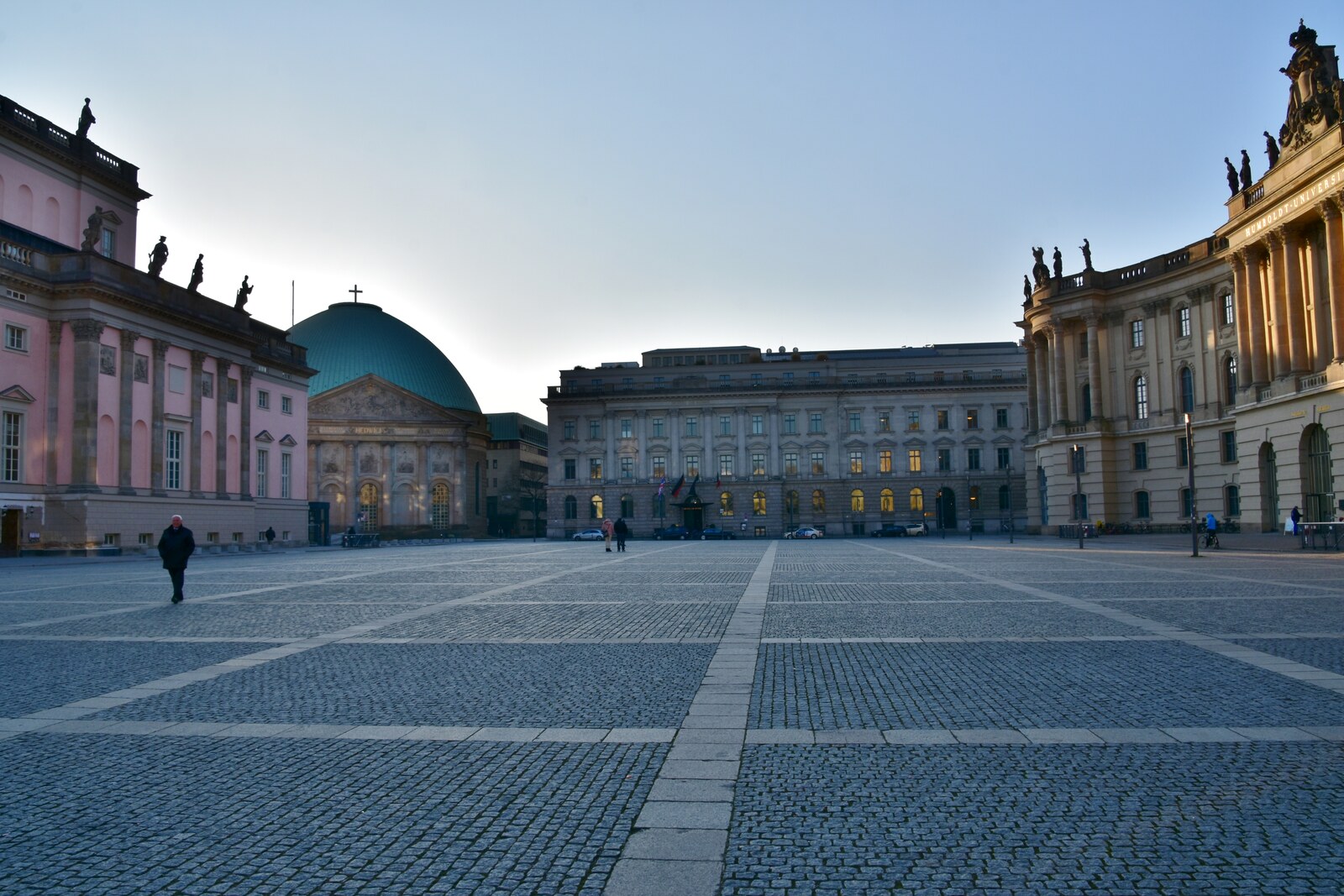
Look around first
What to notice
- Square glass pane in the pavement
- White underground room
- Empty bookshelves
The story of the place
Bebelplatz lies between the university buildings and the opera building; it was once called Opera Square. A square pane of glass has been left in the pavement, and below it you can see the white empty shelves of a closed underground room. After the war, the square was named after August Bebel, one of the founders of German Social Democracy.
On May tenth, nineteen thirty-three, the writer Erich Kästner came here to watch his own books be burned. Kästner was thirty-four. He lived on fees for novels, poems, and newspaper writing; Emil and the Detectives had already made him famous. Now students had included his name on a list of authors who were to be expelled from German literature.
At the time, the square was called Opernplatz—Opera Square—after the theater standing nearby. The place was chosen because of the university. The German Student Body, a nationwide association of student self-government bodies, was already controlled by supporters of the National Socialists. They sought to have professors, students, and books tested for conformity with the so-called German spirit. In April, student leaders announced the campaign “Against the Un-German Spirit,” compiled blacklists, and sent squads, supported by SA party storm troopers, to search libraries and bookshops.
The confiscated books were brought to the square by truck. Here, in front of the university buildings, the student purge became a public oath: professors, students, and numerous spectators saw whom people were henceforth allowed to read and whom they were supposed to strike out. More than twenty thousand volumes went into the bonfire—works by Jewish authors, socialists, democrats, pacifists, and critics of the new regime.
The propaganda minister Joseph Goebbels, who sought to turn the student crackdown into a spectacle for all Germany, joined the action shortly before it began. His speech was broadcast on the radio, and what happened was filmed for newsreels. But the student organizations themselves collected the books and prepared the ceremony. At the bonfire, the organizers recited prewritten “fire oaths” and named writers individually. Kästner heard his works committed to the flames together with books by Heinrich Mann and Ernst Glaeser.
He stood among students in SA uniforms. One woman in the crowd recognized the writer and shouted loudly, “Kästner is right there!”—and even pointed at him. The people around her did not react, and Kästner managed to leave. He was not arrested that night.
The bonfire, however, proved to be the beginning of a real ban. Kästner lost the right to publish in Germany. He remained in the country and earned money by writing screenplays, signing them with other people’s names or leaving them unsigned altogether; in nineteen forty-three, he was forbidden to do this work as well. Other authors on the blacklists went into exile, lost their citizenship, or ended up in prison. The students from the square continued the purge of libraries: by nineteen thirty-five, the official list of banned literature already contained thousands of titles.
The name Bebelplatz appeared after the war. In nineteen forty-seven, Berlin’s city council named the former Opera Square after August Bebel—a turner, publicist, and one of the founders of German Social Democracy. For his political activity, Bebel was sentenced to two years of fortress imprisonment on a charge of preparing high treason, but the party he created survived the bans and grew into a mass organization. His surname became established in the square’s address.
At the site of the bonfire, in nineteen ninety-five, the Israeli artist Micha Ullman created an underground “Library.” Through a square pane of glass in the pavement, you can see a closed white room with empty shelves. They hold roughly the twenty thousand books that were brought here by truck. It is impossible to enter the room: there are no readers or volumes there, only empty spaces for the destroyed copies.
Useful on site
The square is a public space, open around the clock; the memorial’s glass is set directly into the paving stones.
Checked: June 28, 2026. Check the official source before visiting.Approach the glass one at a time with other visitors: reflections from the façades can make it difficult to see the room. Treat the place as a memorial, and do not stand on it as a noisy group.