 Guide On Map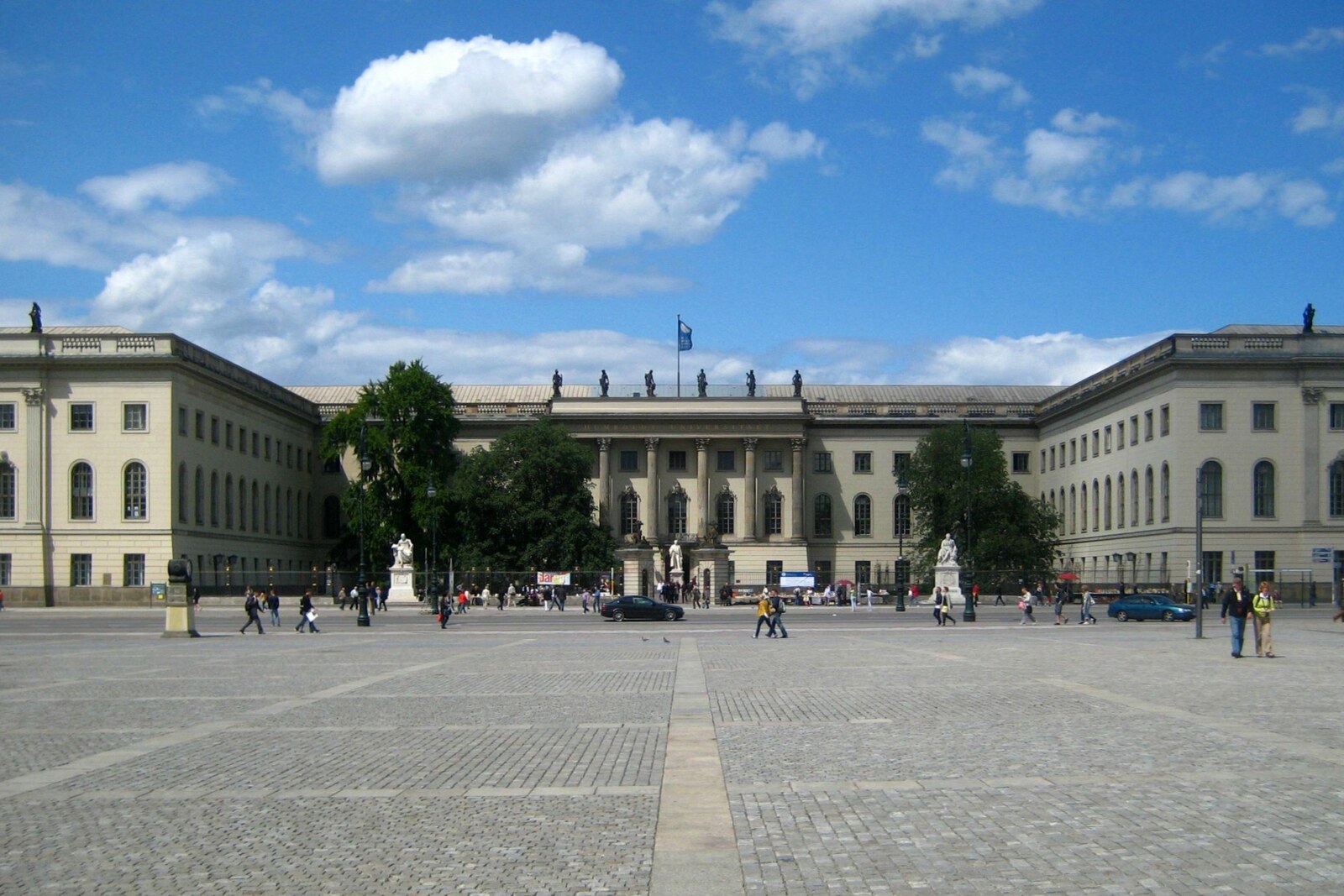
Look around first
What to notice
- Main façade
- Marble figure of Wilhelm with an open book
- Marble figure of Alexander with a plant and a herbarium
- The university's name on the façade
The story of the place
Beneath the broad main façade is Humboldt University of Berlin, where the faculties of law, medicine, theology, and philosophy existed side by side. Two white marble figures stand at the entrance: one holds an open book, the other a plant, with a herbarium lying beside it. The university received these brothers' surname only in the middle of the twentieth century.
The main building of Humboldt University of Berlin was built as a palace for Prince Henry, the younger brother of Frederick the Great, King of Prussia. No classrooms were planned here. They were added later, when Prussia's defeat in its war with Napoleon unexpectedly gave the vacant palace a new purpose.
Under the terms of the Treaty of Tilsit of eighteen oh seven, Prussia lost territories that included the University of Halle (Saale), one of the country's leading universities. Two years later, King Frederick William III assigned Wilhelm von Humboldt to create a university in Berlin. Humboldt was a philologist and an official in the Ministry of the Interior: he headed the department responsible for schools and church affairs. He sought an institution where a professor investigates a problem that has not yet been solved and involves students in that work, rather than passing on to them a ready-made set of truths.
Humboldt asked the king to give the university the former palace of Prince Henry and endow it with its own lands. Their income was meant to make scholars less dependent on ministry decisions. The king provided the palace, but not financial independence. Humboldt, meanwhile, recruited professors, assembled four faculties, and prepared the first classes. His position and further career depended on the same king whose officials he argued with. On April twenty-ninth, eighteen ten, Humboldt resigned: he had still secured neither an independent Ministry of Education nor the financial arrangement he had envisioned for the university.
When lectures began in the autumn, the founder was no longer here. The king had sent him as ambassador to Vienna. Two hundred fifty-six students and fifty-two instructors entered the converted palace. They studied law, medicine, theology, and philosophy. Humboldt lost the post for which he had returned from diplomatic service, but the institution he had prepared opened according to the plan he had drawn up.
His younger brother Alexander did not found the university. He earned his place in its name by doing almost the opposite here: he tried to bring university knowledge beyond the university public. Alexander von Humboldt was a natural scientist who returned to Berlin after years of work with the materials from his travels in the Americas. From November eighteen twenty-seven to April eighteen twenty-eight, he gave sixty-one lectures in one of the classrooms here on the physical structure of the world. Around four hundred students and instructors attended them.
Women were not enrolled in Prussian universities at the time. Alexander therefore repeated a shortened course at the neighboring Sing-Akademie zu Berlin—a large concert hall that the city public could attend. He held sixteen free sessions there, attracting up to one thousand people, and paid the rent himself. His attempt to connect plants, climate, rocks, oceans, and celestial bodies in a single account grew into his five-volume Cosmos; the final volume appeared only after the author's death.
The white marble figures at the entrance appeared in eighteen eighty-three, before the present name. On the left, Wilhelm holds an open book; on the right, Alexander holds a plant, with a herbarium lying beside him. Only in nineteen forty-nine did the university officially receive the surname of both brothers. The inscription on the façade refers at once to the man who established the university here and to the man who repeated a university course for those who were still not admitted here.
Useful on site
Exterior viewing is available around the clock; the inner courtyards and buildings depend on the university's operating schedule.
Checked: June 28, 2026. Check the official source before visiting.An exterior visit is enough for the story. The university remains a working building, so do not linger in passageways or expect free access to classrooms.