 Guide On Map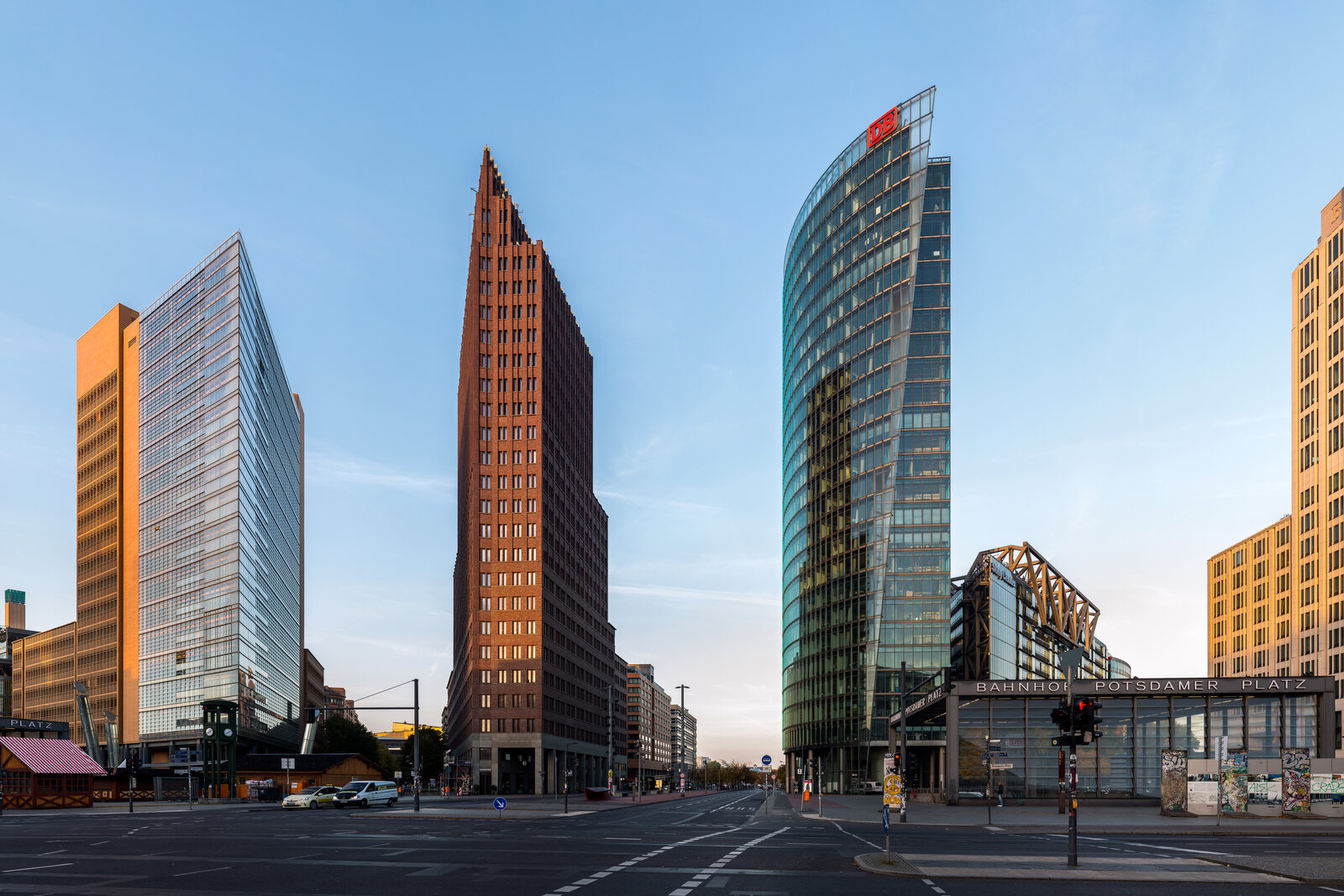
Look around first
What to notice
- Pentagonal signal tower
- Clocks on five sides
- Three-color signals
- Glazed booth
The story of the place
When Potsdam Gate stood here, the road to Potsdam led away from it; around the former entrance to the city, the railway, city transport, hotels, shops, and five streets gradually converged. The pentagonal tower in the middle of the intersection recalls a time when all this traffic required a separate device to keep order. Clocks and colored lights remain on its sides, while behind the glass it is now empty: the signals operate only for display.
Thirty-nine-year-old police officer Friedrich Lange took up an unusual duty here on December fifteenth, nineteen twenty-four. He was to control Berlin’s busiest intersection from a cramped booth eight meters above the ground.
Before that, traffic police stood directly among the vehicles. They stopped the streams with gestures and the sound of a horn; drivers did not always notice them in time. The police department reported officers who were struck and knocked down. In the summer of nineteen twenty-four, a wooden platform was built for them, and pedestrians were directed with boards attached to trees. These measures were no longer enough.
The reason lay underground, on the rails, and in the five streets that converged here. This place was once called the square in front of Potsdam Gate: beyond it began the road to Potsdam, which gave the present name its origin. In eighteen thirty-eight, Potsdam Station, Berlin’s first railway station, opened nearby. Hotels, restaurants, and shops appeared around the terminal, and city transport was brought to the trains. By nineteen twenty-four, around twenty-four thousand vehicles crossed the square every day: cars, trams, motorcycles, bicycles, horse-drawn carriages, and handcarts. Tens of thousands of passengers passed through Potsdam Station.
The Berlin Tram Company commissioned a pentagonal signal tower. Lange was the first to climb its iron rungs, open the hatch in the floor, and take his position in the glazed booth. Each of its five sides had a clock, a window, and three colored signals. The lights did not yet switch by themselves: the police officer checked the intervals with a stopwatch and turned a three-position lever. Drivers in every direction could see his commands at the same time.
One person, protected by steel supports and by height, replaced several officers on the roadway. Drivers now obeyed one signal, and pedestrians were trained to cross at marked crossings. Germany’s first traffic light turned out to be a booth for that same police officer; only the light above his head was automatic.
The original was removed even before the war: in nineteen thirty-seven, underground railway builders dismantled the tower and replaced it with suspended signals. The present copy was made in nineteen ninety-seven and moved to Potsdamer Platz three years later. Its lights now flash for display; ordinary traffic lights control the traffic. The pentagonal booth is empty—the workplace of Friedrich Lange has returned to the intersection without the police officer himself.
Useful on site
Open urban space; shops, restaurants, cinemas, and individual venues operate according to their own schedules.
Checked: June 28, 2026. Check the official source before visiting.It is best to view the tower from a short distance, without obstructing traffic at the crossings. The entire stop is outdoors.