 Guide On Map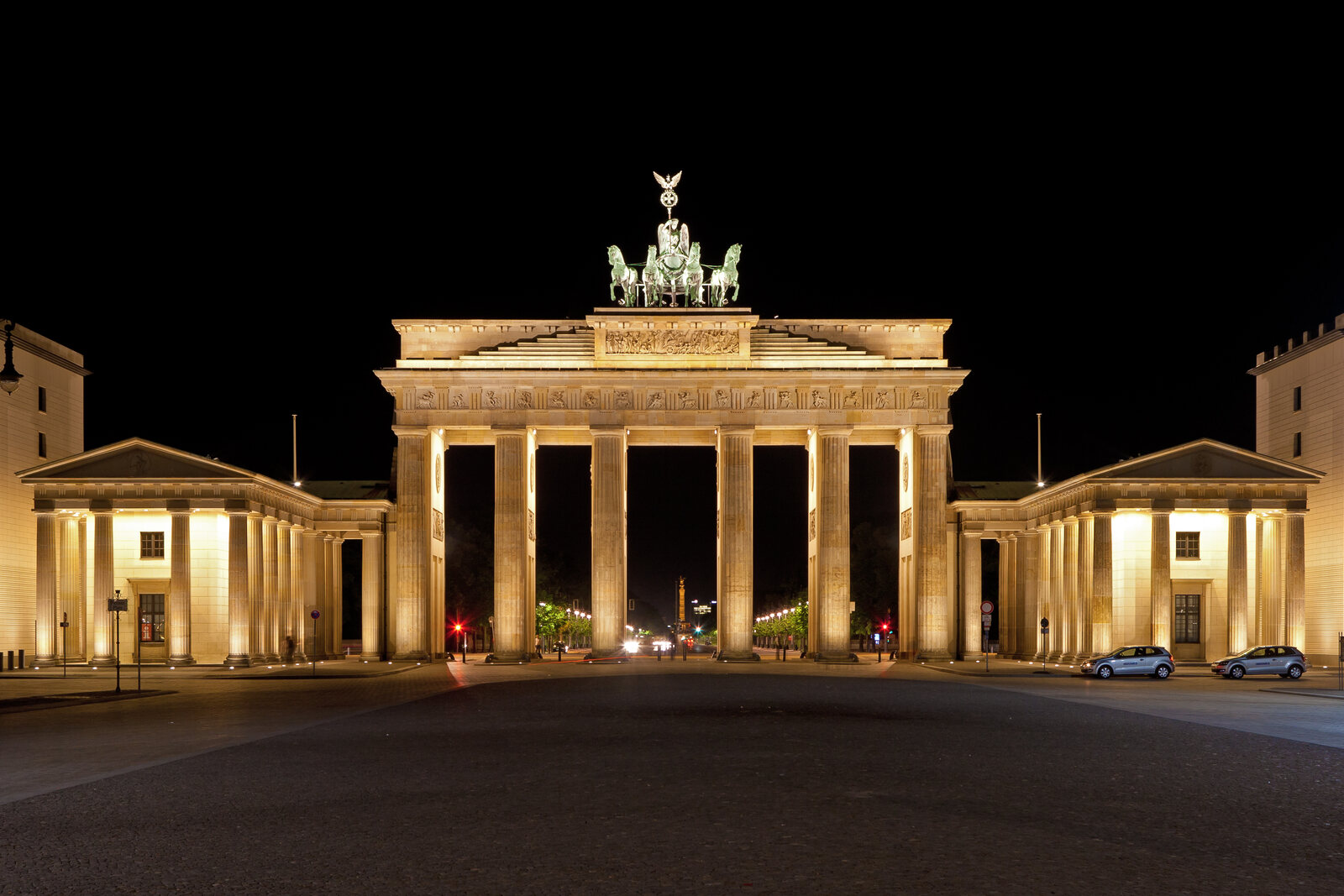
Look around first
What to notice
- Five passages beneath the gate
- Quadriga with 4 horses
- Iron Cross and Prussian Eagle
- Stone columns
The story of the place
For a long time, the city boundary ran here: people entered Berlin through the five passages between the stone columns, while guards and those who inspected imported goods worked at the sides. The name recalled the road to Brandenburg an der Havel. The modest checkpoint was turned into a ceremonial entrance, with a copper chariot and four horses placed on top. The original sculpture was destroyed during the Second World War, so a copy stands above the gate.
On October twenty-seventh, eighteen oh six, Napoleon Bonaparte entered Berlin through these gates. Two weeks earlier, the French emperor had defeated the Prussian army at Jena and Auerstedt; the king had left the capital, and the city had surrendered. Napoleon entered from the west because this was where the ceremonial route along Unter den Linden to the royal palace began.
The palace was still several kilometers away, but Berlin's boundary ran here. Brandenburg Gate formed part of the city's excise wall. Guards and collectors of tax on imported goods sat in the side buildings, and people passing through were inspected. The name indicated the direction: the road to Brandenburg an der Havel began here. Of the twenty gates in that wall, only these have survived.
King Frederick William II commissioned the architect Carl Gotthard Langhans to replace the former modest checkpoint with a ceremonial entrance. It opened in seventeen ninety-one under the name “Gate of Peace.” Two years later, the court sculptor Johann Gottfried Schadow installed a copper quadriga—a chariot with four horses—on top. Its driver depicted the goddess of peace entering the city.
After Napoleon's arrival, the victors themselves decided to rewrite the meaning of this figure. Berlin artists asked the emperor to leave the quadriga in place, but he ordered it sent to Paris as a war trophy. Dominique-Vivant Denon, director of Napoleon's museum, was responsible for its transport; he accompanied the army and selected works of art for France.
Emanuel Ernst Jury, a Potsdam copper craftsman, was commissioned to dismantle the quadriga. He was the one who had once hammered the horses out of copper sheets from Schadow's models and assembled them above the gate. Now Jury received one thousand five hundred thalers for the reverse task: to remove his own horses, lower them to the ground, and pack them into twelve crates. The cargo was taken by barge through Hamburg. It took almost six months to reach Paris and arrived damaged.
Napoleon intended to place the Berlin quadriga in front of a temple glorifying his Grande Armée. He did not complete the temple, and he found no suitable place for the chariot either. After repairs, it was left in storage.
Eight years later, Allied armies entered Paris, Napoleon abdicated, and went into exile on Elba. Prussian envoys found the quadriga and took it back to Berlin. Along the way, people greeted the crates as a trophy; Berliners dubbed this transport “the return coach.” The former laurel wreath, spear, and eagle were missing—they had disappeared in France.
King Frederick William III commissioned the architect Karl Friedrich Schinkel to make new symbols. Schinkel placed an Iron Cross inside the oak wreath and set a Prussian Eagle above it. The goddess of peace came to be called Victoria, the goddess of victory. Thus Napoleon achieved the opposite of what he had intended: the figure he had taken away returned to the same place bearing symbols of his defeat.
The original quadriga was destroyed at the end of the Second World War; one copper horse's head survives and is now in the city museum. A postwar copy stands above the gate. In Victoria's hands remain the oak wreath, the Iron Cross, and the Prussian Eagle, added after the return from Paris. The square in front of the gate on the Unter den Linden side has been called Pariser Platz since eighteen fourteen.
Useful on site
Open public urban space; Tourist Info in the south wing has its own hours; check visitBerlin if needed.
Checked: June 28, 2026. Check the official source before visiting.Listen from the edge of the square, without lingering in the central passages. Walk around the gate to see it from both sides.