 Guide On Map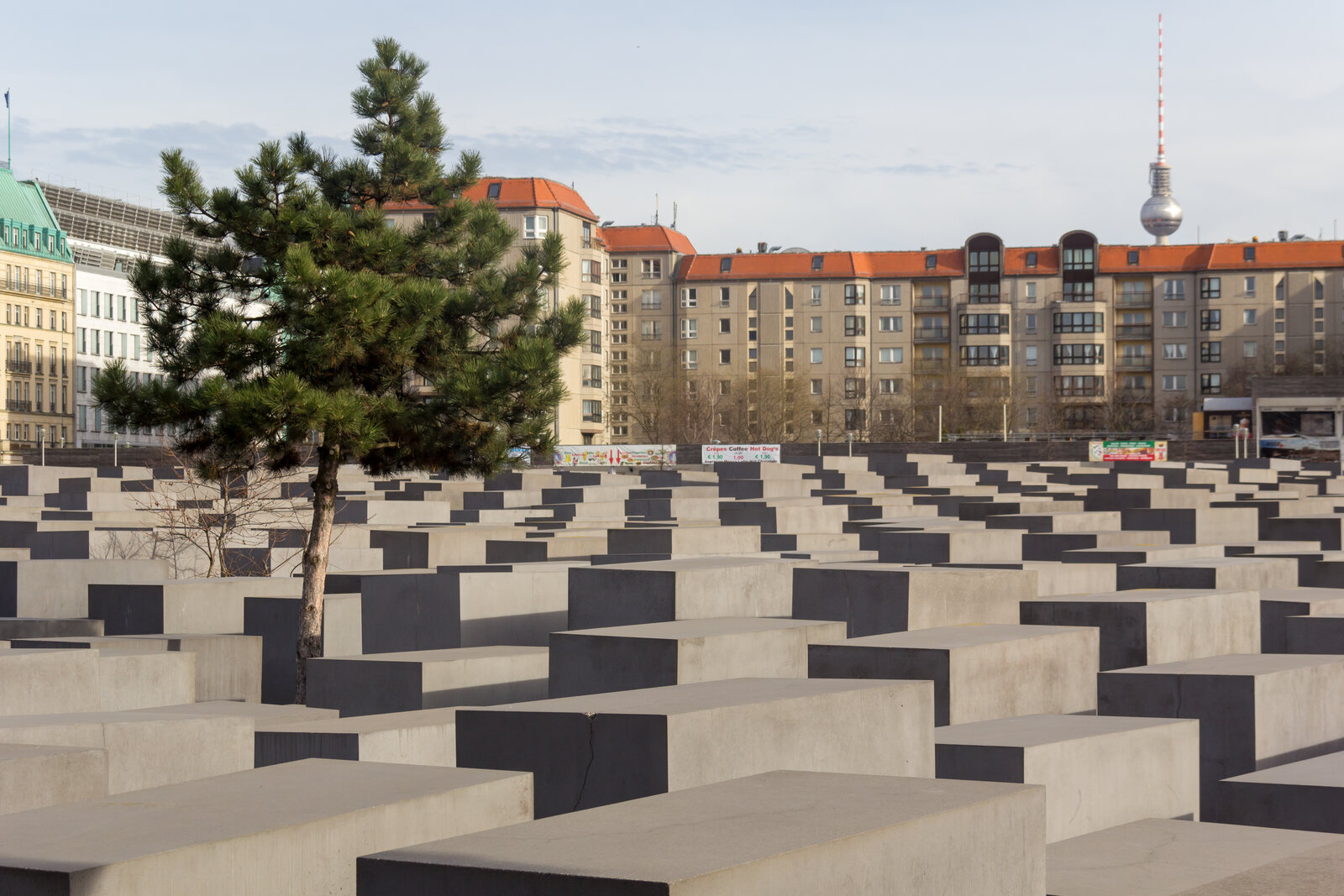
Look around first
What to notice
- Field of concrete stelae
- Sloping paths
- Entrance to the underground Information Centre
The story of the place
On the site of the former Ministerial Gardens, the concrete stelae descend and rise again along with the sloping paths. The field was laid out between the Brandenburg Gate and the Reichstag Building as Germany’s central memorial to Jewish men, women, and children from across Europe, killed by Nazi Germany and its collaborators because of their Jewish origin. Architect Peter Eisenman left the surface without names, dates, or religious symbols: from a distance it appears to be an even grid, but inside it quickly loses its familiar scale.
On May tenth, two thousand five, the journalist Lea Rosh, who had spent seventeen years campaigning for this memorial, held a human tooth above a podium. She announced that the tooth would be placed in one of the concrete stelae.
Rosh found it in nineteen eighty-eight while filming a documentary about the Holocaust. Together with the historian Eberhard Jäckel, she had come to Belzec, an extermination camp established by the Nazis in occupied Poland. There, SS men killed hundreds of thousands of Jews. At one of the mass graves, Rosh saw a molar in the sand. It was impossible to establish whom it had belonged to. She took the find to Berlin and later claimed that it was then that she promised the dead she would secure a central memorial for them.
Television journalism was her profession: Rosh knew how to find allies, attract attention, and withstand public battles. Together with Jäckel, she created a civic initiative that collected around ten thousand signatures. At first, they proposed erecting the memorial on the former site of the Gestapo, the secret police of the Nazi regime. After the fall of the Berlin Wall, the initiative group chose another site: the former Ministerial Gardens north of the ruined Reich Chancellery. In nineteen ninety-two, the federal government agreed to transfer the land.
That is why the field appeared beside the Brandenburg Gate and the Reichstag Building, although no mass killings took place on this site. It was intended as the country’s central memorial to Jewish men, women, and children from different European countries whom Nazi Germany and its collaborators stripped of their rights, confined in ghettos, deported, and killed because of their Jewish origin. The number of victims is estimated at around six million.
There are no names, dates, or religious symbols on the stelae designed by the architect Peter Eisenman. When parliament approved the project in nineteen ninety-nine, the deputies required an information center to be created beneath the field: the concrete grid was to receive a documentary continuation with the fates of specific people and the sites of crimes.
The tooth almost turned the memorial into an entirely different kind of site. Albert Meyer, chairman of Berlin’s Jewish community, pressed for the human remains to be buried according to Jewish rules. He said that the concrete field could not be turned into a cemetery or a repository of relics, and warned that if the tooth were placed in a stele, Jews would have to decide whether they could enter it at all. Staff at the memorials in Belzec and Auschwitz also protested.
Three days after the opening, Rosh gave up her intention. The tooth was returned to Belzec and buried there according to the Jewish rite in the summer of that same year. No Berlin stele contains human remains.
The names are in the underground center. In a separate room, a recording speaks the name and a brief biography of every known Jewish victim or person missing without trace. For all the stories collected there to be heard once in succession would take around six years, seven months, and twenty-seven days.
Useful on site
The Field of Stelae is accessible around the clock; the Information Centre beneath the field has separate hours and may have temporary closures, so check the Stiftung website before visiting.
Checked: June 28, 2026. Check the official source before visiting.Enter the field slowly and keep to your chosen path: the slopes change, and people approaching from the other direction appear suddenly. The Information Centre is visited separately.