 Guide On Map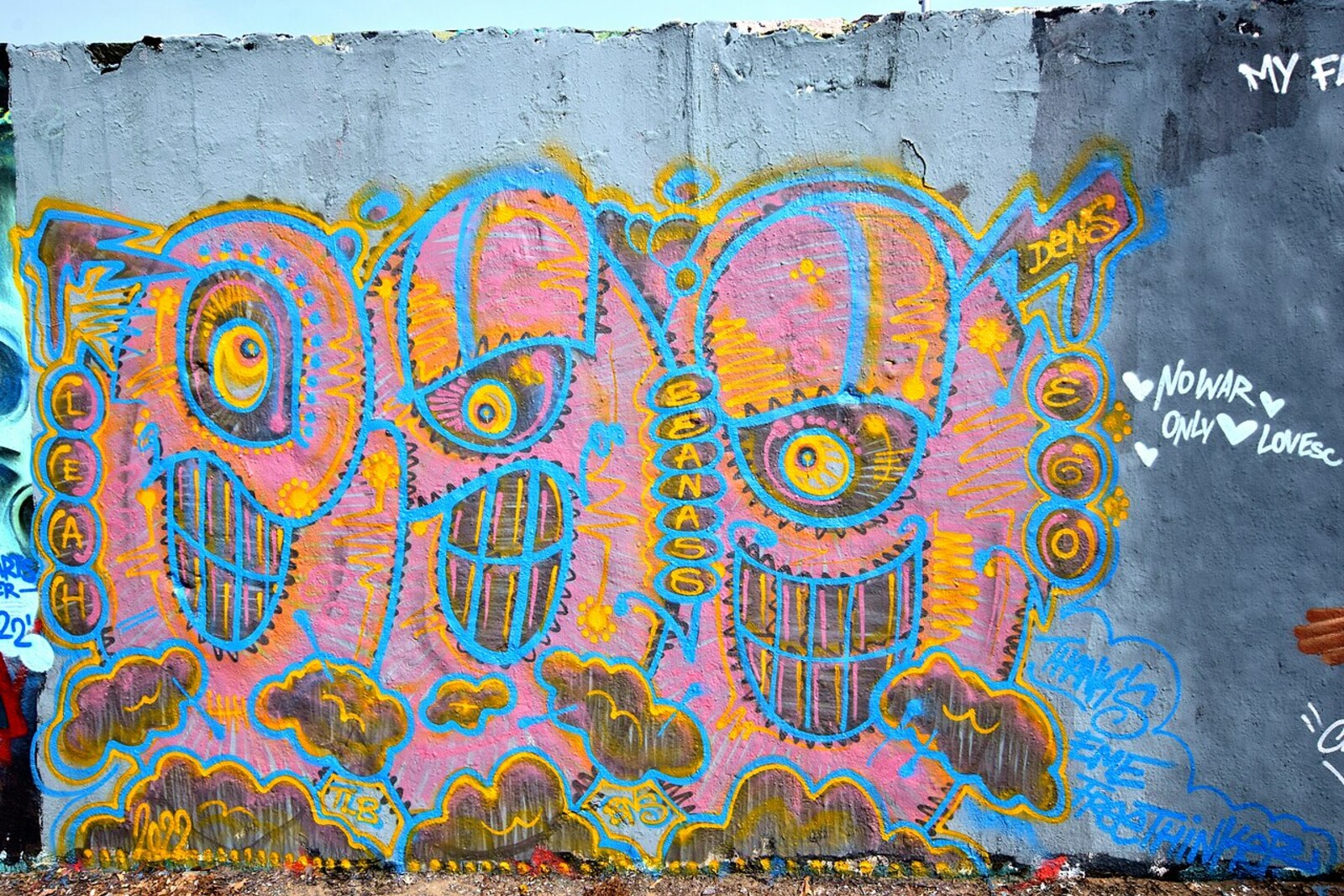
Look around first
What to notice
- Broad lawn
- Amphitheater in the slope
- Fragment of the inner wall
- Cobblestones of Schwedter Straße
The story of the place
The park occupies a broad strip of the former border, once kept empty for visibility. Its former width remains in the lawn, while the old cobblestones of Schwedter Straße emerged from beneath the asphalt and became the main path. An amphitheater is built into the embankment by the stadium, and farther on a long fragment of the inner wall survives—now amid games, music, and the Sunday market.
In February nineteen ninety, the German Democratic Republic (GDR) still existed, the border installations along Schwedter Straße remained in place, and the newly freed-up land already required a decision. The Green Party in the GDR and the environmental association Green League proposed that the Berlin Round Table turn the former border strip into a landscape park. The Round Table was a temporary forum where old GDR organizations and new civic movements worked out the city's immediate future.
The residents of neighboring Prenzlauer Berg needed this land not as a symbol. In the densely built-up blocks around Schönhauser Allee, there were about zero point two square meters of greenery per person, compared with the city standard of fifteen. While officials discussed the proposal, residents began taking over the vacant lot with trees.
In April, the East Berlin graphic artist Manfred Butzmann and two of his colleagues, Anna Franziska Lobeck and Peter Schwarzbach, staged an action called “Wall, Land, Lupine.” They sought to ensure that the freed-up strip would not be divided into building plots, but preserved as a continuous park. The artists brought in the Green League, residents of both Berlins, and the GDR Border Troops. The servicemen helped harrow the ground and, together with the artists, sowed lupines along Schwedter Straße. Until recently, no one could enter here without permission; now border guards were preparing the same land for flowers.
Butzmann conceived of a yellow stripe running through Berlin in place of the concrete one. It did not work out: birds pecked up some of the seeds, rabbits ate others, and many sections of the former border were later built over. Here, the outcome was different. The district assembly supported preserving the open land, and residents, together with the parks department, continued the plantings and began developing the future park. The site was also easier to protect because before the Wall was built, it had remained largely undeveloped: there was hardly any need to return houses and courtyards here to their former owners.
Two years later, the project was assigned to the landscape architect Gustav Lange. He kept a broad lawn in the former dimensions of the border strip, built an amphitheater into the slope by the stadium, and preserved about three hundred meters of the inner wall. Workers removed the asphalt from the border patrol road and uncovered the old cobblestones of Schwedter Straße; the main path now runs along them. In the autumn of nineteen ninety-four, the first section of Mauerpark—“Wall Park”—opened.
The broad empty space that border guards had kept clear for visibility was taken over by games, street musicians, and Sunday karaoke in the amphitheater; a flea market was set up nearby. Butzmann's lupines did not survive. Between Mauerpark and Falkplatz, horse chestnuts and Simon poplars from the first plantings of nineteen ninety still stand.
Useful on site
Mauerpark is open as a public space; the market, karaoke, and events depend on the day and season.
Checked: June 28, 2026. Check the official source before visiting.For a quiet visit, choose a time without major events. If you want to catch the market or karaoke, check the current schedule in advance: the regularity of events can change.