 Guide On Map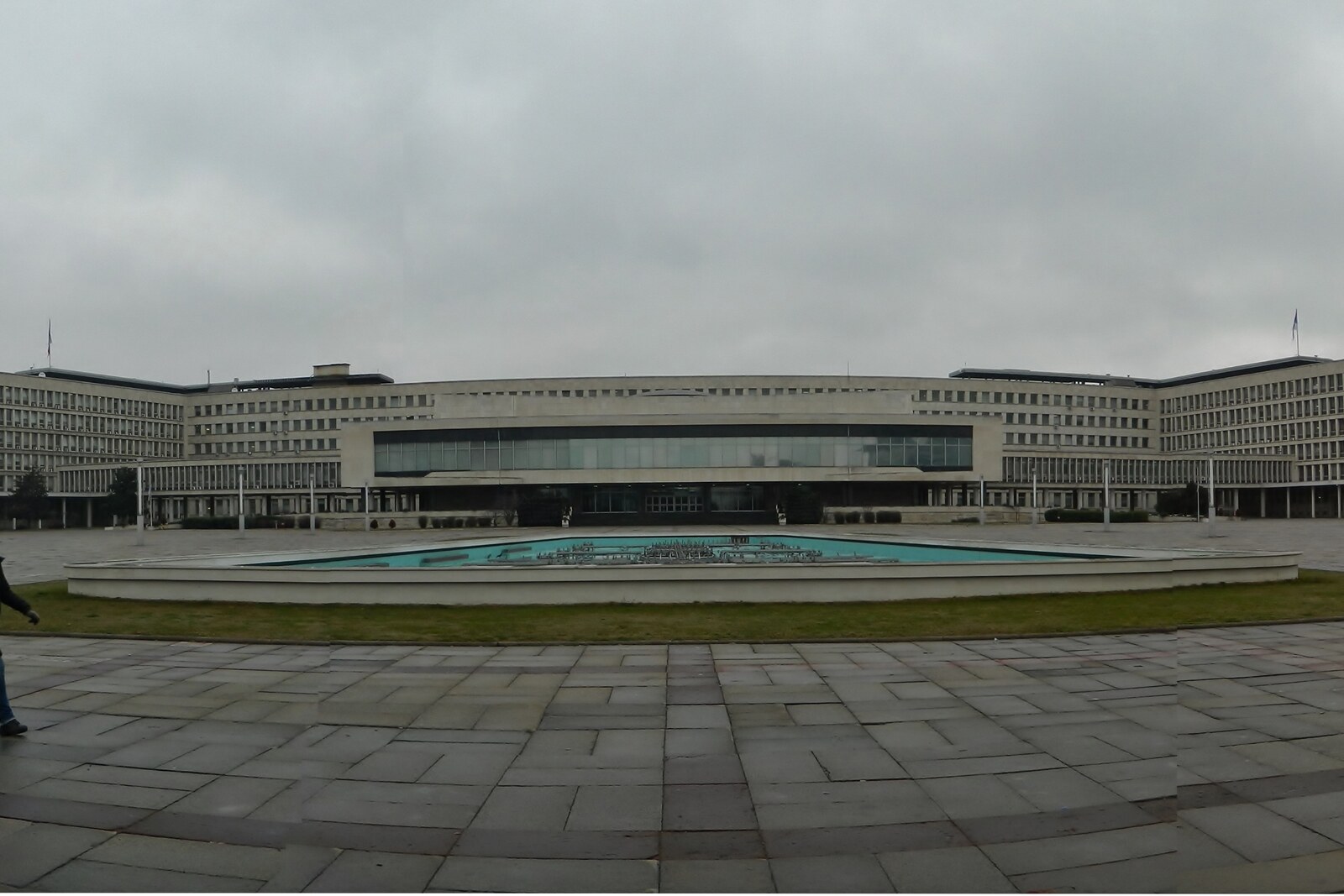
Look around first
What to notice
- Side wings
- Central glazed entrance
- White stone facade
- Slender supports on the ground floor
The story of the place
Two side wings converge on the ceremonial wing, while the ground floor is set back behind slender supports and the entrance’s extensive glazing. Inside, six representative salons were arranged around Yugoslavia Hall so that each federal republic could furnish its own space for shared receptions. The Federal Executive Council worked here, a collegial body with the duties of a cabinet of ministers; the city’s abbreviation SIV outlived the institution itself. Serbian state agencies are now housed behind the white-stone walls, and the main hall bears the name Serbia Hall.
In the mid-nineteen fifties, the architect Mihailo Janković received a commission with a difficult condition: the new building had to be assembled around someone else’s concrete frame, which had stood here for several years. Janković headed the Stadion Design Bureau, which he had founded, and earned his living through major state commissions. The Yugoslav People's Army Stadium brought him recognition. Yet he was not a member of the League of Communists of Yugoslavia: it was his professional reputation that brought him the country’s main government commission, and it was that same reputation he was risking.
The frame had appeared under entirely different circumstances. In nineteen forty-seven, the team of the Zagreb architect Vladimir Potočnjak won the competition for the residence of the Presidency of the Government of the Federal People's Republic of Yugoslavia. The new government planned to move to the left bank of the Sava and begin building the administrative center of New Belgrade from here.
Work began in April nineteen forty-eight. Two months later, Cominform—an association of communist parties subordinate to Moscow—expelled Yugoslavia from its ranks. Josip Broz Tito, the country’s leader, refused to comply with Joseph Stalin’s demands and sought independence. Former allies cut off economic ties, a crisis began, and construction sites in New Belgrade came to a halt. Only the reinforced-concrete skeleton of the future palace had been raised. Potočnjak died in nineteen fifty-two without ever seeing the building completed.
When construction resumed, the institution itself had changed. Instead of the Presidency of the Government, the Federal Executive Council was to be housed here—a collegial body that performed roughly the same work as a modern cabinet of ministers. The abbreviation SIV came from the first letters of its Serbian name, and Belgraders still use it for the palace.
Janković retained the side wings and the overall shape of the frame, which resembled the Cyrillic letter N when seen from above, but had the already raised central section dismantled. In its place, he designed a new ceremonial wing. Massive walls gave way to slender supports, the ground floor was set back, and the main entrance received extensive glazing. Inside, Janković arranged six salons around Yugoslavia Hall, one for each federal republic. Their decoration was entrusted to architects and artists from the respective republics: the federal government acquired rooms in which each of its parts represented itself separately.
Janković’s first sketches resembled Oscar Niemeyer’s work for Brazil’s new capital too clearly. Colleagues reproached the architect for transferring solutions devised for a different climate. Janković revised the design, but retained the long horizontals, free-standing supports, and transparent entrance. White stone for the facades was brought from the island of Brač, while the central wing housed reception halls, offices for council members, and administrative premises.
On April twenty-ninth, nineteen sixty-one, the first meeting of the Federal Executive Council was held here. In September, the palace was ceremonially opened for the conference of non-aligned states. The leaders of twenty-five countries held their main meetings in the old parliament building on the other bank of the Sava, but the conference participants were the first official guests of Yugoslavia Hall. The government deliberately brought them here as well: large undeveloped spaces still surrounded the building, while inside, a government complex designed for international receptions was already operating.
For this work, Janković and his colleagues received an order and a special certificate of honor. The architect himself called the palace his most complete work: here he was responsible for the building, the arrangement of the halls, and the furniture.
After the disappearance of the Yugoslav federation, the building came to be called the Palace of Serbia. Serbian government institutions are now housed here, and official receptions take place here. The frame raised under Potočnjak still stands in the side wings; the central glazed entrance belongs to Janković’s design. And Yugoslavia Hall, which the palace’s first foreign guests entered in nineteen sixty-one, is now called Serbia Hall.
Useful on site
An active government building; there is no regular public access. Interiors are possible only with an official appointment, through protocol, or during rare architectural events.
Checked: June 29, 2026. Check the official source before visiting.The usual route involves viewing the exterior: the ceremonial salons and art collection are not a freely accessible museum exhibition.