 Guide On Map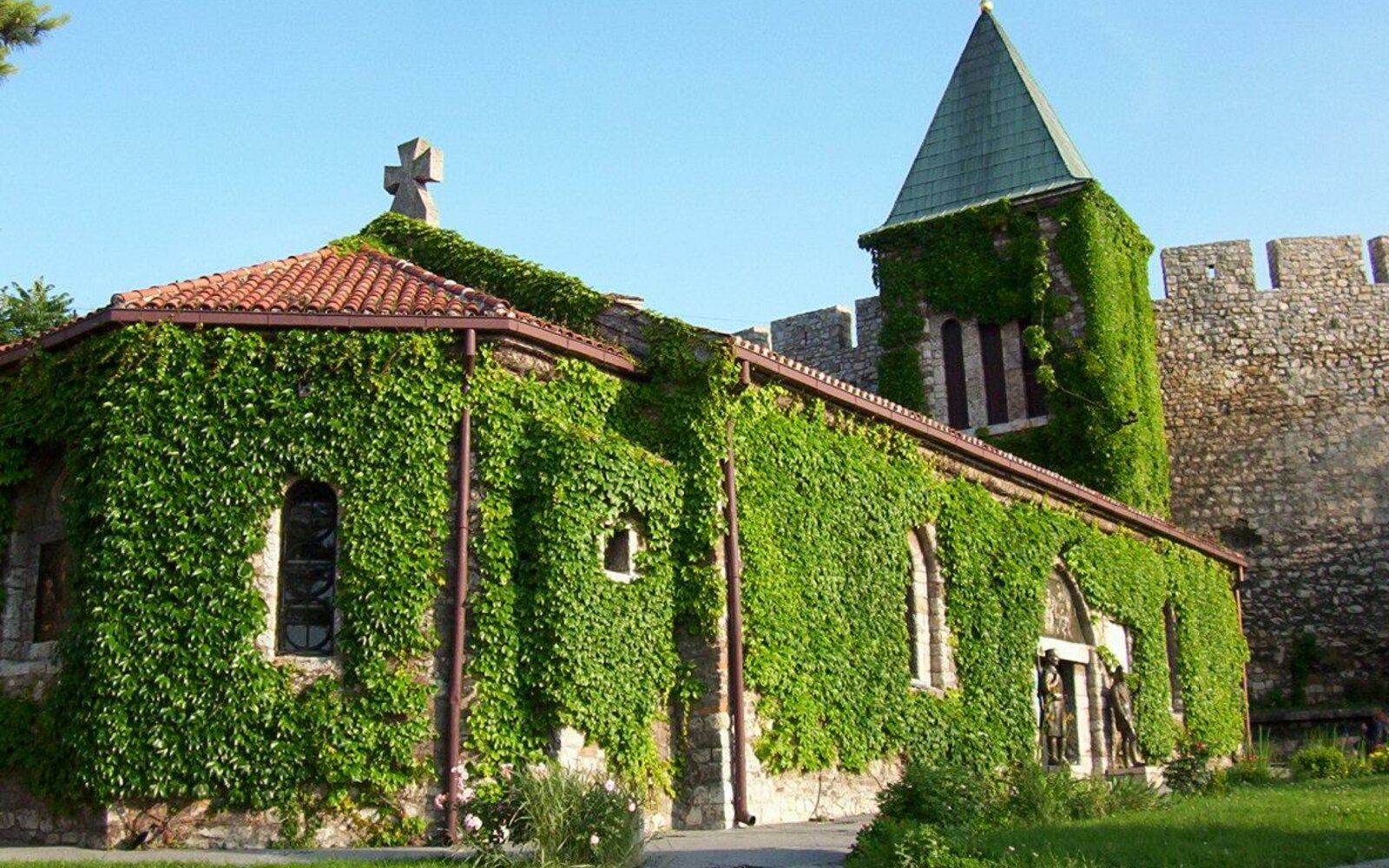
Look around first
What to notice
- Long stone walls
- Altar apse
- Bell tower
- Figures of warriors at the entrance
The story of the place
The long stone building beneath the fortress wall began as a gunpowder store. In the first half of the eighteenth century, the Austrian military established it in the eastern suburb below the fortress. The Lower Town by the rivers then contained an arsenal, barracks, grain stores, and workshops: ammunition had to be kept inside the fortifications, close to the garrison. The Ottomans, who returned afterward, retained the building's former purpose. There was no altar here for about a century and a half.
But Belgraders considered the storehouse a former church. Prince Miloš Obrenović, who was seeking for Serbs the right to restore Christian shrines in the fortress, spoke to the Ottoman pasha of two churches beyond the walls where ammunition was kept. One of them was associated with Ružica Church, a church known from folk songs and legends. Historians have found no evidence that the medieval Ružica Church stood on this very site.
For the townspeople, this uncertainty was no obstacle. In the spring of eighteen sixty-seven, while the transfer of the fortress was being prepared, a newspaper was already reporting a collection of donations for a Serbian church that had previously served the Ottomans as a storehouse. People gave money for the return of a church whose existence here still had to be proven.
After the Ottoman garrison left, Serbian soldiers entered the fortress. The chosen building was not dismantled: an altar apse and a bell tower were added to the gunpowder magazine. Metropolitan Mihailo Jovanović, head of the Serbian Church, consecrated the garrison church in the same year. Officially, it is dedicated to the Nativity of the Mother of God. “Ružica” is a folk name, not the name of a saint; its origin is connected with the ancient Rusalii festival and later legends. There is no reliable record of who first applied this name to the former storehouse.
Serbian soldiers received their church in the same place where ammunition had once been stored. This connection determined its later fate. During the assault on Belgrade in nineteen fifteen, artillery fire severely damaged Ružica Church together with the fortifications by the rivers.
It had to be restored after the war. The Ministry of War paid for the main work, and the Russian émigré architect Nikolay Krasnov prepared the design for the present building. By nineteen twenty-five, the church had been consecrated again. For its decoration, craftsmen from the Military Technical Institute in Kragujevac used artillery shell casings, rifle and revolver cartridges, and officers' sabers. From them they made two large chandeliers, candleholders, and relief icons. Following Krasnov's drawings, figures of warriors from different eras were placed at the entrance; the bronze for the figures also came from remaining military material.
The side walls preserve the volume of the gunpowder store. The apse and bell tower appeared when it was turned into a garrison church. The sabers and shell casings inside, the medieval warrior and the infantryman at the door, remain from the restoration after the following war.
Useful on site
The Lower Town is open as an outdoor route; Ružica Church follows church hours.
Checked: June 28, 2026. Check the official source before visiting.If the church is open, enter quietly and remember that it is an active church; if the entrance is closed, the soldiers and the exterior form still reveal its military origin.