 Guide On Map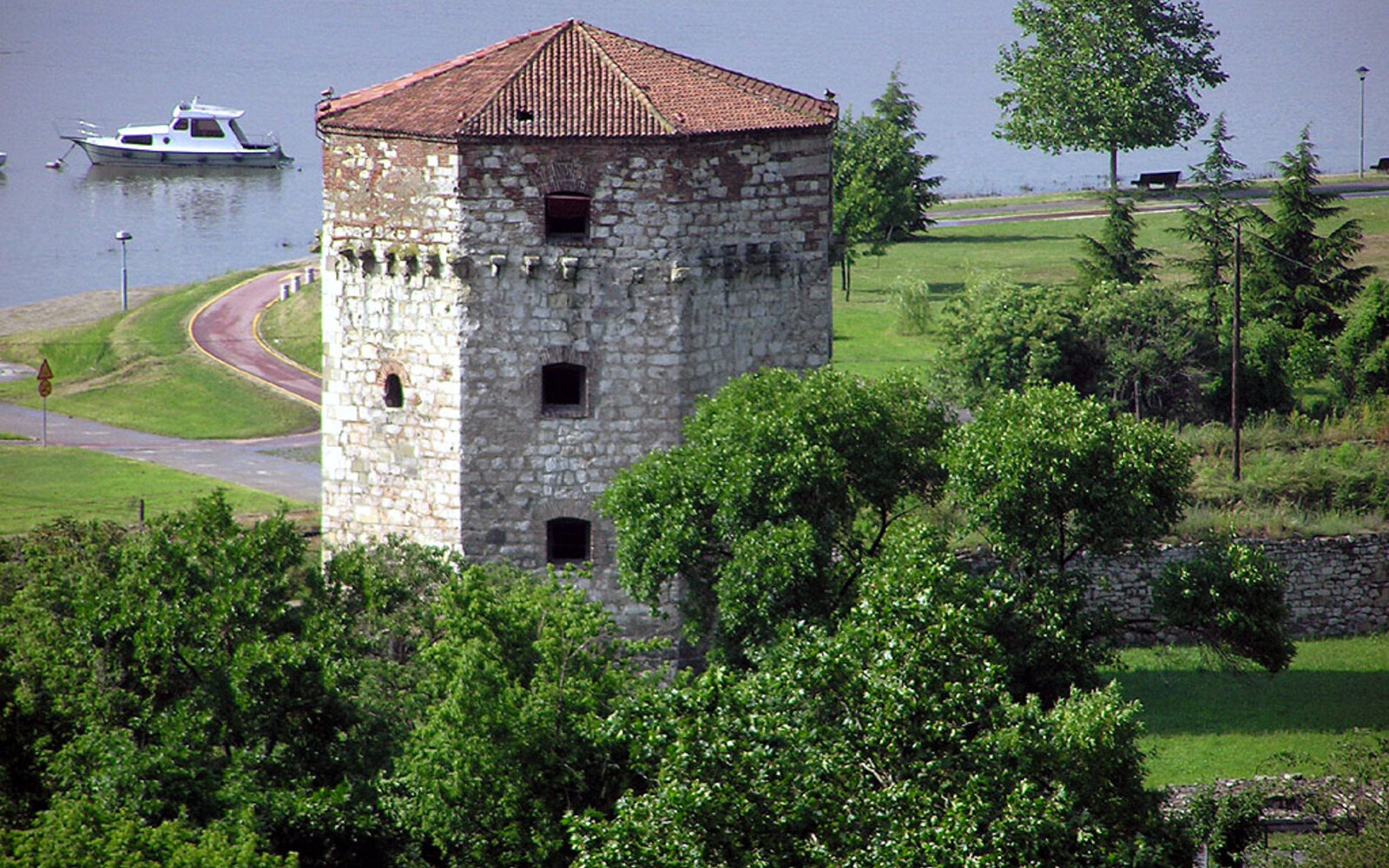
Look around first
What to notice
- Stone tower by the Danube
- Cannon embrasures
- Reproductions of the Charta of Rigas
- Names carved into the wall
The story of the place
The tower was built around fourteen sixty by the river gate of the Lower Town, beside the port. Cannon embrasures remain in its thick walls: from here, the eastern approach along the Danube was controlled. When the port canal was filled in and the harbor lost its former role, the Ottoman garrison turned the tower into a prison. Behind the stone walls now hang copies of the Charta of Rigas, and the names of the prisoners are carved.
Nebojša is not the name of an owner. The old nickname means “fearless.” That was the name of the main tower of the castle of the Serbian ruler Stefan Lazarević. After its destruction in the autumn of sixteen ninety, the name was transferred to this tower by the Danube. Before that, travelers knew it as the White Tower or the Timișoara Tower.
It was built around fourteen sixty at the entrance to the port of the Lower Town. Cannons in its embrasures covered the approach from the east. Later, the port lost its importance, the canal was filled in, and the Ottoman garrison adapted the thick-walled tower into a prison. That was how, at the end of the eighteenth century, a man who intended to change the order of the Balkans with printers’ ink came here.
Rigas Velestinlis, known today as Rigas Feraios, was a Greek publisher and organizer of an uprising against the Ottoman Empire. He had previously earned his living as a secretary at the courts of the rulers of Wallachia, a principality in what is now Romania. He translated books, drew maps, and knew well the world of Greek merchants, through which manuscripts, money, and printed sheets could be moved between cities.
In Vienna, Rigas prepared a plan for a republic for the peoples of the Ottoman Empire. In his constitution, civil rights did not depend on faith or origin. Along with it, he printed a call for an uprising, the revolutionary song “Thourios,” and the enormous twelve-sheet Charta of Rigas. It looked like a scholarly map, with ancient cities, coins, and battle plans. During interrogations, the Austrian police already described its production as part of a revolutionary scheme.
At the end of seventeen ninety-seven, Rigas sent crates of printed material to Trieste. He intended to cross the Adriatic Sea to the Mani Peninsula, where he hoped to begin an uprising. The crates were intercepted, and Rigas himself was arrested immediately after arriving. He spent several months under interrogation in Trieste and Vienna.
Then the Austrian administration separated eight arrestees considered Ottoman subjects: Rigas and seven of his companions. They were put in chains and, after a thirteen-day journey, brought to Zemun—then an Austrian border town opposite Belgrade. The next day, the escort handed the prisoners over to the Ottoman governor. Only the river separated them from the border, and the nearest secure prison was the former port tower, Nebojša Tower.
For about forty days, the prisoners were held and tortured here. On the night of June twenty-fourth, seventeen ninety-eight, Rigas and his seven companions were strangled. Their bodies were thrown into the Danube. None of the eight lived to see the uprising they had been preparing for, and none of them was left with a grave.
The police managed to destroy part of the printed Charta of Rigas, but the entire print run did not disappear. Of the one thousand two hundred twenty copies, several dozen have survived to the present day. After the tower’s restoration, a permanent exhibition was installed inside: reproductions of the Charta of Rigas were placed on the walls, and nearby the names of Rigas and the seven men who died with him were carved.
Behind the tower runs the line of the former port. From here, cannons once held the entrance from the Danube side; across this same river border, the eight prisoners were brought here, and in that same river their bodies disappeared.
Useful on site
Accessible from outside as a route stop; Nebojša Tower is usually open Wed–Sun 11:00-19:00 in summer / 10:00-17:00 in winter.
Checked: June 28, 2026. Check the official source before visiting.Plan an interior visit separately and check access in advance. If the tower is closed, walk around the accessible outer section and take in its position by the former entrance to the harbor.