 Guide On Map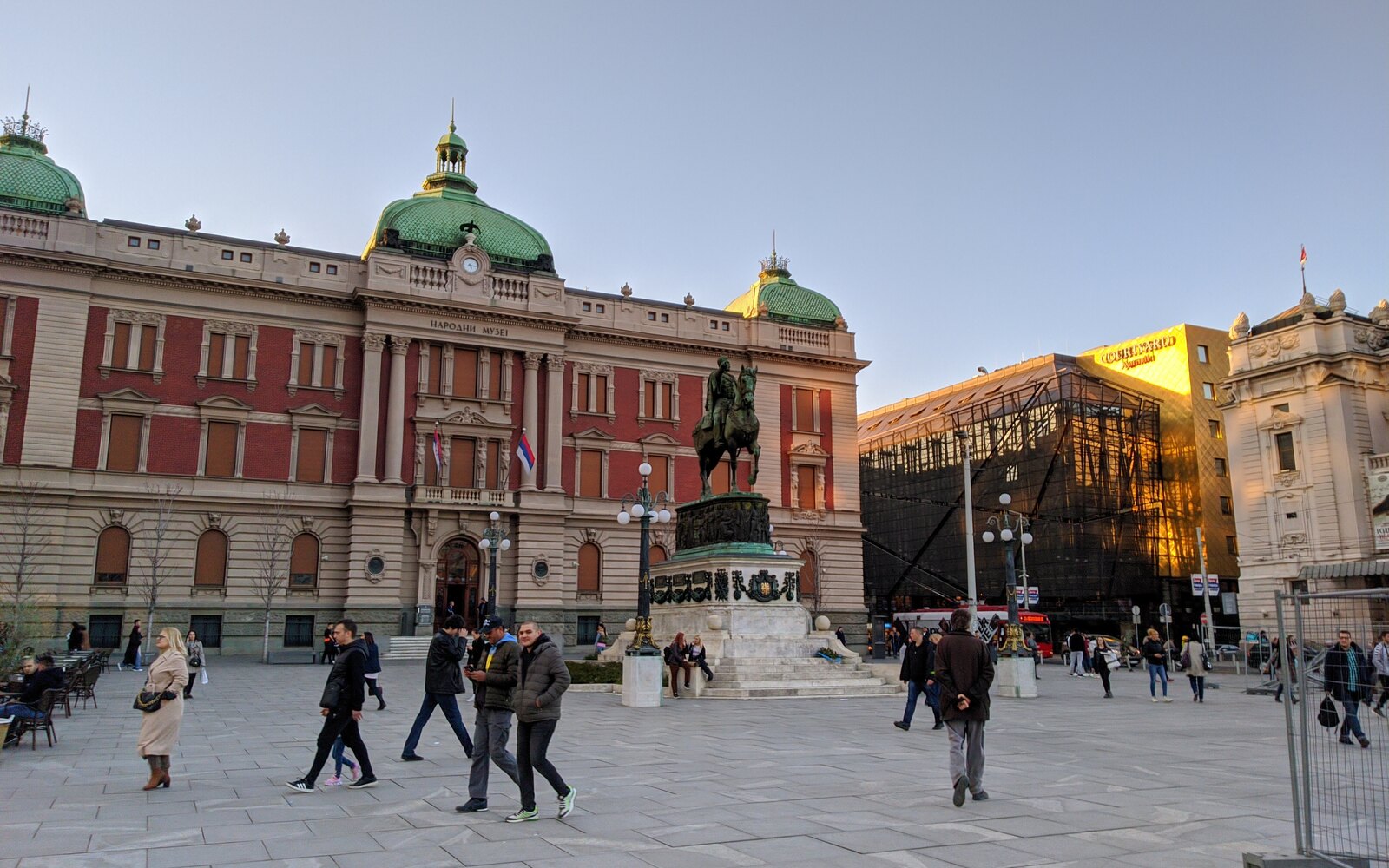
Look around first
What to notice
- Equestrian statue of Prince Mihailo
- Facade of the National Theatre in Belgrade
- Pedestal with the names of cities
- Monument to Vasa Čarapić
The story of the place
Between the equestrian statue of Prince Mihailo and the National Theatre in Belgrade stood Stambol Gate—the main landward gate of Belgrade. It was built by the Austrians in the early eighteenth century, while its Ottoman name appeared later: the road to Istanbul, Constantinople at the time, began here. The central passage was intended for carts, and the two side passages for pedestrians. Beyond the gate lay the city, surrounded by a moat; in front of it stretched an open field where Ottoman officials staged public executions.
In December 1806, Vasa Čarapić, a rebel commander from the Gročani District, led his men here. Before the uprising, he had been elected local knez. At the time, the word meant an elder of several villages: he distributed taxes, settled disputes, and was answerable to Ottoman officials for the residents. Such a position gave a man standing among his neighbors and at the same time made him a convenient target.
Belgrade's region was then controlled by the dahis—Janissary commanders who had seized power in defiance of the sultan. Fearing a revolt, they decided to kill the Serbian knezes. Čarapić managed to escape to Avala; his relative Marko Čarapić was captured and killed. After this massacre, local elders and peasants launched the First Serbian Uprising, and Vasa went from tax collector to military commander of the Gročani District.
The rebels kept Belgrade under siege for about two and a half years. For the decisive nighttime assault, the city was divided among several columns, and Čarapić, with about three thousand fighters, was assigned the most strongly fortified Stambol Gate. He led his men to the gate and was mortally wounded during the assault. Čarapić was carried out of the battle and taken to the tent of Karađorđe, the leader of the uprising, at Tašmajdan. He lived for about two more hours, managed to ask to be buried at Rakovica Monastery, and died.
His column continued the attack. That same day, the rebels captured Belgrade's city section, while the Ottoman garrison retreated to the fortress. At the beginning of the following year, the garrison capitulated. Čarapić himself did not see the result of the assault he began at these gates.
The victory proved temporary: after the defeat of the uprising, Ottoman troops returned. Stambol Gate stood for almost another sixty years. In eighteen sixty-six, Prince Mihailo Obrenović ordered it demolished. He sought the withdrawal of the remaining Ottoman garrisons from Serbian cities and received the keys to Belgrade the following year. The names of the cities handed over at that time can now be read on the pedestal of his equestrian statue.
The prince chose the cleared site beside the former gate for a permanent National Theatre in Belgrade as well. He allocated five thousand ducats from his own funds for its construction, but did not live to see its opening: Mihailo was killed in Košutnjak in eighteen sixty-eight. The theatre opened a year later, and a monument to the prince was installed in the square in eighteen eighty-two. Thus, two of his unfinished undertakings came to stand side by side: the theatre, built after his death, and the empty site left by the gates whose demolition opened Belgrade to new districts.
At first, the space was called Theatre Square. In nineteen forty-five, the Constituent Assembly abolished the Yugoslav monarchy and proclaimed the Federal People's Republic of Yugoslavia. The following year, the square received its present name in honor of the republican system established at that time. The equestrian figure of the prince remained in place when it was renamed.
Today, Belgraders arrange to meet “by the horse”—at Mihailo's monument. Theatre and National Museum of Serbia visitors meet here, city walks begin here, and participants in public events gather here. Stambol Gate itself is no longer there: its site lies between the horse and the theatre. At the beginning of Francuska Street stands a figure of Vasa Čarapić with his hand raised toward his saber; the street bearing his name leads away from the square.
Useful on site
An open city square; the museum and theatre follow separate schedules.
Checked: June 28, 2026. Check the official source before visiting.Move to the edge of the square to see the monument together with the surrounding buildings; do not expect to find the exact outline of Stambol Gate on the ground.