 Guide On Map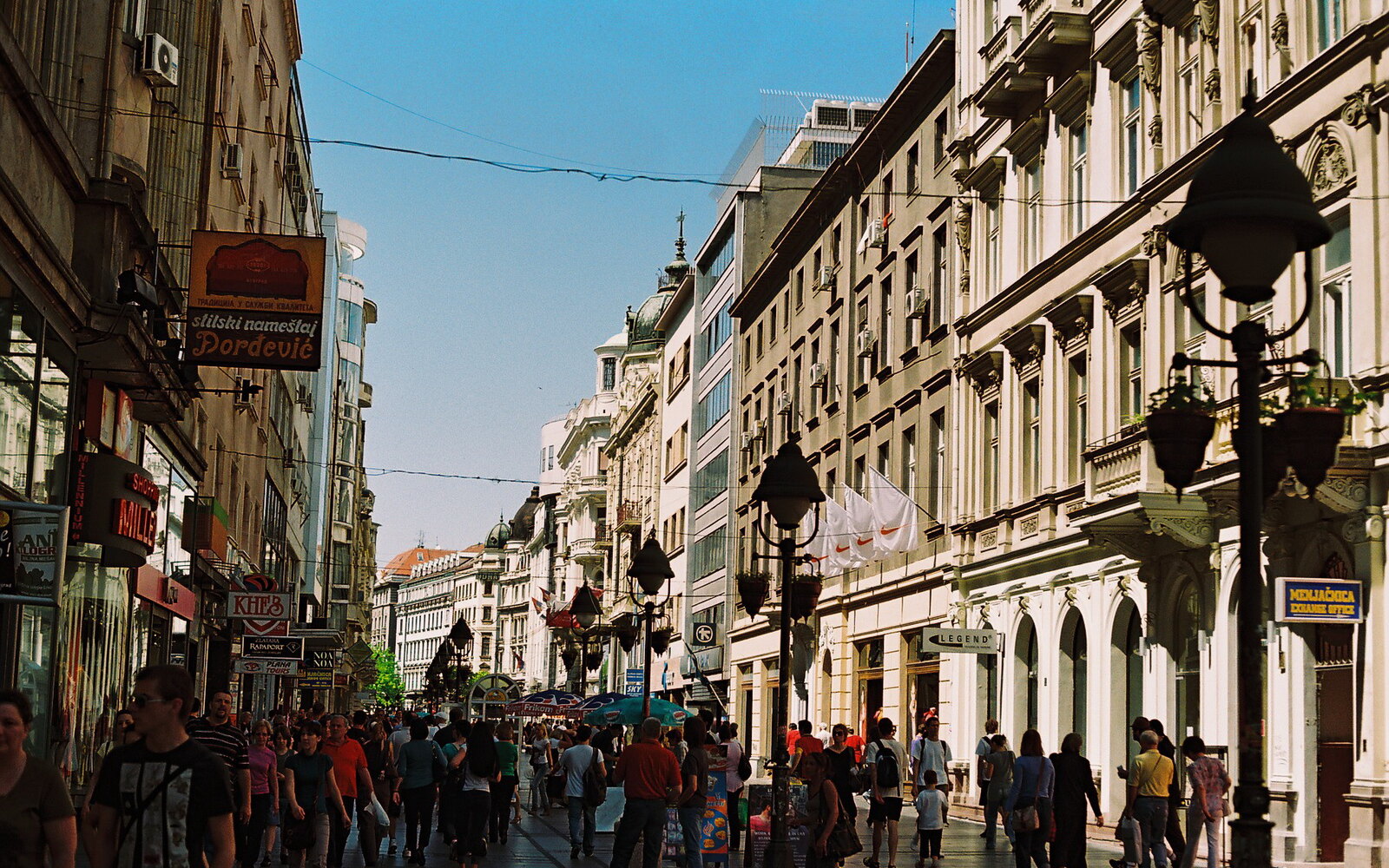
Look around first
What to notice
- Memorial marker to Emilijan Josimović
- Façades of buildings with commercial floors
- House No. 51, The Greek Queen
- The fork with Čika-Ljubina Street
The story of the place
Knez Mihailova Street—Serbian for Prince Mihailo Street—connects Republic Square with Kalemegdan. Today, people walk here between shops, cafés, a library, and galleries. This straight road to the fortress appeared only in the second half of the nineteenth century. Before it, this site contained a short stretch of Delijska Street, winding lanes, and gardens.
In eighteen sixty-four, Emilijan Josimović, a professor at the Higher School, began a geodetic survey of old Belgrade within the former city moat. He taught mathematics, mechanics, and geodesy, and here he wanted to lay out the shortest road between the growing neighborhoods and the fortress.
For three years, Josimović measured streets and plots. He later admitted that the work had caused him a considerable personal loss. The professor printed his explanation of the project at his own expense: he needed to convince officials and city residents that the old development would have to be reshaped.
For the future Knez Mihailova Street, Josimović set aside a strip fifteen meters wide—one of the widest in Belgrade at the time. The route passed through the former princely garden and private properties. For its sake, about thirty buildings were demolished or damaged, two wells were removed, and a large tree standing in the middle of a winding lane was cut down. The project was adopted in eighteen sixty-seven, and work began two years later. Merchants began putting up residential buildings with commercial premises along the new street, and a new commercial center of Belgrade had already formed here in the eighteen seventies.
The name is connected with the same turning point. The Serbian Principality then governed its internal affairs independently, but an Ottoman garrison still occupied Belgrade Fortress. Prince Mihailo Obrenović, the Serbian ruler, sought the withdrawal of the garrisons through negotiations. In eighteen sixty-seven, the Ottoman commander handed him the keys to the fortress. After that, it became possible to link the city neighborhoods with Kalemegdan by a straight street following Josimović's plan.
Prince Mihailo did not live to see construction begin: the following year, he was killed in Košutnjak, beyond the city center. In eighteen seventy, the city administration gave the new street his name—two years before most Belgrade streets received their official names. The name has not changed since.
At the exit from Republic Square stands a memorial marker bearing Emilijan Josimović's name and the year his plan was adopted. Of the former line of lanes, only the position of The Greek Queen building at number fifty-one and the triangular spot where Knez Mihailova Street diverges from Čika-Ljubina Street remain.
Useful on site
Pedestrian street; open at all times, with cafés and shops keeping their own hours.
Checked: June 28, 2026. Check the official source before visiting.Do not try to take in everything at once: keep the direction of the street in view and choose a few façades behind which it is easier to imagine the earlier layers.