 Guide On Map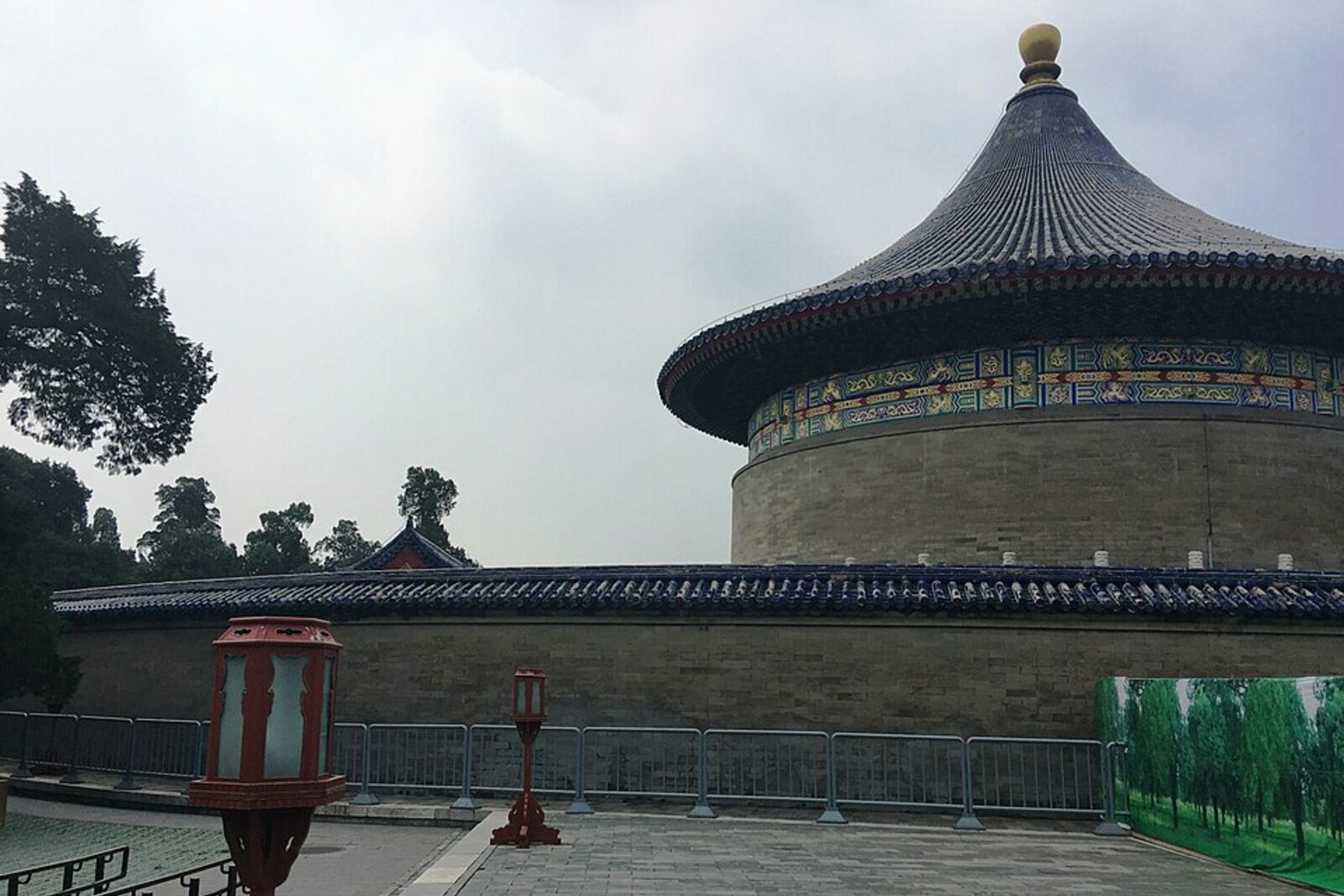
Look around first
What to notice
- Round hall
- Circular brick wall
- Tiled top of the wall
- Southern gate
The story of the place
In the winter of nineteen fourteen, attendants reopened the Imperial Vault of Heaven for a state ceremony. The monarchy in China had already ceased to exist for almost three years, yet the same sacred tablets that had once been carried out for emperors were to be taken from the round hall.
There were no statues here. The main tablet bore the title Huangtian Shangdi—the Supreme Lord of Heaven; tablets of the imperial ancestors were kept beside it. They were regarded as the place where those to whom sacrifices were offered were present. That is why the hall was built beside the Circular Mound Altar: for most of the year the tablets stood here, and before the winter solstice attendants carried them through the southern gate to the ceremony site. This is the purpose of the Imperial Vault of Heaven: it is the repository of the rite's principal sacred object.
Yuan Shikai, president of the young Republic of China, ordered the tablets returned to a state ceremony. He was seeking to turn his presidency into a hereditary monarchy. Yuan relied on the army and on the support of provincial military leaders; openly assuming the imperial role meant testing whether they would remain loyal to him.
New ritual garments were made for the ceremony. Officials were divided by rank, and a robe with twelve embroidered symbols was prepared for Yuan—this number was prescribed for the supreme ruler. On December twenty-third, attendants carried the tablets out of this courtyard and arranged them at the neighboring altar. Yuan offered sacrifice to Heaven as head of the republic, but the sequence of actions, the sacred objects, and his own costume were taken from the imperial ritual. Contemporaries needed no separate announcement to understand which title he was trying on.
A year later, Yuan accepted the throne offered to him and instituted a new imperial era. Several provincial commanders refused to recognize the monarchy and began a war in defense of the republic. Other supporters began to turn away from the president, and the troops could not quickly suppress the resistance. Less than three months later, Yuan revoked the new title. In June nineteen sixteen, he died without ever holding an imperial coronation. His sacrifice remained the last state rite for which the tablets were carried out of the Imperial Vault of Heaven.
The circular enclosure of this courtyard is now called the Echo Wall. It was built around the tablet repository; its ability to carry whispers arose from its nearly perfect circle, smooth masonry of tightly fitted bricks, and tiled top. A sound wave reflects repeatedly from the curve of the wall and loses little energy, so speech can reach a person far along the circumference.
In nineteen fourteen, sacred tablets passed through the southern gate for Yuan Shikai's ceremony. Now visitors pass through it, and their voices travel around the courtyard along the same circular masonry.
Useful on site
Paid central areas: 08:00–18:00 in high season, last entry 17:30; 08:00–17:00 in low season, last entry 16:30; closed on Mondays, except public holidays.
Checked: June 28, 2026. Check the official source before visiting.Test the acoustics only in a quiet voice and without expecting a guaranteed effect: wind and conversation easily drown out the reflections. Do not stand for long on the central paving stones if others are waiting behind you.