 Guide On Map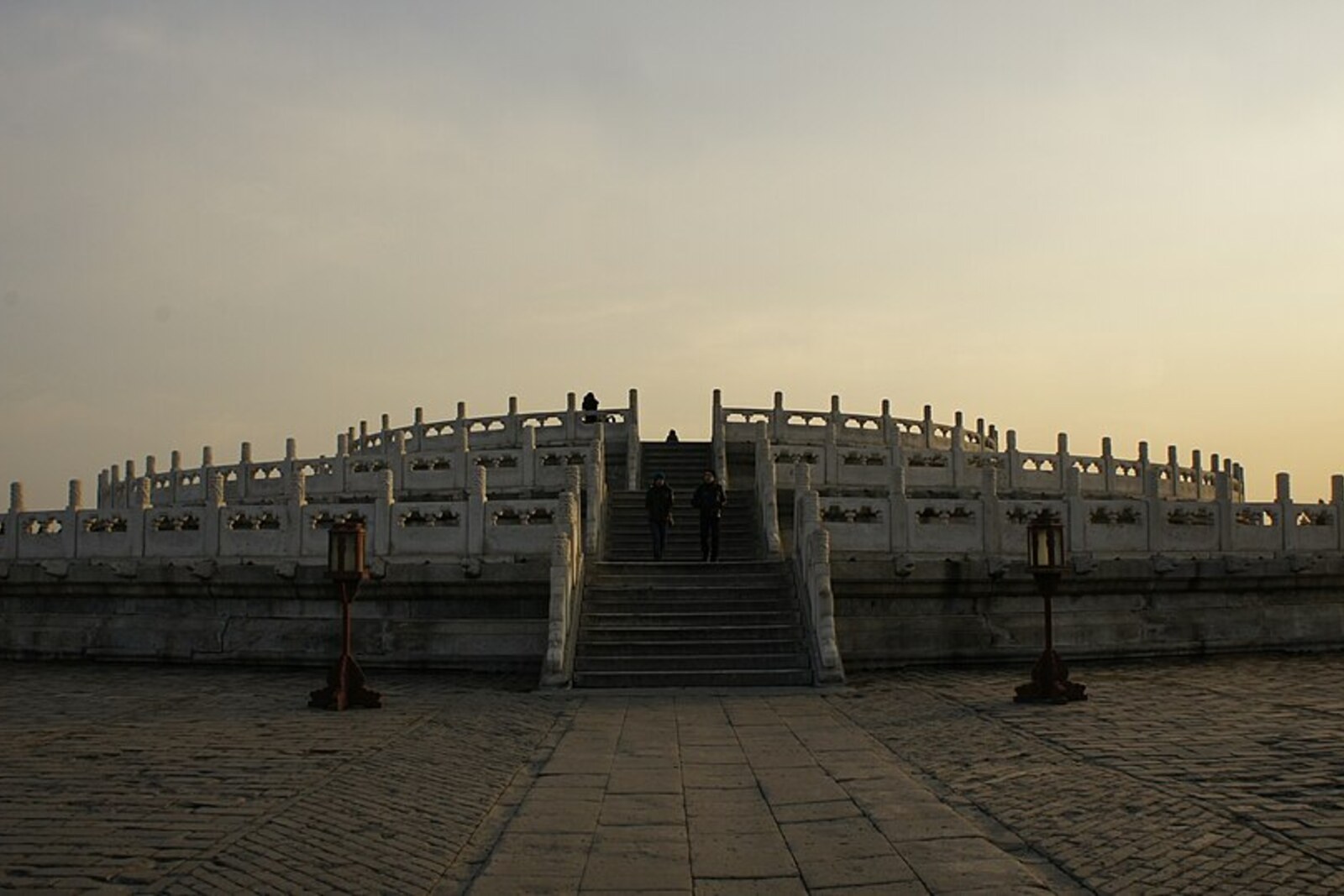
Look around first
What to notice
- Circular stone tiers
- Stone slabs
- White marble balustrade
- Top platform
The story of the place
In fifteen thirty, the imperial court divided the former joint rite for Heaven and Earth. A square altar was built for Earth in northern Beijing, while an open round terrace for Heaven was laid out south of the imperial palace. In winter, offerings of thanks were brought here. The circular stone tiers, slabs, and white marble enclosure belong to a later reconstruction: the top platform was enlarged because the former cramped terrace could no longer accommodate the offerings and participants in the ceremony.
In the spring of fifteen eighty-five, Beijing was suffering from a drought that had begun the previous winter. Officials had already performed the prescribed prayers, but no rain had come. The Wanli Emperor, sovereign of the Ming dynasty, decided to ask Heaven himself. The emperor was called the Son of Heaven, as the only person who addressed Heaven on behalf of all his subjects. If the disaster continued, courtiers could conclude that he was performing this duty poorly.
Wanli put on blue ceremonial robes and left the palace on foot. The emperor was usually carried in a palanquin or driven, but this time he refused both the palanquin and the horses. He was accompanied by two thousand civil officials and two thousand military officials. The entire procession walked from the imperial palace to the Circular Mound Altar.
Wanli climbed to the top platform. He performed bows, while the officials remained behind the circular enclosure and, as the rite proceeded, alternately stood and knelt. This arrangement explains the altar's emptiness better than any lost building could. No community assembled above, and no priests officiated in place of the sovereign. The emperor alone occupied the center and was personally responsible for the request for rain.
Less than a month later, rain really did come. The rite itself, of course, does not prove the cause of the change in weather. To Wanli and his court, the sequence looked unambiguous: the request had been heard. The emperor ordered a thanksgiving ceremony to be held.
A separate altar for such an appeal appeared here in fifteen thirty. Before that, sacrifices to Heaven and Earth were offered jointly. The Jiajing Emperor ordered the rites divided: a square altar was built for Earth in northern Beijing, and a round open terrace for Heaven south of the palace. Hence the literal name: Circular Mound Altar. At the winter solstice, people came here to thank Heaven, and during droughts, to ask for rain.
Wanli stood at the same center, but the present stones appeared later. In seventeen fifty, the Qianlong Emperor ordered the cramped platform enlarged, as there was no longer enough room for offerings and participants in the ceremony. The work was completed three years later: the blue glazed cladding was replaced with stone slabs and a white marble balustrade. The higher, narrower terrace on which Wanli asked for rain has not survived.
Useful on site
Paid central zones: 08:00–18:00 in high season, last entry 17:30; 08:00–17:00 in low season, last entry 16:30; closed Mondays except public holidays.
Checked: June 28, 2026. Check the official source before visiting.The central slab usually attracts a line, but it is easier to listen to the story near the edge of the upper terrace. The stone is exposed to sun, wind, and rain, so do not count on a long stop in bad weather.