 Guide On Map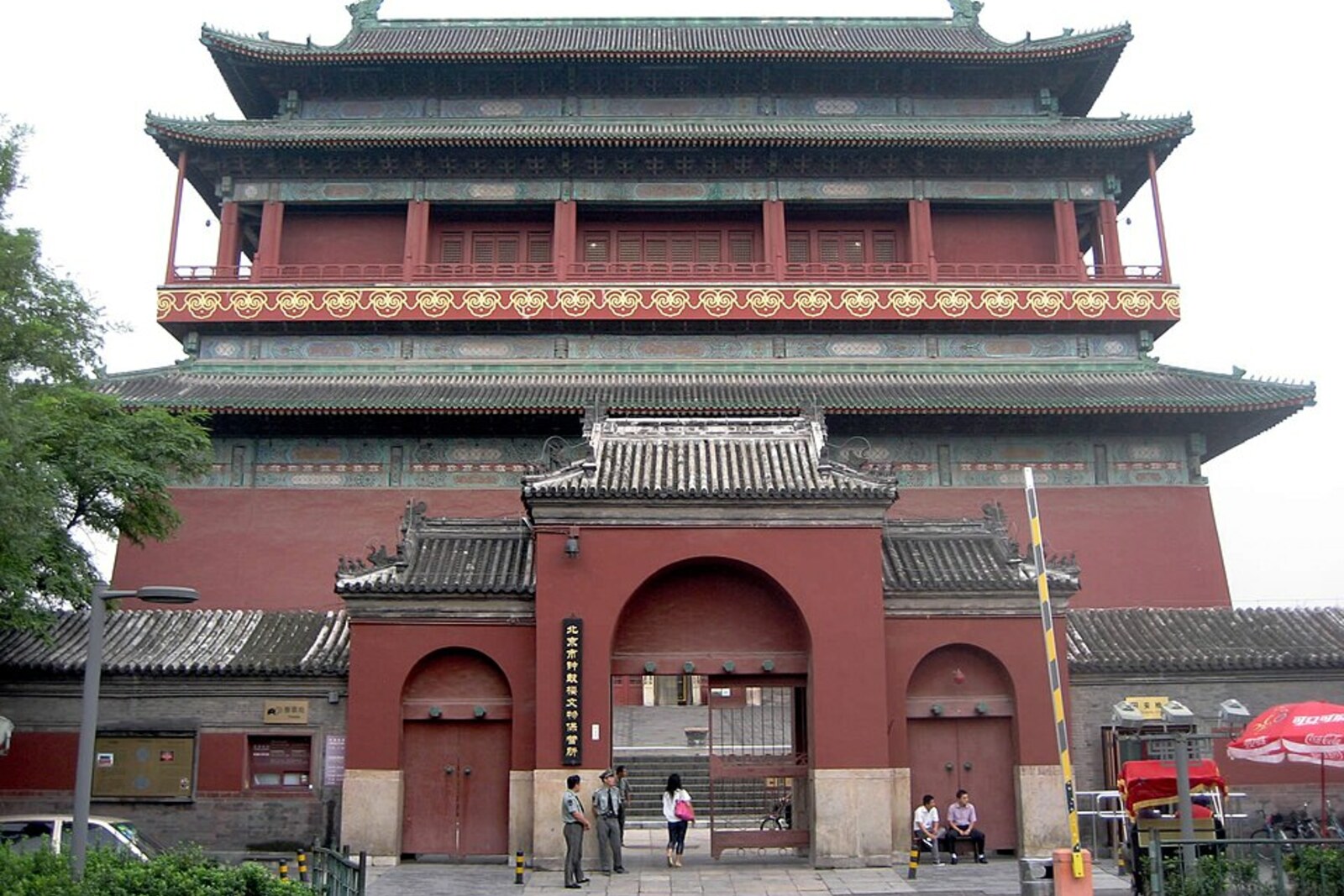
Look around first
What to notice
- Brick arched passageways
- The authentic main drum
- A row of twenty-five drums
The story of the place
Beijing’s nighttime order was once set from the upper level. Court attendants checked the hour by a water mechanism, later by incense sticks, and sounded one hundred eight strikes. The neighboring Bell Tower (Zhonglou) took up the signal, after which the gates were closed and movement through the streets was forbidden. The arched passageways in the brick base lead beneath the upper rooms, where a row of twenty-five drums made for performances from old descriptions stands.
In nineteen hundred, the Eight-Nation Alliance captured Beijing after the siege of the Beijing Legation Quarter. Soldiers also reached the upper level of Drum Tower (Gulou). The city’s time was kept here: one main drum and twenty-four smaller ones. Only the main drum survived from the old set. The official account links the cuts in its skin to that sacking, although researchers of old photographs debate when all the damage appeared. The sacking of the tower itself is documented.
The drums were operated by attendants of the imperial court. They measured the nighttime hours, first with water clocks and later with special incense sticks. At the appointed moment, they struck one hundred eight times; then the bell in the neighboring tower answered. After the evening signal, the city gates were locked and movement through the streets was forbidden. Drum Tower (Gulou) announced the time to all of Beijing at once, which is why it stood above the low houses at the northern end of the city’s main axis.
After the fall of the empire, this service lasted for several more years. In nineteen twenty-four, the last emperor, Puyi, was expelled from the Forbidden City, official time began to be kept by modern clocks, and the drummers stopped climbing upstairs.
Then Xue Dubi, head of a district in the capital and a member of a public education society, took up the abandoned tower. He wanted to educate city residents who could not attend an ordinary school. Contemporaries called Beijing a cultural capital, but many of its residents remained illiterate. In his own memoir, Xue recalled passing beneath the weathered Drum Tower (Gulou) and deciding both to change its name and to find it a new purpose.
First, he named the upper level Mingchilou—“Tower of Awareness of Humiliation.” Photographs, objects, and models connected with the capture of Beijing in nineteen hundred were displayed there, along with tables of foreign loans, indemnities, and treaties forced upon China. The name directly explained the exhibition’s content: Xue wanted visitors to know what a defeat the invasion had proved to be for the country.
The following spring, he asked the Ministry of the Interior to transfer both towers to an educational institution. The city treasury lacked funds, so a group appointed by Xue raised money from the financial and transportation departments, the military, and private donors. Five months later, on October fourth, nineteen twenty-five, Beijing’s first public education center opened here.
The brick arched passageways at the base of Drum Tower (Gulou) were enclosed with glass and divided by purpose. More than six hundred chairs, a projection lantern, and a gramophone were placed in the central hall: public lectures were held there on Saturdays. The eastern section held about three thousand books and separate reading places for women and children. The western section displayed minerals, agricultural products, physics instruments, and a model of a human skeleton. In one of the passageways, an office operated where an illiterate visitor could have a document read to them or get help writing a letter.
On holidays, there were not enough seats. Areas for children and adults were laid out between the two towers, and later a market and a movie theater opened. The education center held literacy classes, exhibitions, and lectures, and similar institutions appeared in other districts of Beijing following its example.
This work also shaped the organization’s later fate. In the nineteen thirties, its staff organized performances and exhibitions against the Japanese occupation of Manchuria. After Beijing was captured, the Japanese administration changed the institution’s name and destroyed more than four thousand books and over three hundred exhibits. In nineteen forty-two, the center closed. After the war ended, city educators restored reading rooms, classrooms, and museum collections here; a cultural center occupied Drum Tower (Gulou) until nineteen eighty-three.
The current row of twenty-five drums was made from old descriptions for demonstration performances. The only authentic main drum is displayed separately. And in the brick base, the very same arched passageways have survived, where a person unable to write could ask to have a letter composed for them.
Useful on site
Daily 09:30–17:30 (26 April–25 October, last entry at 17:20) and 09:30–16:30 (26 October–25 April, last entry at 16:20).
Checked: June 28, 2026. Check the official source before visiting.From outside, take in the tower’s height and its position above the hutongs. If you go inside, take your time at the drums and assess the climb against your own fitness in advance.