 Guide On Map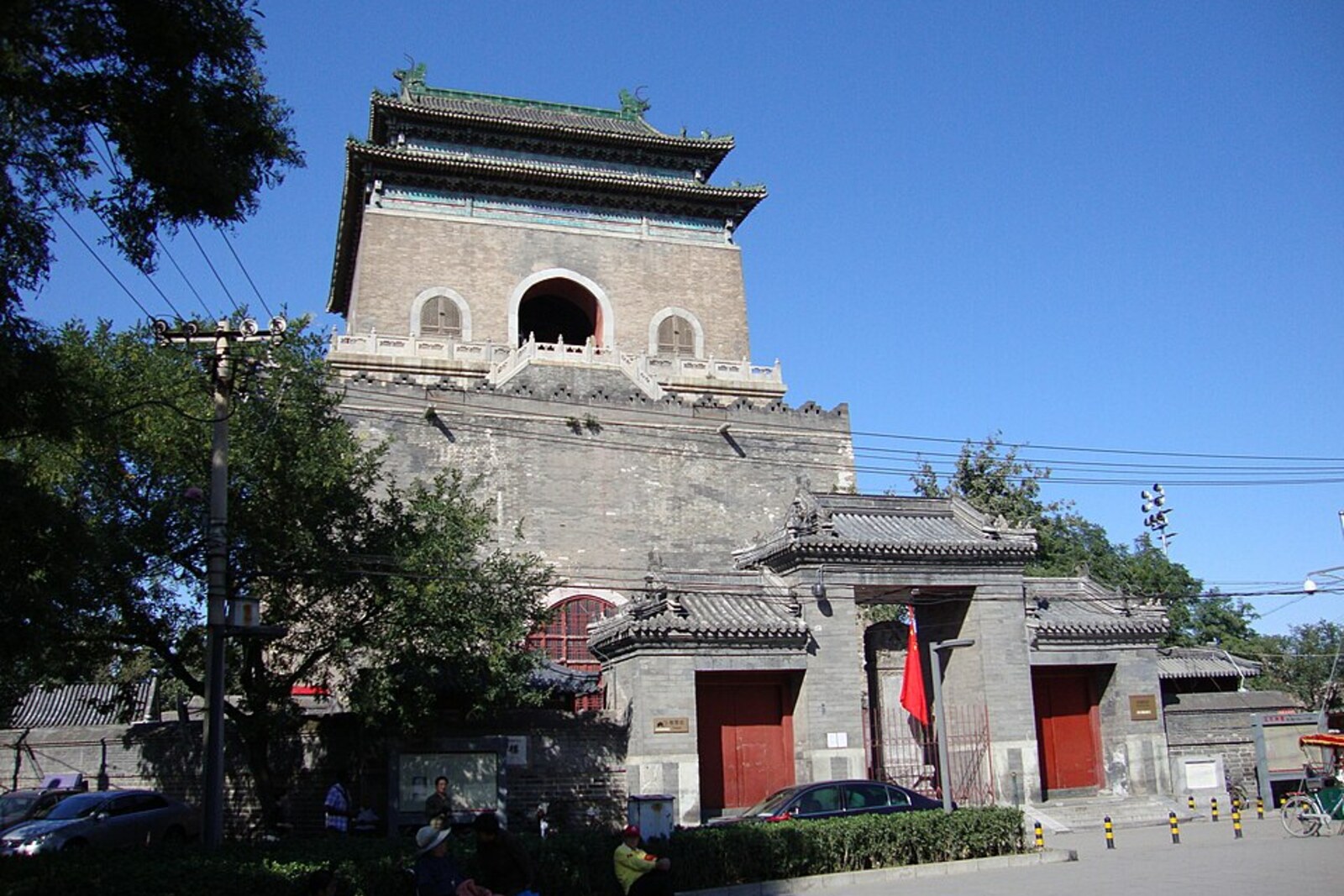
Look around first
What to notice
- Gray brick tower
- Large bronze bell
- Suspended striking log
- Octagonal frame
The story of the place
The gray silhouette of Bell Tower (Zhonglou) stands beside the more ornate Drum Tower (Gulou): its current walls are laid in brick and stone, including details that were once usually made of wood. This is how the tower was rebuilt after the fire; the work was completed in seventeen forty-seven. Beneath an octagonal frame hangs a bronze bell, cast under the Yongle Emperor and weighing around sixty-three tons. A suspended log has been left beside it—part of the city's signal station.
Every evening, soldiers of the Imperial Ceremonial Guard climbed up here. They usually accompanied the sovereign on his outings and stood guard; duty at the towers was part of the same service by which they earned their living. At Bell Tower (Zhonglou), they were assigned to swing a suspended log and strike the rim of a huge bronze bell with it.
They did not begin by their own clocks. Court timekeepers watched a special calibrated candle, while attendants at the neighboring Drum Tower (Gulou) marked the start of each new night watch on the drums. Then Bell Tower (Zhonglou) answered. At seven in the evening, the soldiers made eighteen rapid strikes, eighteen slow ones, and another eighteen steady ones, then repeated the entire sequence. That made one hundred eight strikes—the number of the twelve months, twenty-four solar seasons, and seventy-two five-day periods of the traditional calendar.
The first strikes set actions in motion all across Beijing. The guards at the nine gates of the Inner City answered with their own bells or metal gongs and locked the heavy gate leaves. Patrolmen shut one thousand two hundred nineteen street gates and barriers. Markets stopped trading, residents locked their courtyards, and movement between neighborhoods came to a halt. Even an official courier was allowed out at night only after a written permit bearing a seal had been checked; for an urgent military assignment, the sentries recorded the courier's name. A late trader or traveler remained on the other side of the gates until morning.
During the second, third, and fourth night watches, the drums were silent, while the soldiers of Bell Tower (Zhonglou) marked the time again. The final sequence, around five in the morning, permitted the guards to open the city gates: markets began to gather, and officials set off for work. The name Zhonglou means precisely “Bell Tower.” It was the city's signal station, and its attendants set thousands of other people in motion with a single log.
A fire destroyed the old tower. The Qianlong Emperor, who needed to restore a unified night signal to Beijing, ordered it rebuilt in seventeen forty-five and ordered the wooden framework abandoned. Two years later, craftsmen completed the building in brick and stone; even details usually carved from wood were made of stone. That is why Bell Tower (Zhonglou) is grayer than the neighboring Drum Tower (Gulou) and survived the following centuries without another major fire. The bell itself is older than the current walls: it was cast under the Yongle Emperor and weighs around sixty-three tons.
After Puyi was expelled from the Forbidden City in nineteen twenty-four, the Imperial Ceremonial Guard was disbanded. For the soldiers of Bell Tower (Zhonglou), this meant the end of their service, and for the bell, the end of its daily work. It now remains a museum exhibit beneath an octagonal frame. Both the bell and the suspended striking log beside it are still in place; gone are the people who operated it, the nine city gates, and the one thousand two hundred nineteen neighborhood barriers that were shut after the first strike.
Useful on site
Daily 09:30–17:30 (April 26–October 25, last admission at 17:20) and 09:30–16:30 (October 26–April 25, last admission at 16:20).
Checked: June 28, 2026. Check the official source before visiting.The resonator's complete arrangement is clear only from inside, but the massive stone body is easy to make out from the square as well. Do not stand in the way while looking at the upper tiers.