 Guide On Map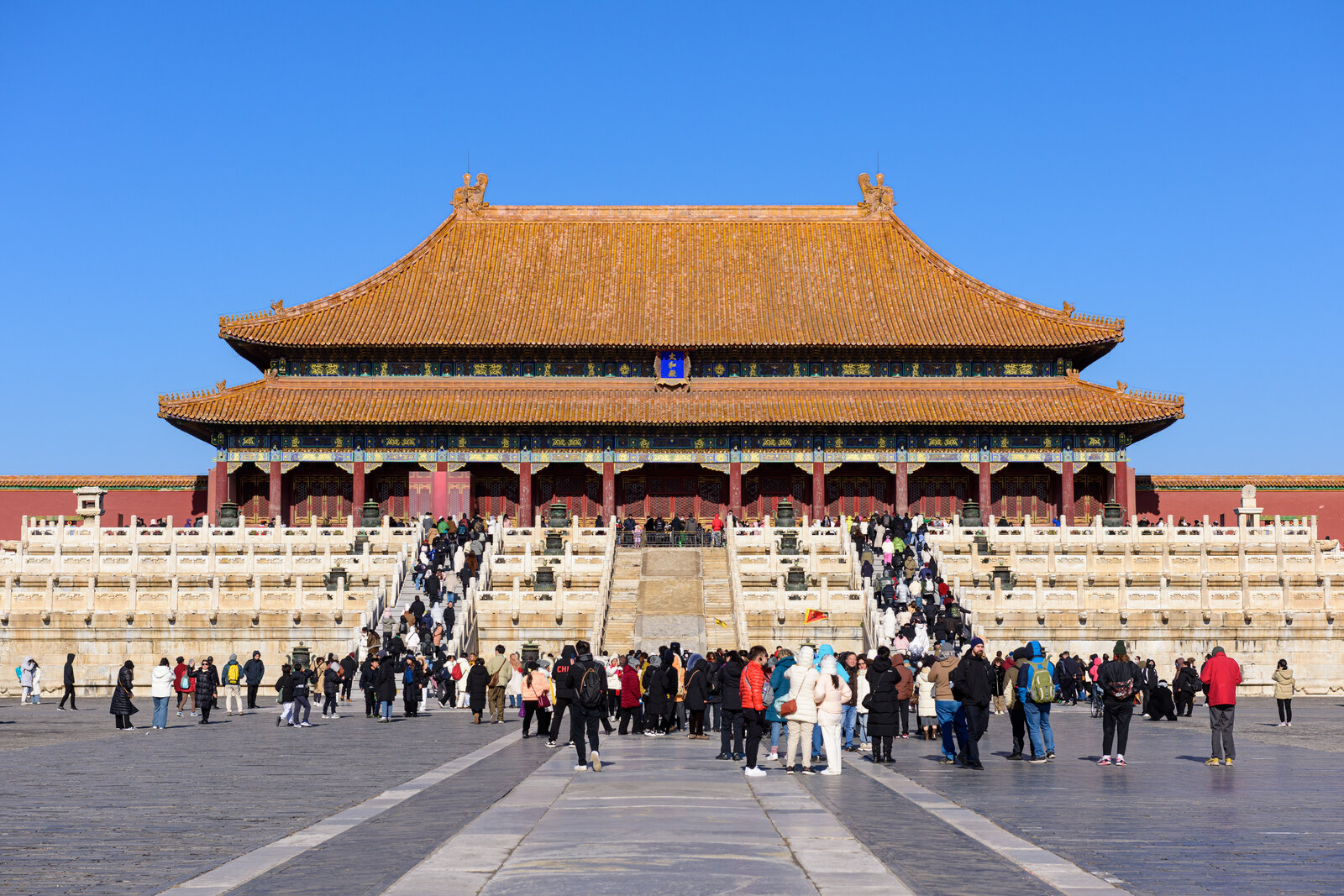
Look around first
What to notice
- Three-tiered marble terrace
- Golden dragon throne
- Large ceremonial courtyard
- Hall of Supreme Harmony
The story of the place
On a three-tiered marble terrace above a huge ceremonial courtyard stands the Forbidden City's main ceremonial hall. Deep inside, a gilded dragon throne survives, made under the Ming dynasty and later used by the Qing dynasty. The hall doors were thrown open only when the court needed to publicly affirm the order of power: at a change of ruler, the appointment of an empress, and the great festivals of the annual cycle. Rank also determined each person's place in the courtyard, so the entire space from the terrace to the gates became part of the rite.
On the evening of November thirteenth, nineteen oh eight, officials arrived from the Forbidden City with an order for Prince Chun Zaifeng. The dying Dowager Empress Cixi had ordered his eldest son, Puyi, to be taken to the palace. Emperor Guangxu had no children, and Cixi chose the boy as his successor. Puyi was two years and ten months old. The prince had to give his son to the court and then become regent, ruling the country in the child's name. Of those close to Puyi, only his wet nurse was allowed to go with him.
Guangxu died the next day, and Cixi the day after that. On December second, Zaifeng carried his son into the Hall of Supreme Harmony and seated him on the dragon throne. A Chinese emperor was not crowned: the central act was the enthronement itself and the homage of high officials. Everyday affairs were handled in other palace rooms. This hall was opened for an emperor's accession, the appointment of an empress, and congratulations on the most important days of the calendar.
The words “Supreme Harmony” come from the Book of Changes and mean the concord of the world order. During the ceremony, this was represented by the arrangement of people: the closest relatives and the highest-ranking officials stood by the hall, while everyone else filled the courtyard in strict order of rank. Above them, on a three-tiered marble terrace, sat the emperor. That day, the person up there was a child who had only recently lived with his parents and did not understand why hundreds of adults were kneeling before him.
Many years later, Puyi recalled that the ceremony was long and that the throne seemed enormous. He fidgeted, cried, and repeated, “I don't like it here. I want to go home.” Zaifeng knelt beside the throne, supported his son, and tried to bring the rite to an end. “Be patient, it will all be over soon,” he urged him. The courtiers heard these words and, after the ceremony, whispered that the prince had uttered an ill omen. Puyi himself later confirmed both his father's words and this whispering among the officials.
The cause of what happened next lay beyond the ceremony. In the autumn of nineteen eleven, the Xinhai Revolution began, the court lost control of many provinces, and Zaifeng resigned his powers as regent. When he returned home, he told his family that he would finally be able to devote himself to his children. Puyi did not return with him.
On February twelfth, nineteen twelve, the Dowager Empress Longyu, who had become regent, issued an abdication decree in the name of six-year-old Puyi. In return, the family was guaranteed that it would retain its titles and be allowed to live in the palace. The boy was left in the northern residential quarters, while the ceremonial southern part of the Forbidden City, including the Hall of Supreme Harmony, was handed over to republican institutions. In nineteen twenty-four, Puyi was removed from the residential half as well.
Inside the hall stands a golden dragon throne, made under the Ming dynasty and used by Qing dynasty emperors. It was on this very throne that, on December second, nineteen oh eight, his father seated the weeping Puyi. After the abdication, the boy was allowed to remain beyond the northern gates of the palace complex; he was no longer allowed to return here as emperor.
Useful on site
According to the Palace Museum schedule: high season 08:30–17:00, last entry 16:00; low season 08:30–16:30, last entry 15:30; closed on Mondays except public holidays.
Checked: June 28, 2026. Check the official source before visiting.Do not rush straight to the doors: the overall design is easier to see from a distance, where the terraces, the axis, and the scale of the courtyard can be read. Near the façade, make room for those looking at the interior.