 Guide On Map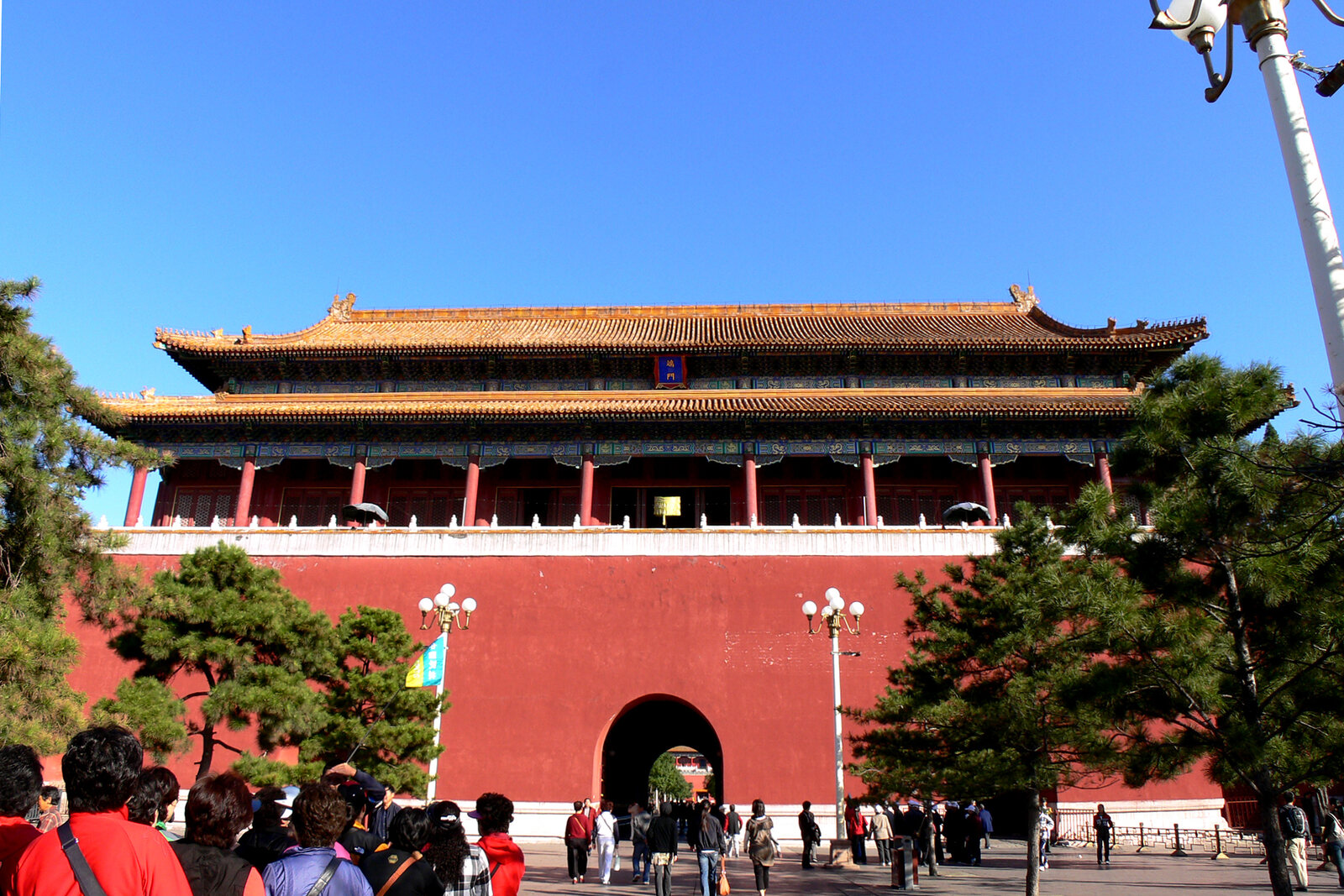
Look around first
What to notice
- Duanmen Gate
- The straight road to Meridian Gate
- Meridian Gate
- The open square in front of Meridian Gate
The story of the place
A straight palace axis runs between Duanmen Gate and Meridian Gate, and at the second gate the road opens onto an open square. Beyond Meridian Gate are the inner courtyards and Zuoshuimen Gate, now Xihemen Gate. Here court ceremonies and punishment were separated: participants in audiences remained inside, while those convicted were brought outside and beaten with heavy sticks.
Beyond Duanmen Gate, the road did not turn into an empty ceremonial courtyard. Along it stood the premises of ministries, censors, and other officials. Here they waited for admission, gathered before audiences, and passed on reports. Duanmen Gate means “Gate of Proper Order.” The next gate, Meridian Gate, was the main southern entrance to the Forbidden City. The word “wu” meant noon and, in the old system of directions, south—hence the translation “Meridian Gate.”
In the summer of fifteen twenty-four, Yang Shen, an official of the Hanlin Academy, finished the morning audience but did not leave the palace. He led more than two hundred high-ranking officials to Zuoshuimen Gate, in the courtyard beyond Meridian Gate. Yang Shen drafted state documents, taught the emperor the classical books, and received a salary for service at court. Earlier, he had taken first place in the highest state examination. Now he was preparing to put his position, income, and his own body at risk.
The dispute had begun three years earlier, when the Zhengde emperor died without leaving a son. His fourteen-year-old cousin Zhu Houcong inherited the throne and entered history as the Jiajing emperor. The order of succession required him to recognize himself as the adopted son of his late uncle, the Hongzhi emperor. Then the new ruler would occupy a place in the direct dynastic line, while honoring his own late father, the Prince of Xing, as a relative of the imperial house.
Jiajing insisted that he would not renounce his father. He wanted to call him imperial father and posthumously raise him to the rank of emperor. For the court, the dispute over kinship titles determined whose son the ruler was as he occupied the throne and what rule justified his accession. Grand Secretary Yang Tinghe, Yang Shen's father and the organizer of the transfer of the throne, demanded that the former order be preserved. After three years of resistance, he lost his office.
When Jiajing ordered the new titles for his parents to be confirmed, Yang Shen assembled officials at Zuoshuimen Gate. They knelt and demanded that the decree be revoked. Twice, orders came from the palace to disperse. After the first eight participants were arrested, the rest began striking the gate leaves and calling on the late emperors as witnesses to the violation of the established order. Jiajing then ordered another one hundred thirty-four people taken into custody.
Five days later, lower-ranking officials were brought to the square in front of Meridian Gate. Court flogging was carried out here: those convicted were beaten with heavy sticks. The usual account of executions at Meridian Gate is inaccurate—there was no permanent place for decapitations here. But seventeen people died from the blows after this dispute.
Yang Shen survived two floggings. He was stripped of his office and exiled to the Yongchang Garrison in the distant southwest. The sentence remained in force for thirty-five years, until his death. Jiajing got his way: his birth father was recognized as emperor, and Hongzhi came to be regarded as his imperial uncle.
Zuoshuimen Gate, where the officials began their protest, stands beyond Meridian Gate and is now called Xihemen Gate. The punishment was carried out on this side of the gate, on the open approach from Duanmen Gate. The kneeling high-ranking officials remained inside the Forbidden City; they were brought outside for the flogging.
Useful on site
Access to Meridian Gate depends on a Palace Museum ticket: high season 08:30–17:00, last entry 16:00; low season 08:30–16:30, last entry 15:30. The museum is closed on Mondays except public holidays, and same-day tickets are not sold.
Checked: June 28, 2026. Check the official source before visiting.Stand slightly aside from the flow and compare the central passage with the side passages. Entry to the Palace Museum is checked separately; without it, you cannot continue the route through Meridian Gate.