 Guide On Map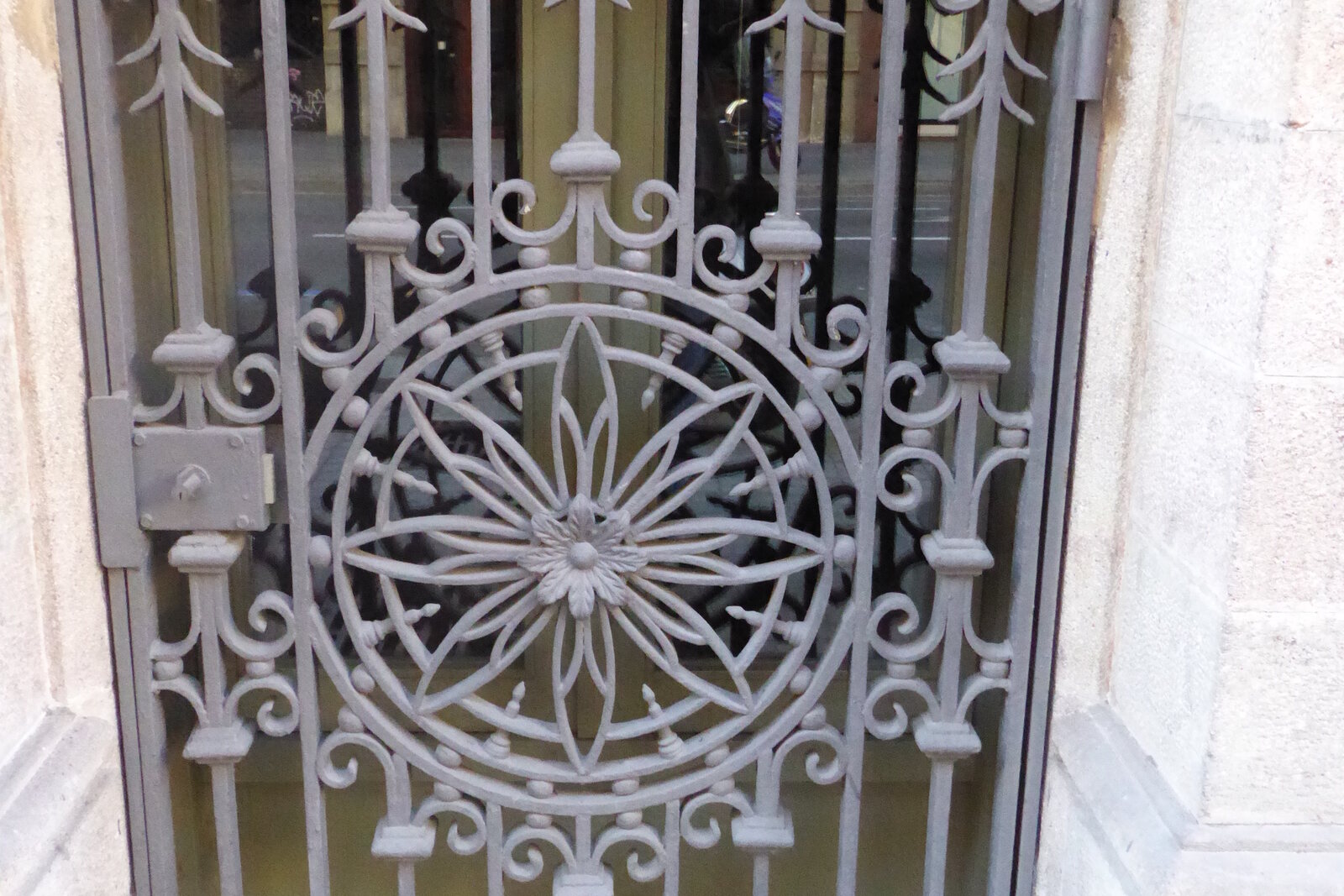
Look around first
What to notice
- Coat of arms beneath a helmet
- Relief date
- Figures of Saint George and Archangel Michael
- Through-passage
The story of the place
The former formal rooms are now occupied by the Institut Ramon Llull, which promotes Catalan language and culture outside Catalonia. The gates on Avinguda Diagonal let you pass through the entire house and emerge on Carrer de Rosselló; carriages once drove this way to the stone staircase. On the stone above the gates remain a shield with a helmet, a relief date, Saint George with the dragon, and Archangel Michael. On the Avinguda Diagonal side, the façade appeared where the old building had had a garden, while on Carrer de Rosselló the house ends much more modestly.
In nineteen hundred, Maria Christina of Austria, the queen regent who ruled in place of the underage Alfonso XIII, granted the industrialist Manuel de Quadras i Feliu the title of Baron of Quadras. The decree specified that the name was given in memory of an old barony that had once existed in his family. Legally, however, the title was created anew—for Manuel, his children, and his lawful heirs.
The new baron earned his living from producing worsted-wool yarn. Together with his brother, he continued his father's business; their father had owned a factory in Sabadell. Manuel also inherited from his father an income-producing apartment building on Carrer de Rosselló: a principal floor for the owners, apartments above for tenants, and a garden behind it opening onto Avinguda Diagonal. This was the house that had to be brought into line with the new title.
In nineteen hundred two, Manuel commissioned Josep Puig i Cadafalch to remodel it. The architect had already redesigned a country estate for him, and the client knew what result he would get. The old walls were kept, but the arrangement of the house changed. The Quadras family occupied the formal floor, the upper apartments continued to bring in income, and the garden on the Avinguda Diagonal side gave way to a new façade.
Puig i Cadafalch moved the grand entrance here. On the ground floor, he created a carriage passage between the two streets and led it to a stone staircase. The rooms facing Avinguda Diagonal were intended for receptions; the family rooms faced Carrer de Rosselló. Thus, the baron could receive guests from the side of the new prestigious avenue without giving up the arrangement of an income-producing apartment building.
On the stone gallery, sculptors carved the coat of arms of the Barony of Quadras beneath a helmet. Its four quarters represented the Quadras, Feliu, Prim, and Coma families; alongside it appeared a relief date—nineteen hundred four. Medieval figures, Saint George with the dragon and Archangel Michael, surrounded the family emblem. The document granting the title acquired here a façade, a staircase, and separate rooms for the baron's public life.
The Quadras family used the house until nineteen seventy-two, when they sold it to the municipal government. The former reception rooms now house the Institut Ramon Llull, an institution that promotes Catalan language and culture abroad.
Above the gates on Avinguda Diagonal, the first baron's coat of arms and the carved date remain. The through-passage still leads to another door on Carrer de Rosselló, where the same house ends in the much more restrained façade of the former income-producing building.
Useful on site
The interior of Palau Baró de Quadras is accessible only through limited guided-tour slots; check the current city/ticket page before your visit.
Checked: June 28, 2026. Check the official source before visiting.The main idea of this stop is to compare the building's two sides. A cultural institution operates inside, so do not expect unrestricted access to the rooms without a separately announced visit format.