 Guide On Map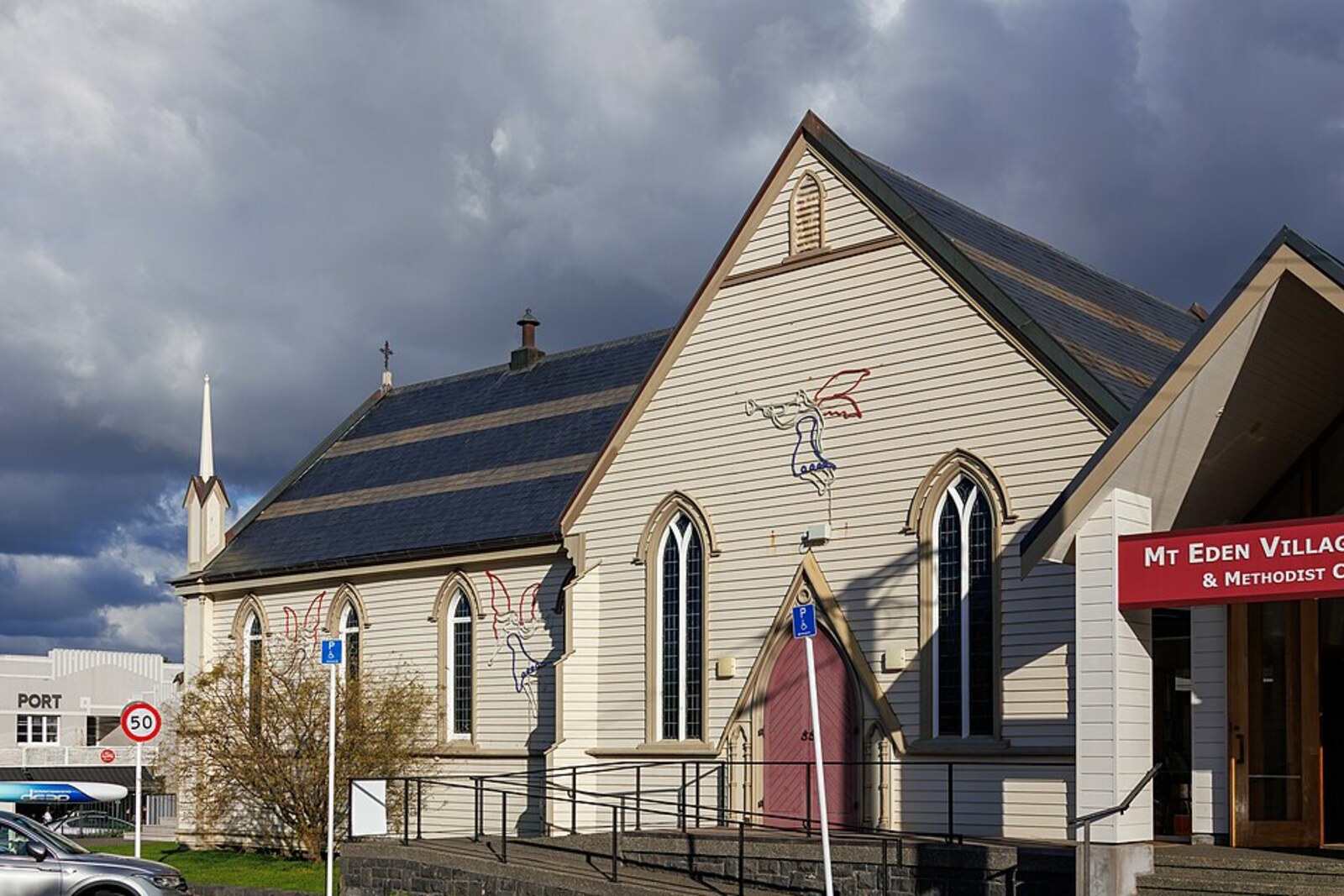
Look around first
What to notice
- The name “Cucksey” on the facade
- The date “1873” on the facade
- The brick row of shops
- The wooden church
The story of the place
The brick row of shops and the wooden church stand almost side by side here, and both buildings long drew a new residential district around them. The shops sold groceries and fuel, people collected mail and used a telephone, while the church had a worship hall and a Sunday school. When it became difficult for the congregation to maintain the buildings, the city paid for their restoration in exchange for regular community use of the premises. Services are still held in the church, while concerts, classes, and residents’ meetings now take place next door.
The name “Cucksey” and the date—eighteen seventy-three—remain on the facade of the corner row of shops. They mark the beginning of Alfred Cucksey’s trade in central Auckland. The current brick building at the corner of Mt Eden Road and Stokes Road appeared much later.
Cucksey was a grocer: his income depended on families buying groceries on credit and regularly. In eighteen eighty-one, he closed his shop on Wakefield Street, bought this site, and moved his trade to a suburb where farmland was just being divided into housing plots. He promised customers city prices, home delivery, and goods without substitutions in quality; he also sold coal and firewood from Mt Eden station.
Cucksey then made his shop a place that the neighbors found hard to do without. By eighteen eighty-five, a post office had opened here. Cucksey led the local campaign for a publicly accessible telephone, and in June eighteen eighty-six a telephone point was installed right in the shop. People came to a single counter for groceries, mail, fuel, and the chance to make a call. Advertisements began describing addresses as “next to Cucksey’s shop,” and the intersection acquired the name “Cucksey’s Corner.”
In nineteen oh five, the old wooden shop was replaced by five brick commercial premises. Cucksey soon retired from business, but until his death in nineteen twenty-two he lived nearby and remained the owner of this row. The date on the facade outlasted the wooden shop: eighteen seventy-three refers to Cucksey’s business, while the bricks in front of you date from about nineteen oh six.
A few shop windows away stands the Methodist church. Methodists are a Protestant congregation; in eighteen ninety-eight they bought the site at the corner of Ngauruhoe Street. Forty people attended a meeting about the construction. They began raising money, and by February nineteen hundred they had a wooden church with two hundred seats and a room for Sunday school.
Nearly a century later, the congregation decided to save its work by the same means visible in Cucksey’s building—income from shops. The congregation had dwindled, and its contributions were no longer enough to support both the buildings and the pastor’s ministry. The old church was to be removed and replaced with a building containing three shops downstairs and a worship hall upstairs. In two thousand three, the project even received court approval.
Residents wanted to preserve the wooden church, and in two thousand four the city offered the congregation another arrangement: money for restoration in exchange for regular community use of the premises. The congregation agreed. A trust created in two thousand eight brought together representatives of the church, the local community, and the city; in two thousand ten, the church was restored and connected to the Sunday school hall by a new foyer. Services are still held in the wooden building, while the neighboring premises now host concerts, classes, and residents’ meetings.
Useful on site
Open street; Village Centre, church, café, and shop hours vary.
Checked: June 28, 2026. Check the official source before visiting.Listen from the sidewalk and cross roads only at marked crossings.