 Guide On Map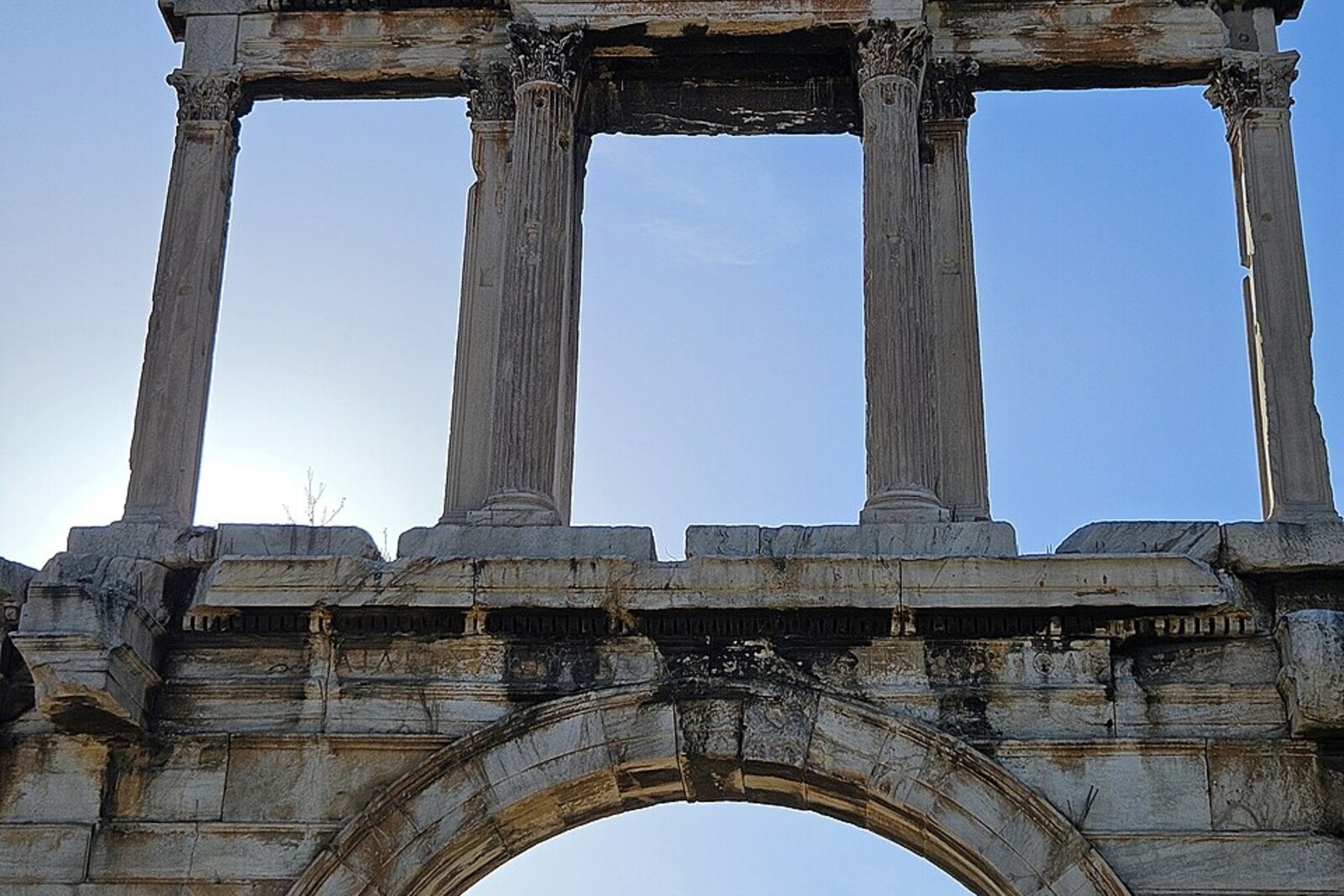
Look around first
What to notice
- Inscription on the Acropolis-facing side
- Inscription on the Temple-facing side
- Arch opening
The story of the place
A road passed through the stone opening toward the Temple of Olympian Zeus, and on the day of the great consecration a ceremonial procession went along it. The arch is often mistaken for the boundary between the old and new parts of Athens, although the actual city gates and the line of the ancient wall stood roughly one hundred meters to the east. Buildings paid for by the Roman emperor stood on both sides of the arch, so the stone did not divide the city into two districts. Different sides of the arch face the Temple and the Acropolis.
The Athenians themselves commissioned this arch and carved on it a phrase that set aside their former founder. On the side facing the Acropolis, it reads: “This is Athens, the former city of Theseus.” On the opposite side: “This is the city of Hadrian, and not of Theseus.”
Theseus here is the legendary king whom Athenian tradition credited with uniting the communities of Attica around Athens. Hadrian was a Roman emperor who sought to give the city the role of center of the Greek world within the Roman Empire. By the time the arch was erected, he had already been an Athenian citizen for about twenty years and had served in the honorary office of archon. After ascending the throne, at the Athenians' request, he changed the city's laws, paid for a library and a gymnasium, and began construction of an aqueduct.
The culmination came in the year one hundred thirty-two. Hadrian came to consecrate the Temple of Olympian Zeus and founded the Panhellenion, an association of selected Greek cities with its headquarters in Athens. Participation in the association gave cities access to the emperor and a place of honor among their neighbors; Athens received delegations, celebrations, and its former importance as a shared center. In gratitude, the citizens erected statues and altars to Hadrian, named a new civic tribe—a grouping of citizens—after him, and built the arch over the road along which the ceremonial procession went to the temple.
For the inscriptions, the Athenians drew on a story from the legend of Theseus. According to Plutarch, the king set up a boundary marker on the Isthmus of Corinth: one side stated that the Peloponnese was here, the other that Ionia was here. The arch's creators repeated the arrangement of this inscription, but named two founders instead of two lands. Theseus united Attica in legend; Hadrian renewed the city with money, construction projects, and a new association.
That is why the familiar explanation of the arch as a gate between the old and new districts is not quite right. Archaeologists found the line of an ancient wall and actual city gates roughly one hundred meters to the east. Buildings paid for by Hadrian stood throughout the city. Here, a road led to the site of the great consecration, and the two sides of the arch divided times rather than districts: first the city of Theseus, now the city of Hadrian, its benefactor.
The legendary marker of Theseus on the Isthmus of Corinth disappeared in antiquity. Its two-sided formula remained here—in the lines with which the Athenians repaid the Roman emperor for a renewed Athens.
Useful on site
An outdoor city monument by the road; no separate ticket is required.
Checked: June 28, 2026. Check the official source before visiting.View the arch from the sidewalk, and do not step into the roadway for a photograph; the inscriptions are easier to make out in side light.