 Guide On Map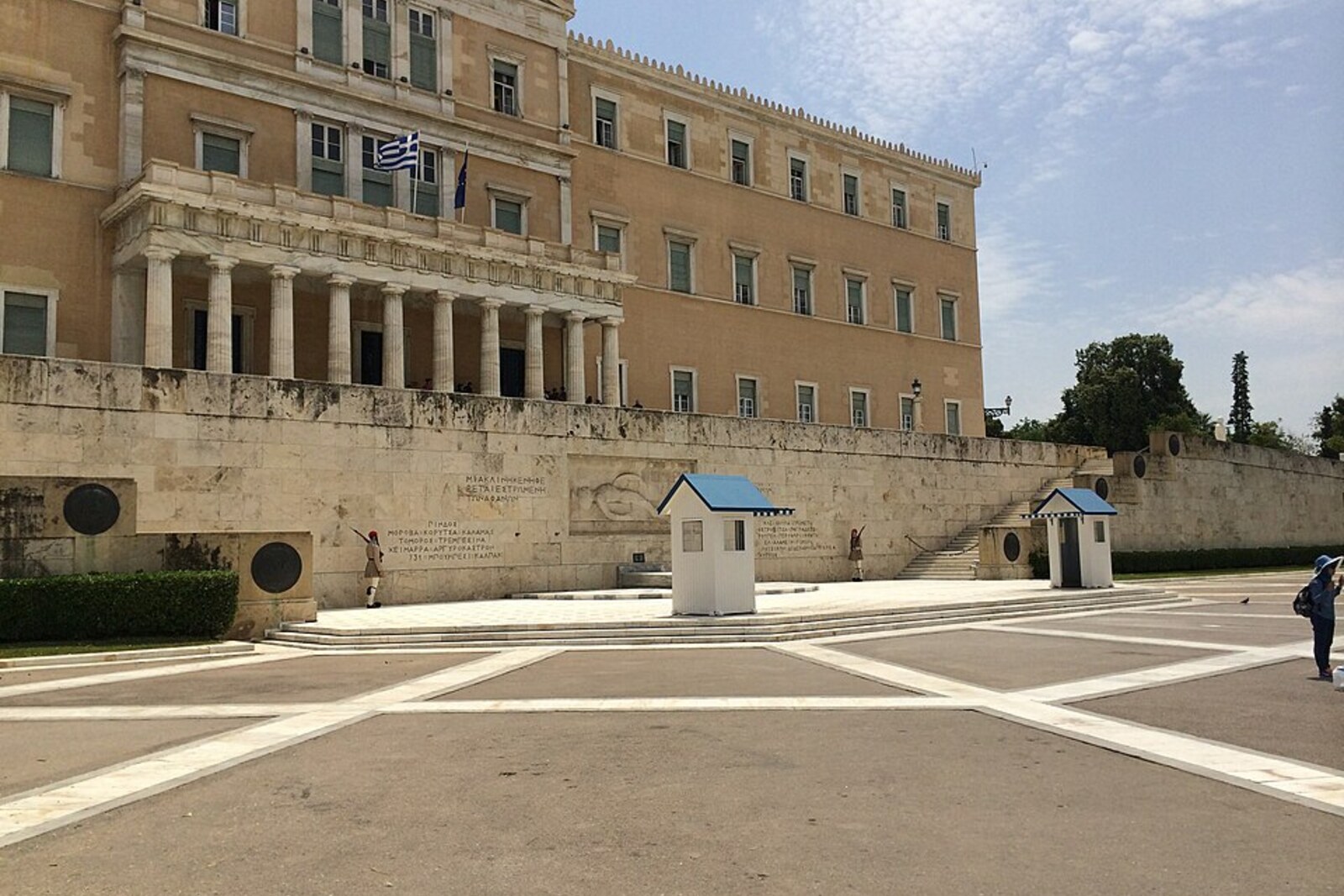
Look around first
What to notice
- Relief of the reclining warrior
- Names of battles
- Stone retaining wall
- Evzones
The story of the place
Evzones stand guard before an empty tomb. There are no remains of a specific soldier beneath the slab: it is a cenotaph, a collective memorial to the fallen whose bodies were not found or could not be identified. Carved on the wall are words by the ancient Athenian historian Thucydides: during funerals for the fallen, a separate empty bier was carried for the missing. That is why the reclining warrior has neither a portrait face nor a name. The names here belong to battle sites.
The memorial came to stand before the Hellenic Parliament because of a dispute over who should receive the former royal building. In nineteen twenty-six, General Theodoros Pangalos, who had established a dictatorship in the country, intended to house the Ministry of War in the Old Royal Palace. He needed a ceremonial facade for the new institution, and he announced a competition for the Tomb of the Unknown Soldier right here, on Syntagma Square.
The choice met with resistance. Architects and publicists proposed the Acropolis, Kerameikos, and the Panathenaic Stadium—places where the memorial could be given quiet. In front of the Old Royal Palace, the composition would have been different: a Ministry of War, a vast space for ceremonies, and a stone wall with a fallen warrior. To argue with Pangalos meant opposing the head of the dictatorship, but he did not have time to carry out the plan. In August of that same year, the general was overthrown and imprisoned on Crete. The ministry did not move into the palace, and work stopped.
Three years later, Prime Minister Eleftherios Venizelos made the decision. He needed to find a permanent home for the Hellenic Parliament and the senate. He could have moved the unfinished memorial, but he left it in the location chosen by Pangalos and personally assumed responsibility for its construction. In the autumn of nineteen twenty-nine, Venizelos's government handed the Old Royal Palace over to the Hellenic Parliament.
The winner of the competition, architect Emmanouil Lazaridis, cut away about seven meters of the slope in front of the building. He created a level ceremonial platform and built a U-shaped retaining wall almost up to the level of the palace floors. At the center of the wall appeared a relief of a fallen warrior in an ancient Greek helmet, with a shield beneath his arm. Names of battles from recent wars were carved on either side. Individual soldiers remained nameless, but the stone preserved the geography of their deaths.
The memorial was unveiled on March twenty-fifth, nineteen thirty-two. The Hellenic Parliament first convened in the building only on July first, nineteen thirty-five. Thus, the square Pangalos had envisioned in front of the Ministry of War ended differently: an assembly chamber stood above the stone wall, and before it was a place for state memorial ceremonies.
A company of Evzones took up this post as early as nineteen twenty-nine, when the memorial was still under construction. Now a pair of guards changes every hour; on Sundays at eleven in the morning, a large unit of the Presidential Guard arrives here with a band. During official memorial ceremonies, wreaths are laid at the slab. The Evzones stand here for the fallen, though the Hellenic Parliament is behind them: the guard at the Tomb of the Unknown Soldier appeared six years before deputies began meeting in the former royal palace.
Useful on site
Exterior viewing daily; guard change every hour, large ceremony Sun 11:00; interiors only by program/appointment.
Checked: June 28, 2026. Check the official source before visiting.Do not step onto the ceremonial platform or obstruct the guards' route; the interior of the Hellenic Parliament is not required for this stop.