 Guide On Map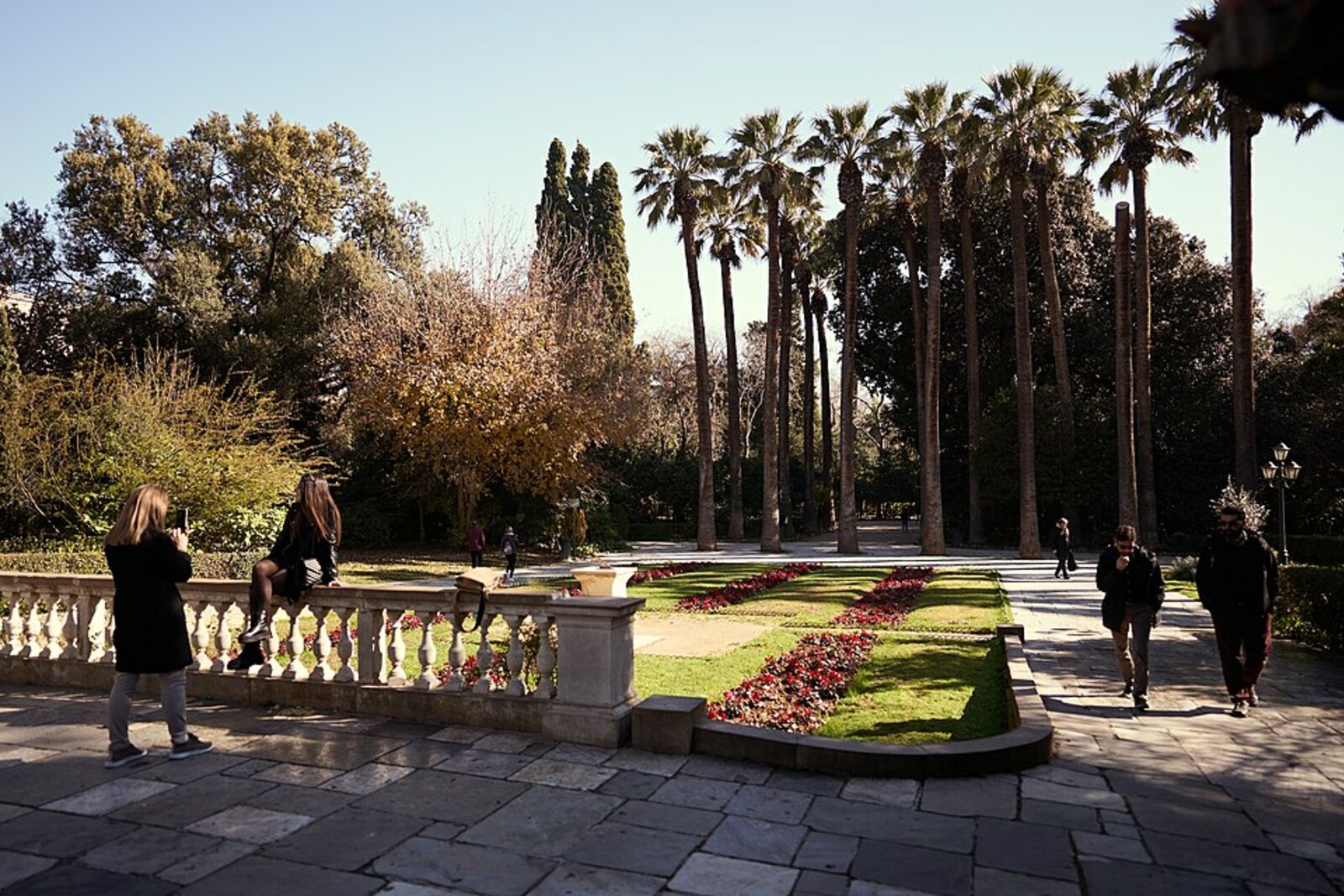
Look around first
What to notice
- Palms at the main entrance
- Open irrigation channels
- Ponds
- Metal faceted chair
The story of the place
Beneath the trees stretches a former palace garden where water determines the layout of the entire space. Open channels and ponds receive the flow from an ancient aqueduct that collects water at the foot of Mount Hymettus and carries it by gravity from the high northern part to the low southern part. The aqueduct was built under the Athenian ruler Peisistratus in the sixth century BCE, and it remains the main source of irrigation to this day.
In eighteen thirty-nine, Queen Amalia ordered fifteen thousand ornamental plants to be brought from Genoa. The twenty-year-old wife of Otto, Greece’s first king, wanted to lay out a garden behind the palace then under construction, like those she knew from Central Europe. But Athens had only recently become the capital; dry, nearly treeless land lay around the palace, and the city lacked even drinking water.
Amalia entrusted the planting to agronomists and gardeners, but she supervised the work herself. In letters to her father, she reported almost every day on how much her garden had grown. A metal faceted chair was installed on a rocky rise: the queen sat there and watched the planting. This “Amalia's Stone” survives in the northeastern part of the garden.
The imported plants did not take well. Some could not withstand the Athenian summer, and in the winter of eighteen fifty, a severe frost killed almost all the citrus trees. The gardeners replanted, adding pines, cypresses, and plants from Sounion and Euboea. By eighteen fifty-two, they had extended the plantings to their present boundaries, laid out winding paths, and created ponds, canals, and small clearings.
Water was the hardest thing to obtain. The French writer Edmond About, who lived in Athens at the time, accused the palace of taking several city reservoirs for irrigation. He wrote: “Athenians suffer, while the lawn feels perfectly fine.” It was a contemporary’s jab, but behind it lay an understandable dispute: residents bought water, while grass and foreign trees were watered behind the palace fence.
The fence mattered. Amalia was creating the Royal Garden for her family. Townspeople were admitted only after the king and queen had left for their evening ride. If Amalia was delayed, the gates might not open until dark. Visitors had very little time to walk the paths, which were maintained in part with water needed by the whole city.
In eighteen sixty, an ancient aqueduct was discovered here during work. It had been built under the Athenian ruler Peisistratus in the sixth century BCE. Its underground galleries collected water at the foot of Mount Hymettus. Along stone channels and through ponds, the water flowed by gravity from the garden’s high northern part to its low southern part. This aqueduct remains the main source of irrigation even now.
Two years after the discovery, Otto was forced to leave the throne. Amalia left with him and never returned to Greece. The next royal family kept the garden behind the palace. It became a state public park only in nineteen twenty-three, when the gates began opening from sunrise to sunset. Four years later, the former Royal Garden was officially named the National Garden of Athens.
At the main entrance from Amalias Avenue stand tall palms, planted by the queen herself in eighteen forty-two. Behind them, paths cross open irrigation channels: the public enters through the former palace gates, while beneath the trees water still flows from the ancient Athenian aqueduct.
Useful on site
Daily from sunrise to sunset; in emergencies, hours may be changed by notices at the entrances.
Checked: June 28, 2026. Check the official source before visiting.Stay on the open paths and protect the plants; it is easy to lose your bearings inside, so check the map at the forks.