 Guide On Map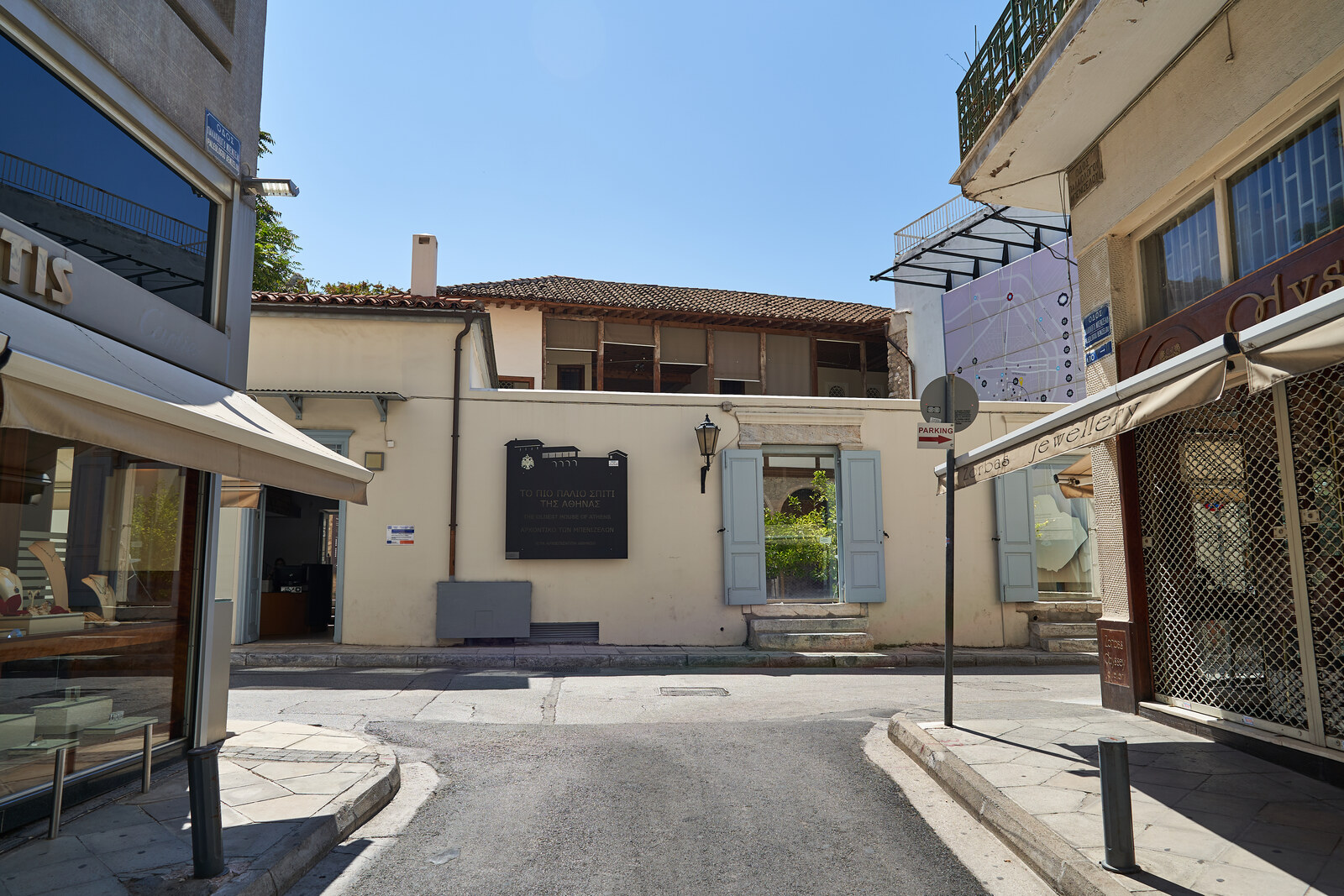
Look around first
What to notice
- High stone wall
- Wooden upper-floor gallery
- Ground-floor arches
- Summer and winter rooms
The story of the place
Behind the high stone wall lie two courtyards and a two-story house: a wooden gallery runs around the upper floor, while the lower floor is cut through by arches. Upstairs, people changed rooms with the seasons; downstairs, grain, oil, and wine were kept. This was where the family property was managed, children were taught, townspeople's requests were dealt with, and visitors were housed. The walls in their present form took shape mainly in the first half of the eighteenth century; no other Athenian urban estate of this type remains.
In seventeen ninety-six, Ioannis Benizelos housed the English geologist and traveler John Hawkins in this house. The guest lived here for forty days. Hawkins gathered information about Greece, while his host taught at an Athenian school and wrote a history of his native city from documents, townspeople's accounts, and his own observations.
Benizelos could host a foreigner for weeks because he belonged to one of Athens's wealthiest families. Its members served as notaries, teachers, and elders—the term used for people who handled the affairs of the local Christian community. Their urban estate occupied a plot between two courtyards, hidden behind a high wall. They lived upstairs, in summer and winter rooms; downstairs, they stored grain, oil, and wine. Houses like these were used to manage property, teach children, receive petitioners, and accommodate guests.
Ioannis left a handwritten History of Athens. In it, ancient monuments stand alongside events the author had seen himself. For later researchers, this townsman's account of Ottoman Athens proved especially valuable: visitors usually described the ruins, while Benizelos recorded everyday transactions, disputes within the city, and officials' actions.
A gap remains in the manuscript's history after that. It is unknown whether Benizelos gave it to Hawkins during those forty days or later. Another fact is known: it ended up in England, among the former guest's books, and did not return to the family for more than a hundred years.
In December nineteen twenty-seven, Ioannis Gennadios received the catalogue for the sale of Hawkins's library—Gennadios was a Greek diplomat, book collector, and the chronicler's great-grandson. He was about to throw the catalogue away when he noticed the distorted surname “Beninzelo” in the description of lot four hundred fifty-seven. Gennadios recognized his ancestor's handwriting and bought the manuscript. He prepared it for publication but did not live to see the complete edition: it appeared only in nineteen eighty-six. The autograph itself is kept at the Gennadius Library in Athens, which he founded.
The present two-story house was built mainly in the first half of the eighteenth century; it is now the last surviving urban estate of this type in Athens. The surname on the gate belongs to the entire Benizelos family. One of its owners welcomed an English traveler here, the manuscript went into the guest's library, and the author's great-grandson found it at an English auction by a surname printed incorrectly.
Useful on site
The official website in the footer lists Tuesday–Thursday 10:00–13:00 and Sunday 11:00–16:00, but the visit page also contains a notice that it is closed to the public; check the website or phone before you go.
Checked: June 28, 2026. Check the official source before visiting.Do not connect the present rooms literally with Philothei's life: the building is almost two centuries younger than she was. Check admission separately.