 Guide On Map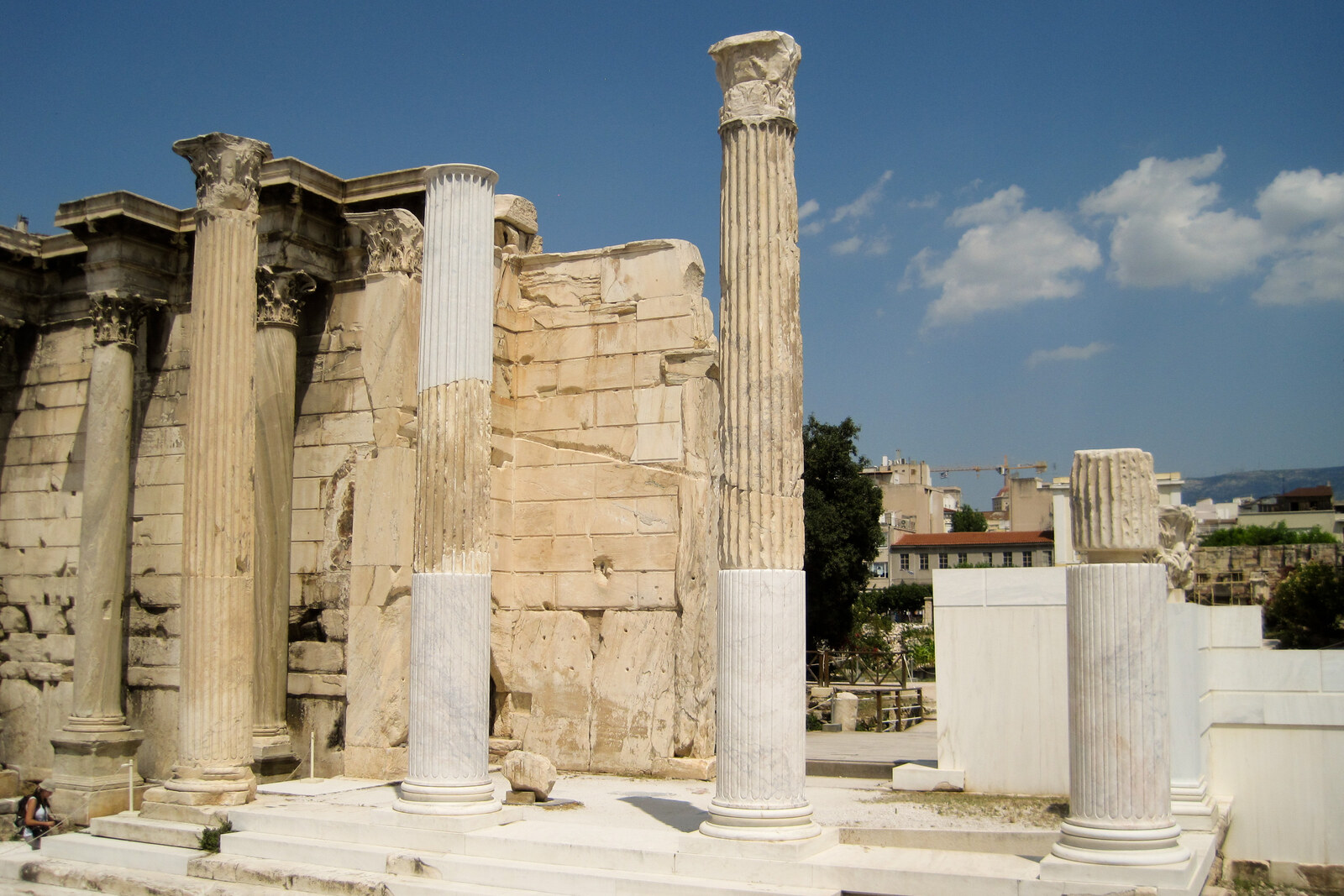
Look around first
What to notice
- 7 columns of the northern wing
- Ceremonial entrance
- Niches in the eastern wall
- Marble columns of the western facade
The story of the place
A large open courtyard once lay beyond the ceremonial entrance, surrounded by one hundred columns, and its scale is now recalled by seven columns in the northern part of the western facade. Recesses from the two-story depository remain in the eastern wall, where cabinets containing papyrus scrolls were inserted. On either side, people worked with texts, read and copied them, while classes took place in corner halls with stone seats. Teachers, students, copyists, and city officials who needed books or documents met here.
In one hundred thirty-one to one hundred thirty-two, the Roman emperor Hadrian, who sought to make Athens the cultural center of his empire, gave the city this vast complex. He saw Greek education as a way to connect the peoples from the Atlantic Ocean to Mesopotamia, and at the same time made Athens the center of the Panhellenion, an alliance of Greek cities in the Eastern Mediterranean.
For Athenians, education was also a source of income. Teachers lived on fees from their students, while visiting students spent money sent by their families. Hadrian gave this trade in knowledge an imperial scale. Beside the old city center, he ordered a courtyard with one hundred columns and a single ceremonial entrance. Literary works and city documents were kept in the eastern wing; rooms for reading and copying manuscripts stood on either side, and teachers gave lectures in corner halls with rows of stone seats.
A book could not be taken down by its spine then. The text was written on a papyrus scroll, the scroll was placed in a wooden box or cabinet, and the cabinet was inserted into one of the niches in the two-story book depository. Wax tablets were used for temporary notes. People came here for a document, worked on a copy, listened to a teacher, or argued after a lecture. The name “Hadrian's Library” conveys only one function of the complex, but it accurately names the person who paid for it.
The Athenians responded to Hadrian with honors and revered their patron as a deity even in the Parthenon. The emperor linked his own name with the city's main commodity—education; teachers and copyists received premises, and city officials a place for the archive.
In two hundred sixty-seven, the Heruli sacked Athens and badly damaged the complex. Later, people repaired the walls, built churches in the former courtyard, and dismantled old sections for stone. Almost nothing remains of the southern half of the western facade; seven columns of the northern wing survive at the entrance. Niches where the cabinets stood are still visible in the eastern wall. The cabinets and scrolls themselves have long been gone.
Useful on site
1 April – 31 August: 8:00–20:00; 1–15 September: 8:00–19:30; 16–30 September: 8:00–19:00; 1–15 October: 8:00–18:30; 16–31 October: 8:00–18:00; 1 November – 31 March: 8:00–15:00; last entry 30 minutes before closing; closed 1 January, Easter Sunday, 1 May, 25 and 26 December. Hours may change; check the website.
Checked: June 28, 2026. Check the official source before visiting.Admission to the archaeological site depends on its operating hours; much of the facade can be seen from outside without a separate visit.