 Guide On Map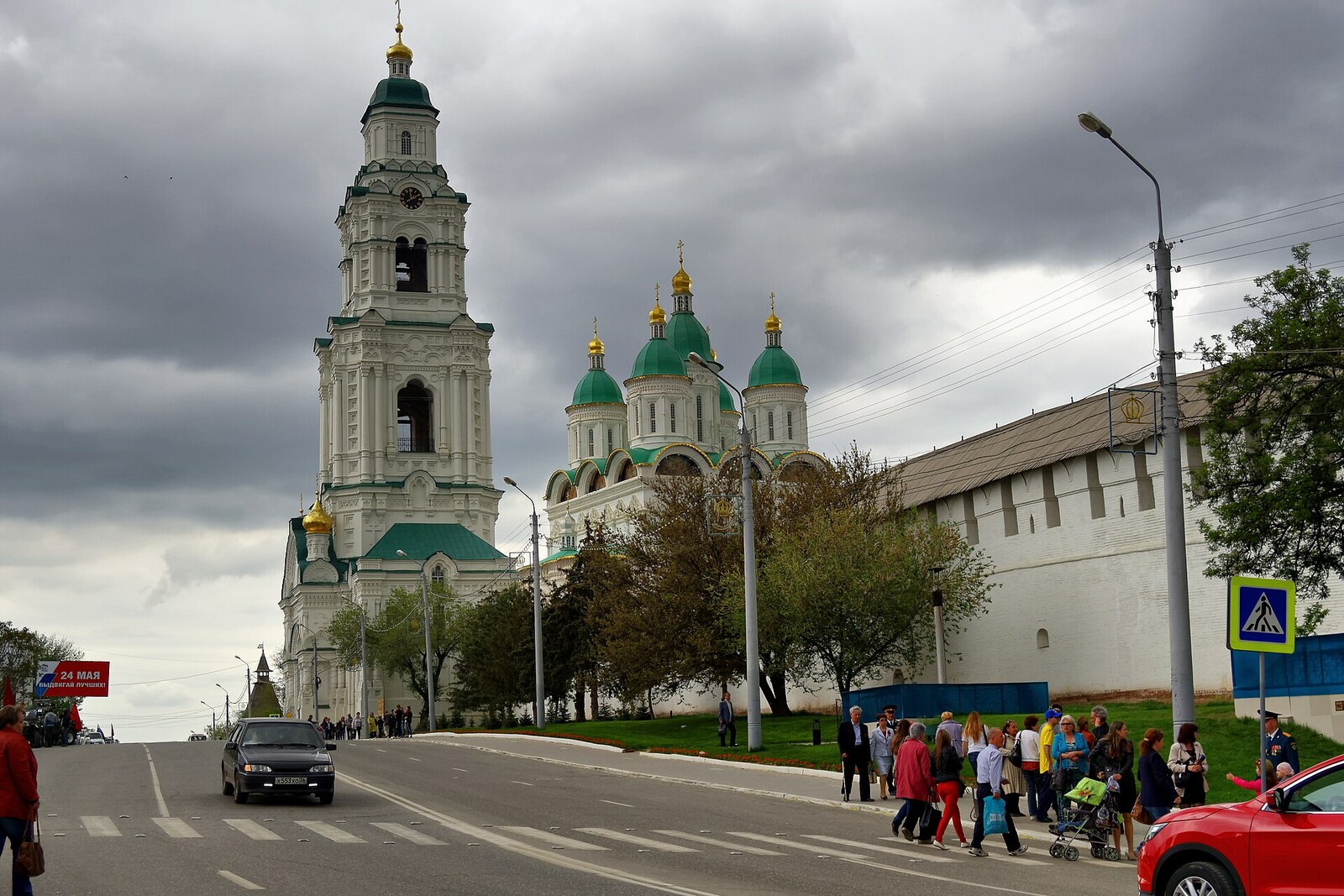
Look around first
What to notice
- Four-tier bell tower
- Passage arch
- Kremlin wall
The story of the place
The main eastern entrance is open in the Kremlin wall, and the present four-tier bell tower rises above the passage arch. In the early twentieth century, it replaced the first cathedral bell tower, which had stood here since the beginning of the eighteenth century. The name Prechistensky Gates outlived the earlier building and remained attached to this entrance to the Kremlin.
A church once stood above these gates, but it is no longer there. It was built here after the nighttime flight of people who had hoped to make Astrakhan Kremlin a stronghold in the struggle for the Russian throne.
In the winter of sixteen thirteen to sixteen fourteen, the Don Cossack ataman Ivan Zarutsky was in charge of the city. He had lost most of his army in earlier battles, retreated to the lower Volga River, and was now gathering Cossacks for a new campaign. With him was Marina Mniszech, the widow of two impostors, who was seeking the throne for her young son Ivan. The boy's father was considered to be False Dmitry II, who passed himself off as the miraculously saved son of Ivan the Terrible. For Marina, defeat meant the destruction of her son's claim; for Zarutsky, it meant the end of a position sustained by the loyalty of armed detachments.
Zarutsky executed the Astrakhan voivode and several clerks and merchants. He hoped to obtain warriors from the Volga and Yaik Cossacks—those from the Yaik / Ural River—to draw the Nogais to his side, and, in case of defeat, he sought help and refuge from the Persian shah. Meanwhile, letters were being sent from Moscow demanding that people swear allegiance to the already elected tsar, Mikhail Romanov. Nogai detachments refused to go with Zarutsky, and the violence of his Cossacks prompted the townspeople to rise against him.
In May, Zarutsky, Marina, and her son left Astrakhan with the remnants of their detachment and with hostages. Their attempt to escape to the sea ended in defeat, so the fugitives headed for the Yaik / Ural River. There they were caught by musketeers sent from Astrakhan. Zarutsky, Marina, and the boy were put in chains and sent to Moscow. The ataman was executed. Young Ivan was hanged. Marina died in captivity; sources recount the circumstances of her death differently.
In the spring of sixteen fifteen, the new Archbishop of Astrakhan, Onufry, consecrated the Church of the Kazan Icon of the Mother of God above the Kremlin's main eastern gates, in memory of the city's liberation from Zarutsky's detachments. In church language, the Mother of God was called the Most Pure, and the gate church gave the gates their name, Prechistensky.
In seventeen ten, the church was dismantled and the first cathedral bell tower was built in its place. The present four-tier tower was completed in the early twentieth century. Nothing remains of the commemorative church above the passageway; it is preserved in the name of the gates through which people enter the Kremlin today.
Useful on site
The grounds and exterior views are accessible on site; the Kremlin's museum objects are available according to the museum schedule.
Checked: date not specified. Check the official source before visiting.Begin with an exterior view and do not linger in the passageway. Bell ringing may interrupt the narration—let it sound, then continue afterward.