 Guide On Map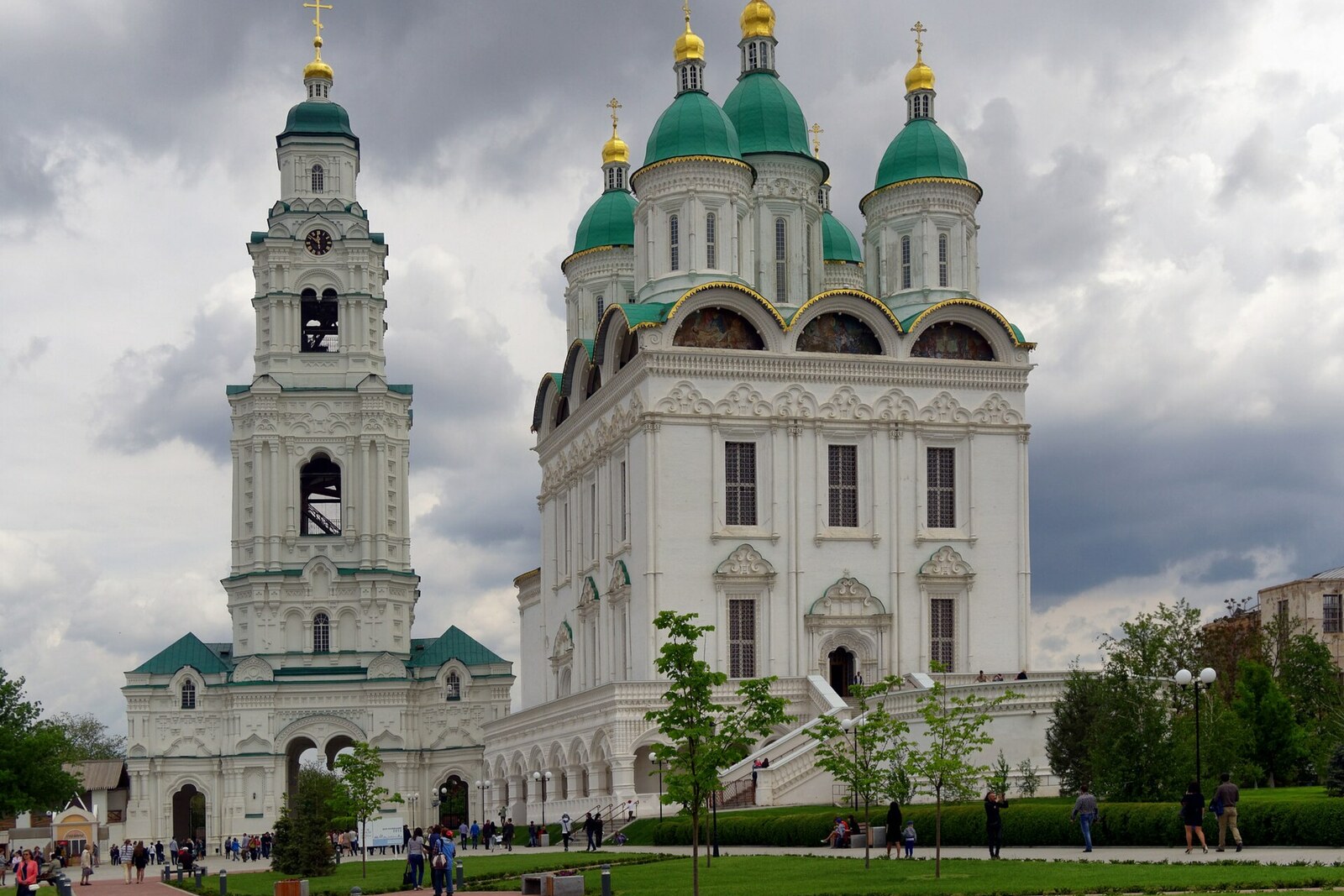
Look around first
What to notice
- The cathedral's five domes
- The western gallery
- The round stone platform
- The broad staircase
The story of the place
On May eleventh, sixteen seventy-one, Metropolitan Iosif was serving the liturgy in Dormition Cathedral when Cossacks came for him. The five-domed church was not yet standing before them. An earlier, single-story stone cathedral stood on the same site.
A year earlier, Stepan Razin's detachments had taken Astrakhan. Razin went up the Volga River, while the city was controlled by the atamans he had left behind and the Cossack circle, an assembly that made collective decisions. Iosif sought to make the townspeople renounce the rebellion and submit a plea for pardon to Tsar Aleksei Mikhailovich. He publicly read the tsar's charters promising mercy and wrote to the Don River and the Terek River, urging the Cossacks not to support Razin's followers.
Iosif also risked his own household. The Astrakhan see was supported in part by income from the Volga River fisheries. Even before the city was taken, Razin's men had plundered the metropolitan's uchug, a large fishing enterprise: they took caviar, fish, bread, boats, nets, and gaff hooks. Now Iosif was accused of causing the Don and Terek Cossacks to refuse assistance to the rebels because of his letters.
When Iosif heard the demand to appear before the circle, he ordered the great cathedral bell rung. Wearing a bishop's vestments and accompanied by the clergy, he went out to the Cossacks and again called on them to end the rebellion. His words were already seen as a direct threat. The metropolitan was stripped of his vestments, taken to the Powder Yard, and tortured over fire, with demands that he surrender the letters and the church treasury.
After the torture, Iosif was led to the Raskat. This was the name for a high platform beside a tower where cannons were placed. An old manuscript says that the metropolitan was seated on the edge, facing Dormition Cathedral. He grabbed a Cossack standing beside him and nearly pulled him down with him. The Cossack was held back; Iosif was laid on his side and pushed off.
An hour later, priests carried the body back into the cathedral. The following day, a panikhida was held there, and on the tenth day Iosif was buried in the church. The Cossack atamans held Astrakhan only until the end of autumn: the city surrendered to the tsar's troops. One of the rebellion's principal leaders, Fyodor Sheludyak, was executed the following year. Iosif himself was later canonized.
The present cathedral was built almost forty years after his death. The upper church was consecrated in memory of the Dormition of the Theotokos—her death, which church tradition calls a dormition, meaning falling asleep. The lower church served as the burial place of Astrakhan bishops.
At the same time, a round stone platform with a broad staircase was added to the western gallery: Lobnoye Mesto. The name came from the Gospel name Golgotha. In Russian cities, this was the name given to an elevated tribune: decrees and important state announcements were proclaimed from it, and public punishments were carried out there as well. In Astrakhan, such a platform was connected directly to the cathedral.
The exact relationship between the present Lobnoye Mesto and the Raskat remains disputed. According to one version, the stone platform was built on the foundations of the former tower. According to another, the Raskat stood thirty to thirty-five meters west of the cathedral, where a lawn and the path to the Consistory Building now run. Archaeologists have not found a convincing foundation for the tower.
The Raskat and the earlier cathedral are gone. In the lower church of the building that replaced it stands a reliquary containing Iosif's relics. The round platform outside appeared later and is not regarded as the proven place of his fall.
Useful on site
Outside access is free, subject to the grounds' opening arrangements; interior access depends on the schedule of the active church and museum rules.
Checked: date not specified. Check the official source before visiting.From outside, the connection between the church and the state tribune is easy to see. Inside, follow the rules of the active cathedral; access to the lower church may be restricted.