 Guide On Map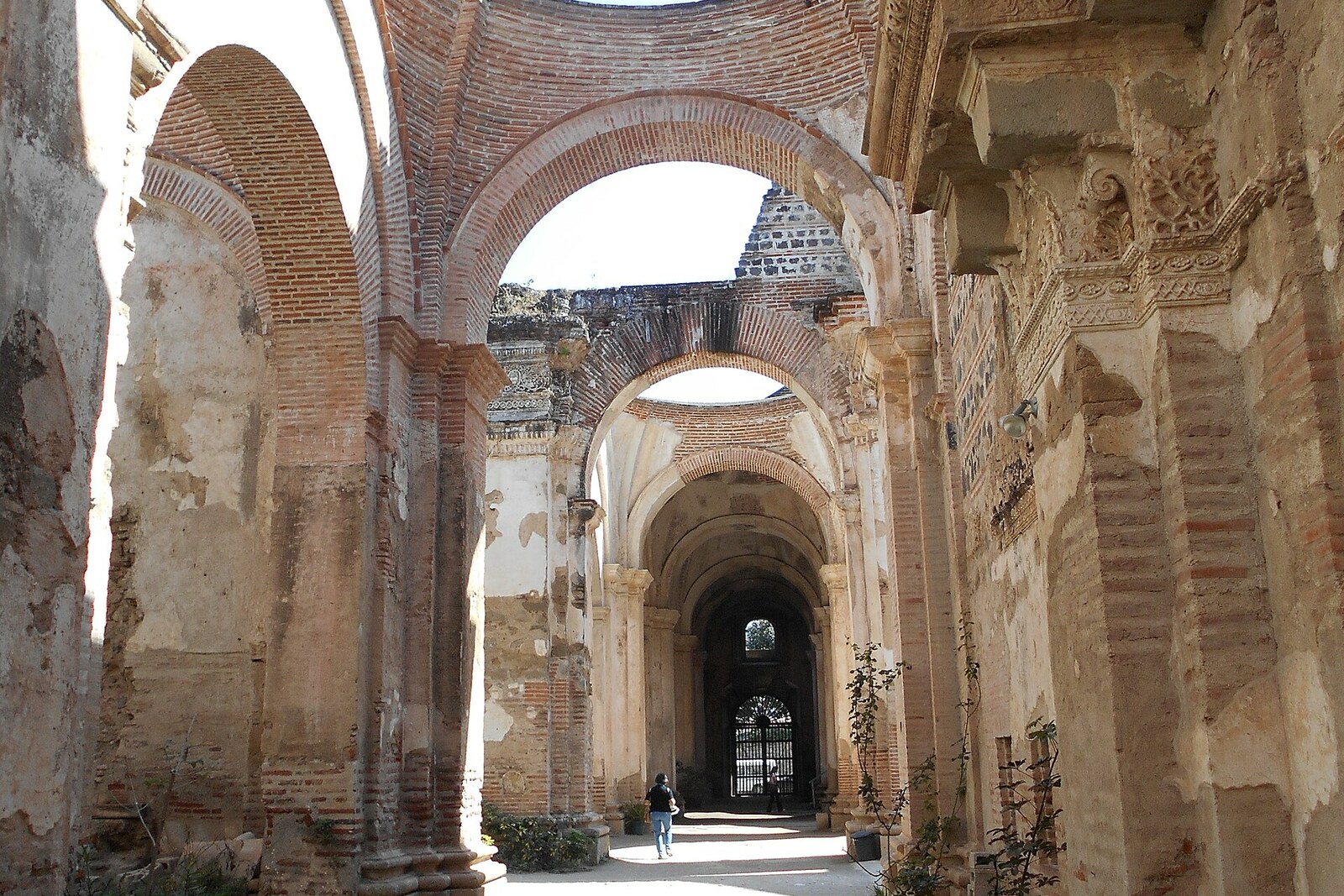
Look around first
What to notice
- Cathedral facade
- Covered front section
- Open naves
- Stone pillars and arches
The story of the place
In February eighteen oh six, the ailing priest Rafael José Luna asked for part of these ruins to be given to his parish. He proposed repairing several surviving vaults and setting up a church beneath them. By then, Guatemala’s former main cathedral had stood empty for more than thirty years.
Before the earthquakes of seventeen seventy-three, this was Santiago Cathedral—of Iakov the Apostle, whose name the city bore. A bishop’s cathedra is what makes a church a cathedral: from here, the archbishop governed a vast diocese, the cathedral chapter served here, and church archives and property were kept here. After the capital was moved, the archbishop, the canons, and the cathedra itself left for Guatemala City. The cathedral was left without its former function, but far from all parishioners left Antigua Guatemala.
Thirty-one years after the earthquake, Archbishop Luis Peñalver y Cárdenas found three temporary parishes here in damaged buildings. He combined them into one—the Parish of Señor San José—and chose Luna as its rector. The parish covered Antigua Guatemala itself and many surrounding settlements, lived chiefly on collections from there, and had to support three assistant priests. Luna had already complained that he was ill and could not manage the expenses.
The name San José, that is, Saint Joseph, came from another church. It was opened in seventeen fifty-four. The church was associated with the carpenters’ guild: Joseph, Mary’s husband and Jesus’ earthly father, was himself a carpenter according to Christian tradition. After the earthquake, the church attendant and the craftsmen received a plot in the new capital and took the principal sacred objects there. The items left in Antigua Guatemala were first kept in San Pedro Church; then San José Church was set up in three borrowed lecture halls of the former university.
Luna tried to give such a parish a permanent home in the old cathedral. For him personally, the matter ended sooner: in that same year, eighteen oh six, illness and a dispute with the Brotherhood of San Sebastián forced him to leave his post. He never served in the restored church.
Seven years later, the Franciscan Francisco Velasco repeated the request. The city council agreed to transfer the former cathedral to the parish, and the church chapter approved the decision. The transfer of the building, however, did not yet mean it could be occupied: there was no money for repairs, and services continued in the university lecture halls.
By eighteen nineteen, two thousand four hundred pesos had been collected for the work. The city council ordered that the dangerous parts be dismantled first. Construction then stopped. Only in eighteen thirty-two did people begin a partial restoration, after which the Parish of San José finally moved here.
The present arrangement preserves the limit of their plan. Behind the facade stands the active parish church of San José; there has long been no episcopal cathedra here. Farther on begin the naves of the former Santiago Cathedral, open to the sky. In the square, the two names are joined in the familiar word “cathedral,” while in the building itself the boundary is visible in the masonry: at the front stand the altar and roof; behind them are the pillars and arches whose restoration the parishioners could no longer afford.
Useful on site
Published hours for the ruins — 09:00–17:00; parish — 07:00–18:00. Access is separate; changes are possible.
Checked: date not specified. Check the official source before visiting.Entry to the ruins may be separate from the active church; if it is unavailable, compare the facade with the outer perimeter of the complex.