 Guide On Map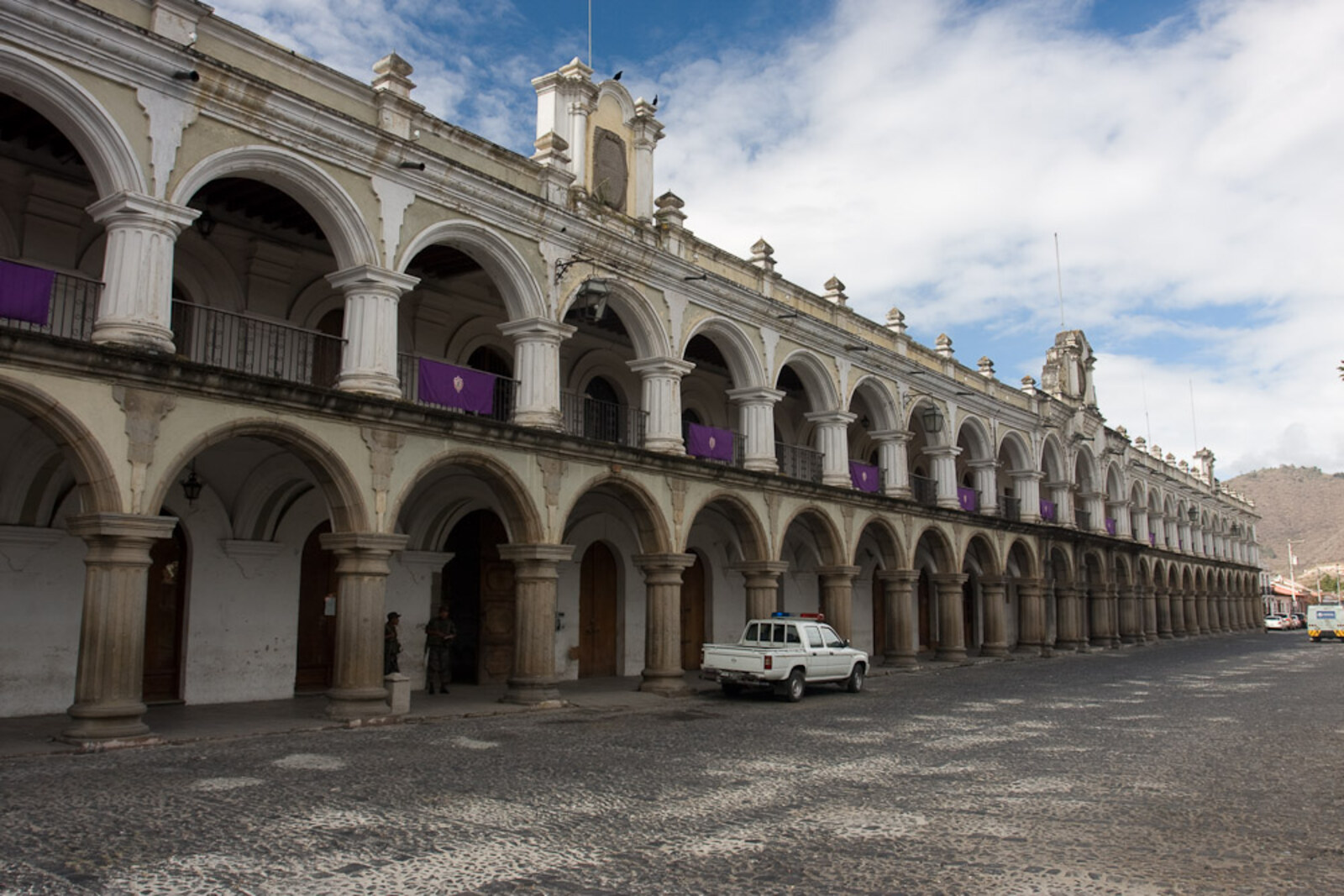
Look around first
What to notice
- Two-tiered arcade
- Stone columns
- Long façade along the square
The story of the place
Behind the long arcade along the square, the National Museum of Art of Guatemala operates today. The Palace of the Captains General was the place from which the Spanish authorities governed Central America. Two levels of stone arches run along the edge of the main square, and the present façade was assembled only after the destruction of the old capital. The stone columns were left under shelters by the portal for almost a century and returned to the façade in the second half of the nineteenth century.
The double arcade occupied an entire side of the main square, but behind it stood more than a single ceremonial residence. The highest court—the Royal Audiencia—met here; the royal seal and treasury were kept here, coins were minted, and weapons and prisoners were held here. The head of this entire system lived here as well. He commanded the troops, governed the provinces, and presided over the court. The office was called “captain-general,” which is why the palace retained the name of the successive captains-general.
The last of them to govern the old capital from here was Martín de Mayorga—a career military officer whom the Spanish king appointed governor of Guatemala. He arrived in the city in June seventeen seventy-three. By the day of his arrival, an earthquake had already damaged the palace, and a month and a half later, on July twenty-ninth, a new series of tremors destroyed a significant part of the city.
Mayorga had to decide whether the court, the treasury, the prison, and his own residence could be returned here. He commissioned an inspection from the military engineer Antonio Marín, who had just arrived from Spain and barely knew the city. Marín went inside the damaged buildings although the walls continued to crumble. He explained this risk by his service to the king and the honor of an engineer: for him, signing a convenient report without inspecting the ruins himself would mean ruining both the residents and his own professional reputation.
The palace façade was still standing, but the porticos on both levels and a side wall had tilted and threatened to collapse. After inspecting the interior rooms, Marín decided that repairs would not be enough here. By his estimate, clearing the debris and rebuilding would require millions of pesos; trying to house people in patched-up buildings would turn those buildings into graves.
Mayorga used the engineer’s report to press for moving the capital. He was opposed by Archbishop Pedro Cortés y Larraz, who wanted to rebuild the city on its former site. Many priests, city councilors, and homeowners stood behind the archbishop: their property, income from church loans, and customary livelihoods were tied precisely to this square and the surrounding blocks. For Mayorga, the palace was also his home and workplace, but the Crown had appointed and maintained him; he would have had to answer to it for the next collapse.
After receiving the king’s authorization, Mayorga did not limit himself to sending away the officials. He ordered the removal from the palace of its furniture, doors, balconies, and everything that could be useful in building the new government complex. On January sixteenth, seventeen seventy-five, the master builder Bernardo Ramírez began taking usable materials away from here. The earthquake damaged the palace, and people dismantled a significant part of what was still standing. The court and treasury left; the remaining townspeople occupied the surviving rooms and built small houses directly on the ruins of the portal.
The stone columns were not taken away: they proved too heavy. For almost one hundred years, the columns lay under shelters in front of the ruined palace, until they were used in rebuilding the façade in the second half of the nineteenth century. Behind the present arches is the National Museum of Art of Guatemala, while the columns themselves remained where Mayorga had been unable to send them—to the new capital.
Useful on site
The arcade outside is accessible at all times; according to the latest official publication, the museum is open Tuesday through Sunday, 10:00–18:00.
Checked: date not specified. Check the official source before visiting.Do not count on free access to all the rooms: the main story can be read from the square in the structure of the façade.