 Guide On Map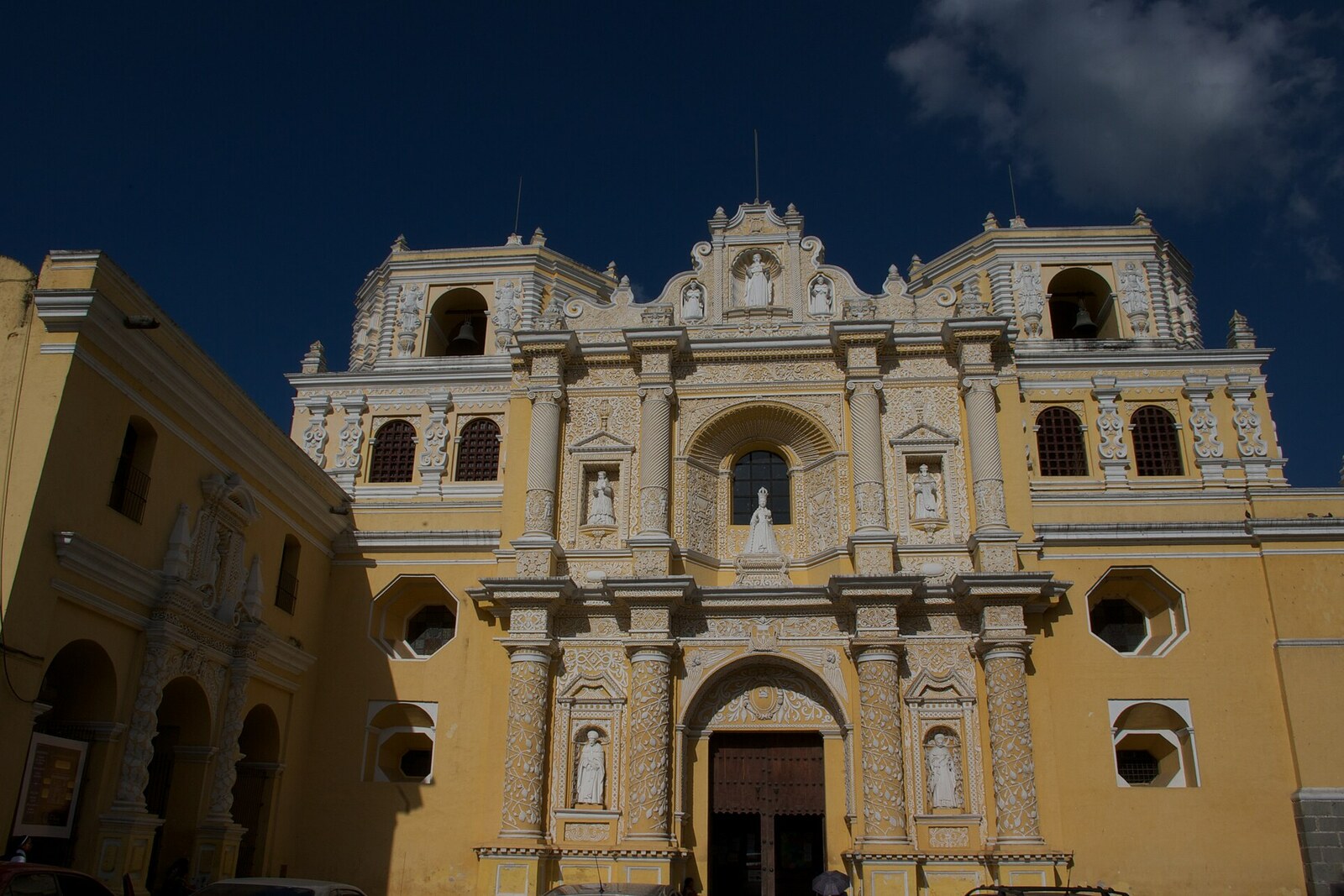
Look around first
What to notice
- Stone façade
- Main entrance doors
- Figure of Jesús Nazareno
The story of the place
Behind the heavy stone façade of La Merced Church stands the church of the former convent of the Mercedarians, the Order of Our Lady of Mercy. Its brothers once ransomed Christians from captivity; around their church grew a community of laypeople who supported services and commissioned sacred images for the altars. The stone building survived the destructive tremors better than many neighboring structures and even received parishioners when services had to be moved into the courtyard. Through the main doors, visitors still enter to reach one of the city’s most venerated images.
On July seventh, seventeen seventy-eight, a wooden figure of Christ carrying the cross was taken from this church in a box. The cross itself did not fit in the box. One of the parishioners slung it over his shoulder and carried it to San Lucas Sacatepéquez—about fifteen kilometers along the road to the new capital.
The figure was known as Jesús Nazareno de La Merced. “La Merced” is the name of Our Lady of Mercy, the patroness of the Mercedarians. Pedro Nolasco founded this religious order in twelve eighteen to ransom Christian captives. The Mercedarians built a church and convent here, and a lay brotherhood of parishioners commissioned its own Nazarene for the church. In sixteen fifty-five, the sculptor Mateo de Zúñiga carved the figure for seventy-five pesos; the painter José de la Cerda painted it free of charge.
The significance of this sculpture was not determined by its price. In seventeen twenty-one, city officials came to its altar, knelt, placed their hands on the Gospels, and declared the Nazarene the city’s protector against earthquakes, epidemics, fires, and floods. Every Holy Tuesday, they pledged to attend a solemn service here called La Reseña.
Destructive tremors began on July twenty-ninth, seventeen seventy-three. The following morning, the Mercedarians took the Nazarene down from its throne and carried it to a straw shelter, where the Capuchin nuns were already taking refuge. Later, the figure was returned to a temporary church set up directly in the courtyard of La Merced Church. The stone church suffered less damage than many neighboring buildings and continued to receive parishioners.
The Spanish Crown decided to move the capital from Santiago de los Caballeros de Guatemala—what present-day Antigua Guatemala was called at the time—to Ermita Valley, where modern Guatemala City arose. The residents did not want to leave. For weavers, moving meant losing customers and the places where they bought yarn; dyers, potters, and tanners lacked water and premises for workshops in the new valley. Everyone else faced abandoning their homes and building again on the allotted plots.
Captain General Martín de Mayorga, the Crown’s chief representative in Guatemala, understood that one order would not move the people. He ordered the Mercedarians to take away the Nazarene and Our Lady of Mercy. Residents followed the box containing the figure as far as the city gate, while the man carrying the cross continued on to San Lucas Sacatepéquez. Two days later, the sacred figures were delivered to the new capital. Their departure prompted many families to relocate. The Nazarene carved by Mateo de Zúñiga remained in Guatemala City and is now in the La Merced Church there.
The figure that is carried out of this church during Holy Week appeared here later. It was venerated by the residents of the San Jerónimo district, who founded their own brotherhood in sixteen seventy-five. They paid for services, brought paintings, and bequeathed property to the brotherhood. After the local chapel was destroyed, the Nazarene was transferred to San Sebastián Church.
In eighteen sixty-two, the archbishop appointed La Merced Church as the new church of the San Sebastián parish, but the residents of the old district refused to give up their figure. They kept it for another twenty-one years. After the earthquake of eighteen seventy-four, San Sebastián Church was almost reduced to ruins, and in eighteen eighty-three the Nazarene was finally transferred here. From that time on, it came to be called Jesús Nazareno de La Merced.
The Christ carried through these doors in a box is in Guatemala City. Inside today’s La Merced Church stands the Christ that the residents of San Sebastián refused to agree to give up to La Merced Church for twenty-one years.
Useful on site
The façade is accessible from the street at any time; access to the active church depends on services and may be interrupted in the middle of the day.
Checked: date not specified. Check the official source before visiting.This is an active church: during services, view the façade and enter only without disturbing parishioners.