 Guide On Map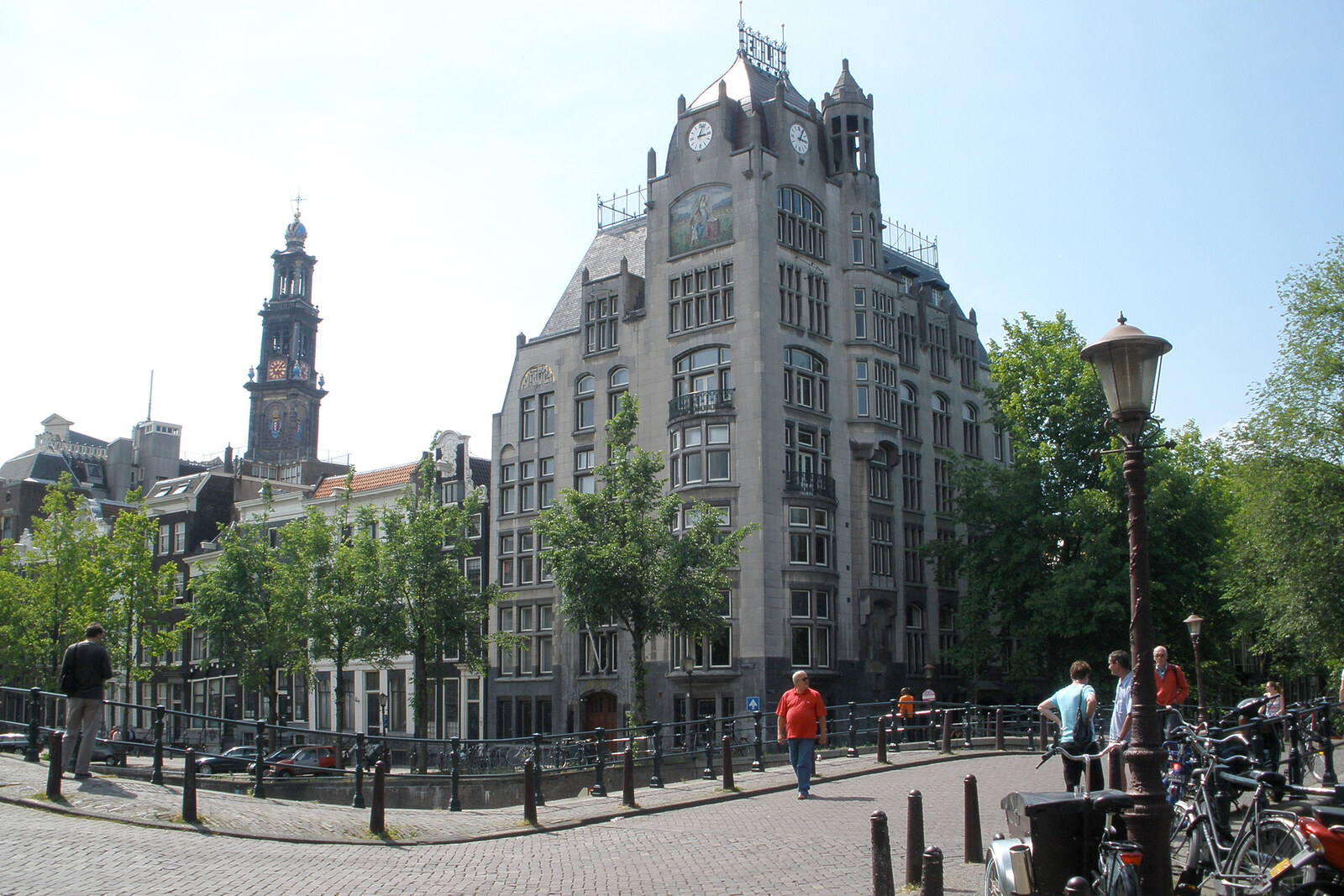
Look around first
What to notice
- Copper roof
- Four golden letters in the railing
- Two mosaics with an angel, a mother, and a child
- Insurance policy in the mosaics
The story of the place
On the canal corner, beneath a copper roof, rises a six-story building with golden letters in its railing. It was built for a life-insurance office, where clerks and actuaries turned clients’ contributions into obligations for distant years. From the outset, the building had a reinforced-concrete frame, electric lighting, heating, an internal telephone, and elevators; for Amsterdam at the time, it was an early high-rise office building. The work of this office is displayed on the façade: an angel shields a mother and child and shows them a policy.
Keizersgracht is the Imperial Canal. It was named after Maximilian of Austria: in fourteen eighty-nine, the future emperor allowed Amsterdam to place a crown on the city’s coat of arms. When work began on digging this canal in sixteen fifteen, Maximilian’s name was given to the water.
The corner building is now called Astoria, but this name appeared only after its first owner had gone. The four golden letters in the railing above the copper roof refer to the former name—Eerste Hollandsche Levensverzekerings-Bank.
It was founded in eighteen eighty-four by the insurance agent Jacob de Jong. He lived for his trade and invested in the new company himself: of the hundred shares distributed among the six founders, thirty were registered in his name. De Jong worked to make people entrust their family savings to a small insurer. Four years later, he moved the office into the house that stood on this corner.
In nineteen hundred, Jacob died. Management was taken over by his sons, Pieter and Casper de Jong. They now had to prove that the firm’s obligations had not ended with the founder’s life. Under them, the old house was demolished, and in its place a six-story office building rose, with a reinforced-concrete frame, electric lighting, heating, an internal telephone, and elevators. The insurance company was selling a promise to pay money decades later—and housed its employees in one of Amsterdam’s earliest high-rise office buildings.
The service was explained directly on the façade. In two mosaics, an angel shelters a mother and child and points to an insurance policy lying before them. Behind these images, actuaries calculated how much clients had to pay and how much the company was required to set aside for future payments. Under the de Jong sons, the firm opened branches in five more cities, and its number of agents grew to five hundred.
In nineteen eighty-five, another insurer absorbed the company, and three years later its employees left central Amsterdam. Later, the bank’s name itself disappeared. The mosaics with the policy and the golden letters above the roof remained on the corner; the name Astoria appeared when there was no one left to explain them.
Useful on site
Outdoor stop at a public quay, accessible around the clock.
Checked: June 28, 2026. Check the official source before visiting.Step back far enough for the tower and neighboring façades to fit within a single field of view. The story concerns the building’s exterior; there is no need to go inside.