 Guide On Map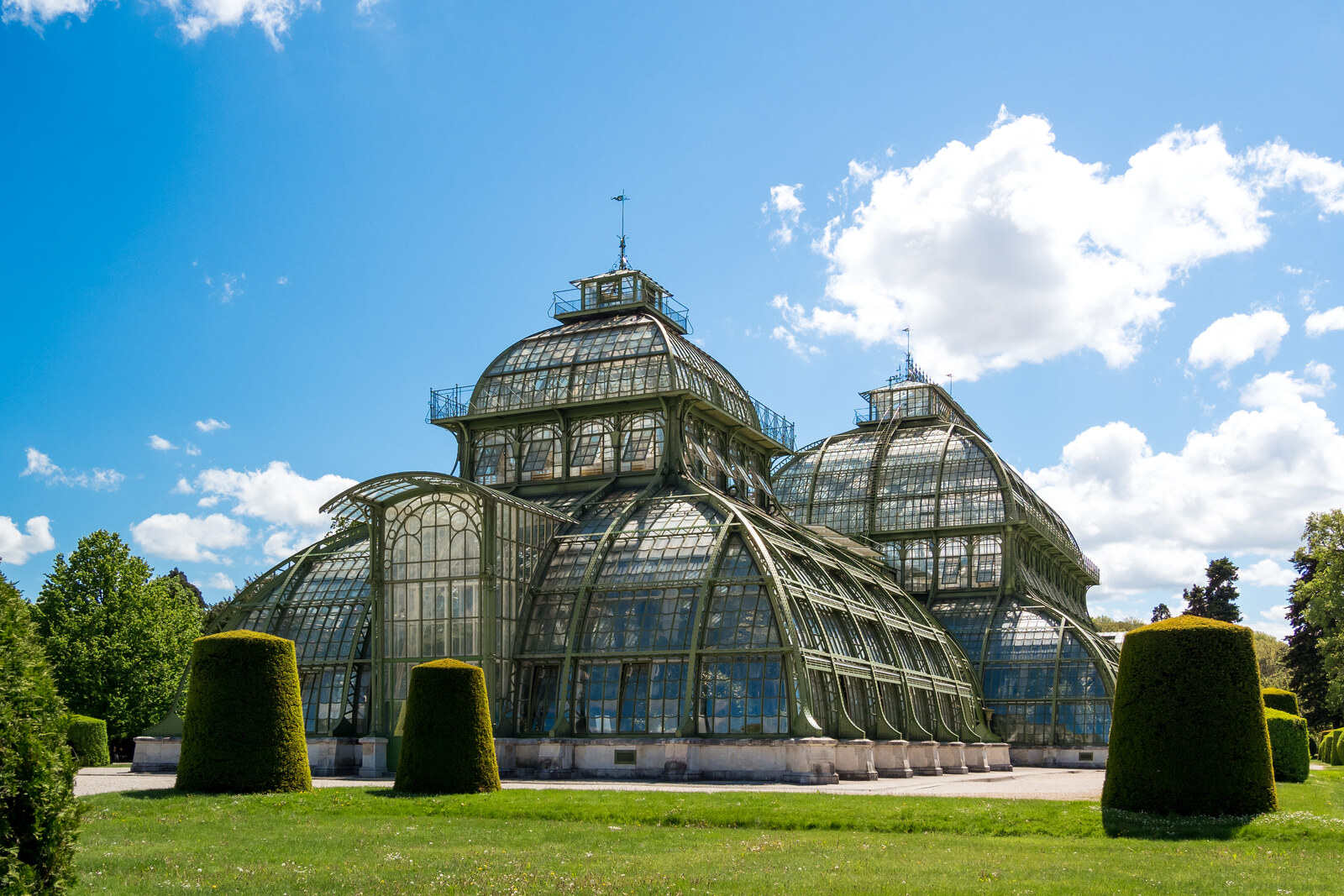
Look around first
What to notice
- Three connected glass pavilions
- Iron frame
- Tall palms
- Passageways between the pavilions
The story of the place
On June seventeenth, eighteen eighty-two, Emperor Franz Joseph I, who commissioned the Palm House, stepped beneath its glass vaults—and saw an empty building. Newspapers called the inspection a grand opening, although the gardeners had not yet moved either palms or tree ferns here.
The emperor wanted a modern exhibition palace for the plants that his family had been bringing to Schönbrunn for decades. The collection no longer fit in the old greenhouses on the site of the former Dutch-Botanical Garden. The court gardeners needed something different: to gather the plants beneath one roof while keeping separate the species that required different temperatures and humidity.
Four years before the opening, Adolf Vetter, inspector of the court gardens and responsible for the collection, and Franz Xaver Segenschmid, an employee of the court construction office who was to design the new building, were sent to study the greenhouses of Germany, France, and England. They visited the World's Fair in Paris and Kew Gardens outside London. Kew's Palm House became the direct model for the Vienna project, but Segenschmid divided it into three connected pavilions.
After the imperial inspection, the gardeners began the move. Tropical plants were placed in the southern section, species of moderately warm climates in the central one, and those that needed cool conditions in the northern one. Palms gave the building its name, although from its first summer araucarias, camellias, acacias, cycads, and a collection of tropical aroids assembled by Heinrich Wilhelm Schott, the former director of the court gardens, also grew here.
On designated days, the public began to be admitted for a small fee. There were so many visitors that they interfered with the gardeners' care of the plants. In April eighteen eighty-four, access had to be reduced to three hours on Mondays and Thursdays.
The original division has been preserved. Today, the gardeners maintain no less than eighteen degrees in the southern pavilion, twelve in the central one, and six in the northern one. The three glass volumes remain three different climates—the very reason Vetter and Segenschmid traveled through Europe's greenhouses.
Useful on site
The Palm House is open year-round. Austrian Federal Gardens lists May–September 10:00–18:00, last entry 17:30; October–April 10:00–17:00, last entry 16:30. The official ticket seller may update the hours separately.
Checked: June 29, 2026. Check the official source before visiting.The frame is easy to examine from outside. If you want to see the collection inside, check greenhouse access in advance and allow separate time for it.