 Guide On Map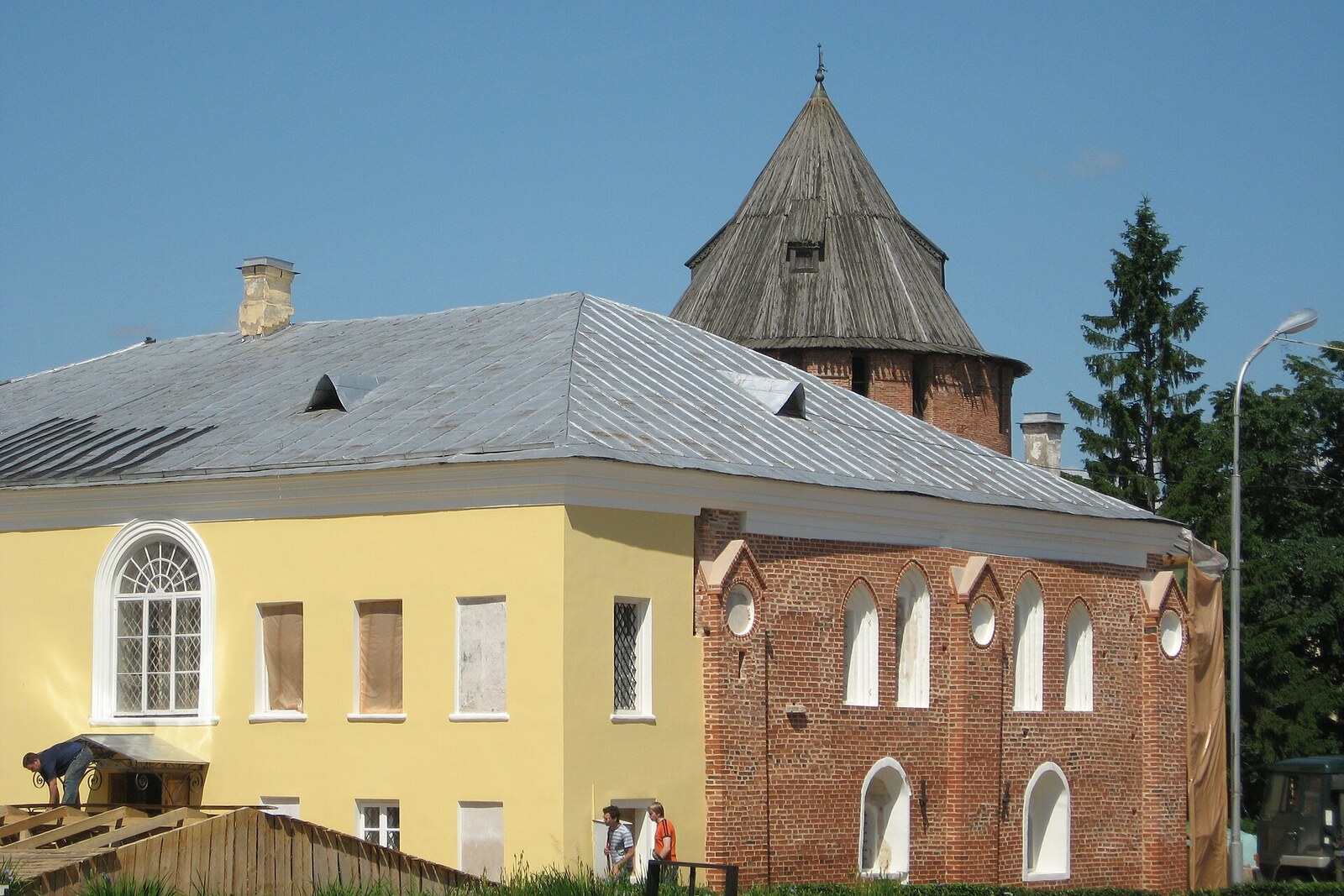
Look around first
What to notice
- Central pillar
- Gothic vaults
- Stone ribs of the vaults
The story of the place
The upper hall of the Faceted Chamber rests on a pillar in the middle; convex stone ribs radiate from it across the vaults. The Chamber was built in fourteen thirty-three under Archbishop Evfimii II by Novgorod stonemasons and invited German masters. Novgorodians called the archbishop vladyka, and the Council of Lords met at his court, where posadniks and senior boyars heard lawsuits, conducted business with ambassadors, and prepared decisions for the Novgorod Veche. The hall now contains a museum exhibition, and the facets on the vaults gave the Chamber another name—the Faceted Chamber.
In January fourteen seventy-eight, the archbishop's clerk drew up a sworn charter abolishing the Novgorod Veche, which had once elected Archbishop Feofil. Feofil was the last Novgorod archbishop chosen by the townspeople by lot. He now had to persuade those same townspeople to renounce the old order and admit Ivan III, Grand Prince of Moscow, into Veliky Novgorod.
Such negotiations converged at the Archbishop's Court because the Novgorod archbishop handled both church and city affairs. He chaired the Council of Lords, a deliberative body of posadniks—that is, elected city leaders—and senior boyars. Here they heard lawsuits, received ambassadors, and prepared decisions for the Novgorod Veche. Archbishop Evfimii II built the Faceted Chamber in fourteen thirty-three: Novgorod stonemasons worked alongside invited German masters. Novgorodians called the archbishop vladyka, hence the name Vladychnaya.
By the winter of fourteen seventy-eight, Ivan III's army had surrounded the city. The grand prince demanded that the Novgorod Veche be abolished, the Veche bell removed, and the office of posadnik eliminated. His governors were to govern the city. Feofil traveled several times to the prince's camp: he sought a surrender without an assault and tried to preserve the old court, the city's landed estates, and the Novgorodians' right not to leave for service in distant lands.
For the archbishop himself, the negotiations were also a property dispute. Ivan first demanded half the lands of the House of St Sophia and of the wealthiest monasteries. Feofil asked that the possessions not be taken away and their owners not be evicted. The grand prince eased his demands: ten volosts were taken from the vladyka instead of half the lands. He promised not to carry out a mass removal of people, but refused to confirm the promise by kissing the cross. Feofil accepted the terms without a guarantee, with the surrounded city behind the walls and Novgorod military commanders already crossing over to the prince's camp.
On January thirteenth, the archbishop brought Ivan a sworn pledge document. He signed it in his own hand and affixed his seal; separate seals represented the five city ends—the districts of medieval Novgorod. On January eighteenth, the decision was adopted at the Council of Lords in the Archbishop's Court. The chronicler noted it with utmost brevity: from that day on, there was no Novgorod Veche in Veliky Novgorod.
The chronicle does not name the exact room. The ceremonial hall of the Chamber is associated with the announcement of Ivan III's terms, but the grand prince himself remained in the camp at that time. He entered the city ceremonially only on January twenty-ninth. His governors received the city court and administration; two of them were housed directly in the archbishop's residence. Feofil was left with the affairs of the church court. On February eighth, by Ivan's order, the Veche bell was removed, and then it and the city archive were taken to Moscow.
The agreement made it possible to open the gates without an assault, but it did not save all the participants in the negotiations. Ivan's opponents were arrested, and their property was inventoried for the treasury. Two years later, the grand prince ordered Feofil arrested as well, on suspicion of secret contacts with Veliky Novgorod's former allies. The archbishop was deprived of his see and confined in Moscow's Chudov Monastery, where he died in fourteen eighty-four.
The Chamber now serves as a museum. Its upper hall has preserved a central pillar and Gothic vaults with projecting stone ribs—facets—which later gave the Chamber its second name, the Faceted Chamber. The Veche bell and the city archive are no longer here; the room where the council chaired by the vladyka met remains.
Useful on site
Open from 10:00 to 18:00; closed Monday; sanitary day—the last Wednesday of the month.
Checked: date not specified. Check the official source before visiting.Check separately whether entry is possible. If the building is closed, listen to the chapter outside, considering its place beside St Sophia Cathedral.