 Guide On Map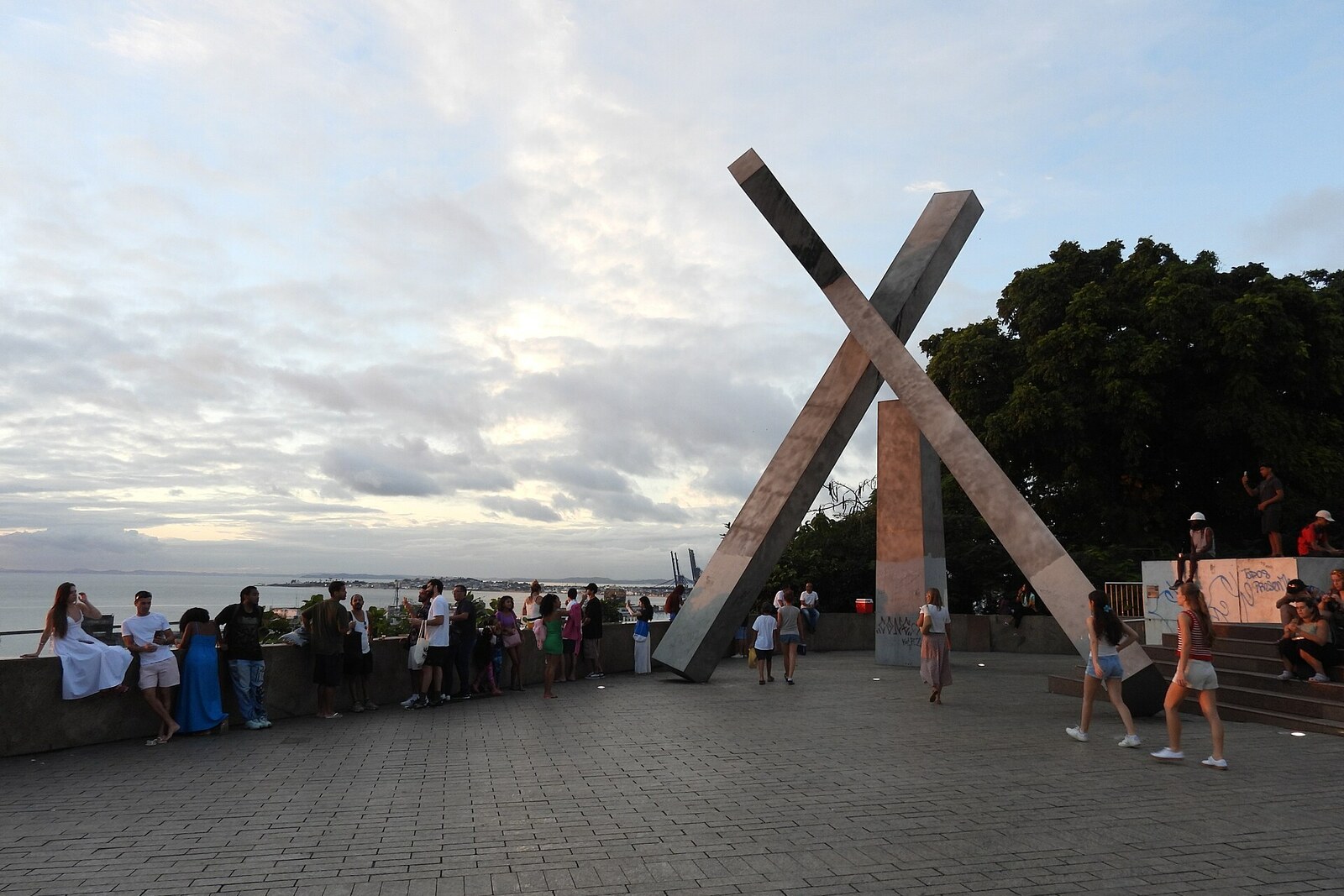
Look around first
What to notice
- Twelve-meter slanting cross
- Support on a crossbar
- The square's open space
The story of the place
Above the open Praça da Sé stands a slanting twelve-meter cross of stainless steel: one of its crossbars rests on the ground, making the monument appear to have fallen. The sculpture was installed at the end of the last century on the former churchyard; the stone walls of the Old Sé Cathedral stood nearby, on the other part of the square. The space around it had already taken shape as an urban transport hub: after two neighboring blocks were demolished, a tram terminus was brought here.
In nineteen sixteen, Praça da Sé did not yet exist. Part of what is now open space was occupied by the Old Sé Cathedral, Salvador's former cathedral. By then, the archbishop's services had long since moved to the neighboring former Jesuit church, but the sixteenth-century building remained the property of the archdiocese.
The Companhia Circular de Carris da Bahia wanted to create a direct route from Rua da Misericórdia to Terreiro de Jesus. As long as the cathedral stood, the cars had to turn behind it, lose speed, and delay traffic. The company offered the church council a choice: cut five meters off the building or demolish it entirely. The council chose demolition.
Archbishop Jerônimo Tomé da Silva asked Pope Benedict XV for permission. He explained that the church was no longer needed for services, that there were enough other churches nearby, and that the Old Sé Cathedral supposedly had no artistic value. In nineteen nineteen, permission came from Rome on one condition: a cross was to be erected on the cleared site.
However, the keys to the church were not held by the archbishop. The Old Sé Cathedral was managed by the secular Brotherhood of the Blessed Sacrament, which relied on royal charters dating back to the seventeenth century. The brothers controlled the church property and insisted that neither the building nor its furnishings be sold without them. They hired the lawyer Metódio Coelho. First, he spent a full year going from office to office, trying to stop the deal; then the brotherhood filed suit and won the right to remain in the church. The archdiocese failed to obtain either the premises or the keys.
There was also a dispute over the price. The tram company offered money, while the archbishop considered the sum insufficient and demanded additional conditions—among them, ten years of free electricity for the seminary. The brotherhood risked losing the church, its property, and the compensation it intended to use to build a new church and preserve the sacred objects.
After several proceedings, the court in nineteen thirty-two rejected the brotherhood's claims, ruling that the matter was subject to canon law. For the final deal, the tram company paid the money, and the state transferred the building of the Convent of Palma to the municipality, which the archbishop then received. By then, most of the brothers had agreed to the demolition, but they continued to demand compensation for themselves and resolved to dissolve the brotherhood, transferring its remaining property to the charitable Santa Casa to establish a hospital.
On August sixth, nineteen thirty-three, large church images were carried out of the Old Sé Cathedral in a procession. The next day, the dismantling of the building began. Some of the altars, carvings, silver, and sculptures were moved to other churches and to the collection of what is now the Museum of Sacred Art. The trams received a direct route. In nineteen forty, the municipality demolished two more neighboring blocks and established a terminus here. That is how Praça da Sé appeared—a square named after a cathedral that was no longer there.
The pope's condition concerning the cross remained unfulfilled for eighty years. In nineteen ninety-nine, the municipality commissioned the sculptor Mário Cravo to create a twelve-meter monument of stainless steel. He set the cross at a slant, supported by one of its crossbars. The Fallen Cross stands where the churchyard once was; the stone structure of the Old Sé Cathedral occupied the neighboring part of what is now the square.
Useful on site
Open urban space, accessible around the clock; the monument and the view are seen from outside. Concerts may temporarily alter access.
Checked: June 24, 2026. Check the official source before visiting.Walk around the sculpture from several sides, but do not climb on it; in the square, watch both pedestrian traffic and the edge of Cidade Alta.