 Guide On Map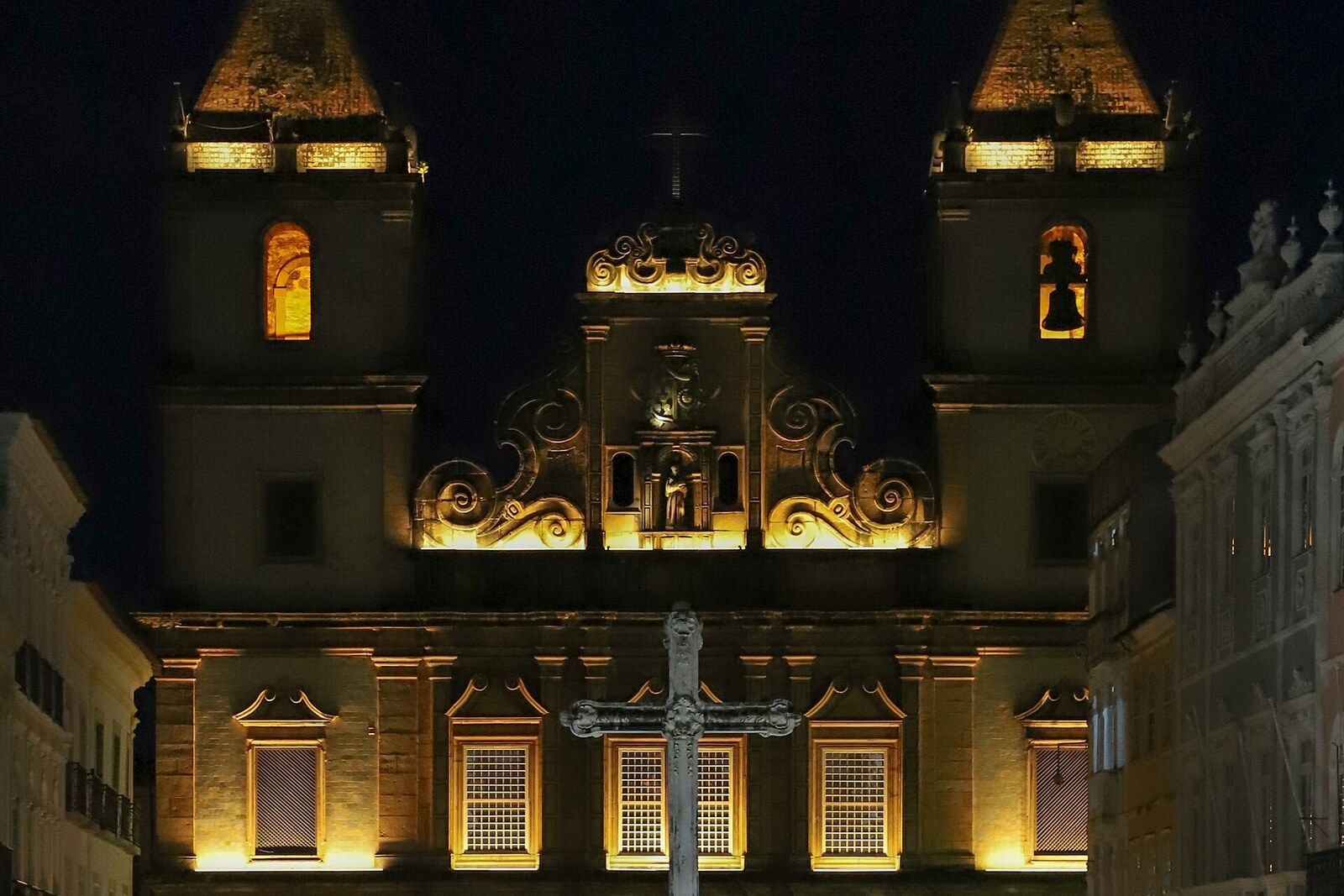
Look around first
What to notice
- Closed church doors
- Convent buildings
The story of the place
The locked doors today lead into the church of a Franciscan convent. The Salvador residence was founded in fifteen eighty-seven, and construction of the present church began in seventeen oh eight. Beside it stand the convent buildings, where live the brothers of a community that called itself Lesser Brothers and renounced personal property.
The church doors are closed now. Restoration has been underway here since part of the central nave ceiling collapsed in February two thousand twenty-five; under the current plan, visitors are expected to be allowed in again by two thousand twenty-nine. The convent buildings, meanwhile, remain home to the Franciscan community.
São Francisco is named after Francis of Assisi. At the beginning of the thirteenth century, this merchant's son renounced his inheritance and gathered brothers who promised to live without personal property. They called themselves Lesser Brothers—hence the Franciscan Order. Its Salvador convent was founded in fifteen eighty-seven, and construction of the present church began in seventeen oh eight.
The gilded interior came later. Wealthy townspeople donated to the church, commissioned annual masses for themselves, and received burial places inside the church: the more generous the contribution, the closer to the high altar. The Franciscans could maintain a poor way of life in their cells, while the donors' money was turned into carved wood covered with thin sheets of gold.
By the end of the nineteenth century, another kind of poverty threatened the convent: there was no one left to live in it. In eighteen fifty-five, Brazil's imperial government prohibited monastic orders from accepting novices. The old brothers were dying, with no replacements; after the proclamation of the republic, six monks remained in the entire northeastern Franciscan province, all of them in Salvador.
They asked the Franciscans of Saxony for help. On December twenty-seventh, eighteen ninety-two, German brothers arrived at this convent to restore the nearly vanished community. There was plenty of work beyond the altars. Street drains emptied into the convent garden, cases of yellow fever occurred in the residence, and ants had made tunnels beneath the foundations. The brothers excavated the bases, destroyed anthills, sealed cracks with cement, and succeeded in connecting the drains to the city sewer system.
But the gilded carving confronted them with a question that cement could not solve. The German reformers adhered to a strict understanding of Franciscan poverty. They drew up a rule under which only the tabernacle and sacred vessels were permitted to be gilded. An oral account preserved in the community adds that some of the arriving brothers proposed removing the old gilding, but the residents of Salvador objected. The proposal did not pass.
The German Franciscans stayed. In nineteen oh one, the order officially restored the province here and reopened fourteen convents. They saved the residence from abandonment, and the people of Salvador preserved its gilded interior.
Behind the closed doors, this carving is still there. At the center of the high altar, Christ removes one hand from the cross and touches Francis of Assisi—the founder of the order, whose followers came to save the convent and nearly deprived it of its gold.
Useful on site
Closed to visits and services during the restoration period. The official plan of June 2, 2026 provides for a possible opening after the work is completed in 2029; the timeline is preliminary.
Checked: June 24, 2026. Check the official source before visiting.Access to the church and convent spaces may differ; check on site, and if the interior is closed, listen to the narration by the façade.