 Guide On Map
Guápulo: Down from Quito to the Sanctuary
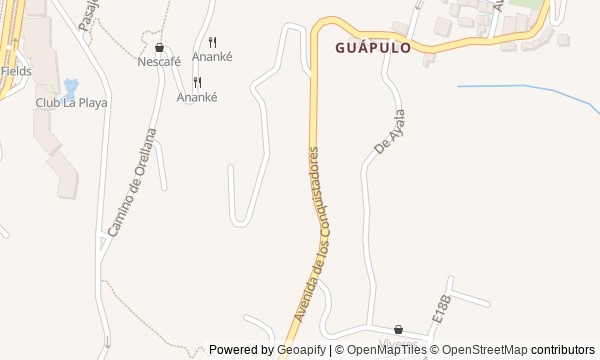
From the Mirador de Guápulo along Camino de Orellana to the plaza and Calle Leonardo Tejada
Guide On Map on your phone
Open the walk like a regular app
It takes about 10 seconds to install. No app store needed.
The whole path
Route map
About the walk
You will begin on Quito's upper edge, where Guápulo and the Tumbaco Valley open up beyond the railing of the Mirador de Guápulo. Then the stone road leads down to the plaza, the Guápulo Sanctuary, and the former sacristy. The city panorama gives way to a steep residential slope, and the history of conquest to stories of neighbors, pilgrims, feast expenses, and the work of carvers.
You will learn why trucks at the head of the procession are filled with oranges, why a small board needed two projecting beams, and how a painted canvas proved more useful than a lost original. The answers appear only when you are there.
The story separates documents from later versions and quietly shows how shared faith became money, obligations, paintings, and carved wood. By the end of the descent, you will read the Guápulo Sanctuary as the work of an entire neighborhood, not as a solitary old church.
Why this order
From the Mirador de Guápulo, you will see the full drop between Quito's plateau and Guápulo, so the next step is Camino de Orellana itself: the panorama becomes a real descent eastward. The road reaches the slope's only broad level stretch—the plaza in front of the Guápulo Sanctuary—where processions gathered and feast offerings were distributed. After the plaza, the route enters the church: the public feast becomes clear through the image and the fundraising that built it. The Fray Antonio Rodríguez Museum continues the thread in the former sacristy, where the Brotherhood of Our Lady of Guápulo fixed stories of miracles in paint. The final walk along Calle Leonardo Tejada returns from the pictured old interior to the craftspeople who used such an image to restore a lost retablo.
Those who want to see Quito beyond its formal historic center Those interested in local feasts and how religious brotherhoods worked Those who enjoy stories about the fate of particular objects Those ready for a long descent
Those looking for a walk without a noticeable change in elevation Those who want only an overview of Quito's main sights Those who prefer an open-ended walk without a dense historical narrative
Before you go
Wear shoes that hold firmly on uneven stone, and bring rain protection: a wet descent calls for especially short, careful steps. Before setting out, check notices about the road's condition—the slope is being reinforced, and after bad weather some sections may be difficult or closed. The Guápulo Sanctuary remains an active church, so speak quietly inside and do not disturb services. Confirm separately whether the museum can be visited: an open church door does not mean the museum section is accessible.
When to go
Start in the morning or early afternoon so you can see the valley in good light and take the stone descent without rushing. Leave extra time for the plaza and church: a service or local event may change the usual rhythm of a visit.
Backup plan
If the stones are wet, the road is closed, or the route feels unsafe, skip the walking section between the Mirador de Guápulo and the plaza and reach lower Guápulo by car, after checking which approach is open. You can continue from the plaza: the church, the museum façade, and Calle Leonardo Tejada preserve the second half of the story. If the museum is closed, look at the complex from outside and do not try to enter through service or church areas; keep the story of the paintings as context for a future visit.
Route conditions
Elevation. Ascent — 8 m; descent — 163 m
OpenStreetMap extract of June 18, 2026: database data, not a check on the ground. Data © OpenStreetMap contributors, ODbL licence
Walk plan
Open in maps ↗- 1
Mirador de Guápulo
Here you will see why the festival begins up high and how much neighborhood work is needed for the shared procession. - 2
Camino de Orellana
The descent will connect today’s route into Guápulo with the expedition that set out from here beyond the Andes and broke apart at the rivers. - 3
Plaza de Guápulo
This open space shows where personal festival obligations became exchanges among families. - 4
Guápulo Sanctuary
A small portable image will explain where the funds for the large church and its decoration came from. - 5
Fray Antonio Rodríguez Museum
The painted cycle shows how an account passed on to the brotherhood became visible proof of the local cult. - 6
Calle Leonardo Tejada
The final stop links the name on the sign to the brothers’ joint work restoring the main altar.
Route features
Everything you need stays in the browser
Progress, saves and your trip plan are stored on this device.
Add Guide On Map to your home screen so the walk opens outside the browser.
How we handle sources, maps and corrections: our editorial standards