 Guide On Map
Hong Kong Old Town: Markets, Courts, and Life on the Slope
From Central Market through Hollywood Road to Western Market
Guide On Map on your phone
Open the walk like a regular app
It takes about 10 seconds to install. No app store needed.
The whole path
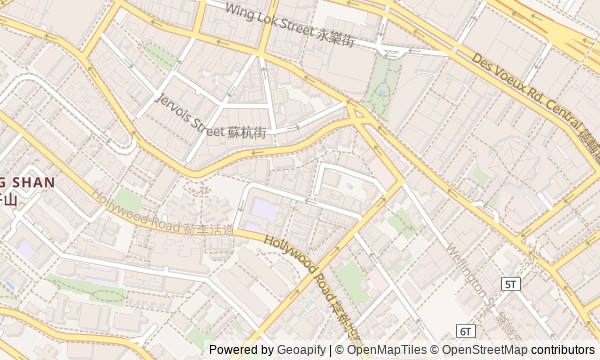
Route map
About the walk
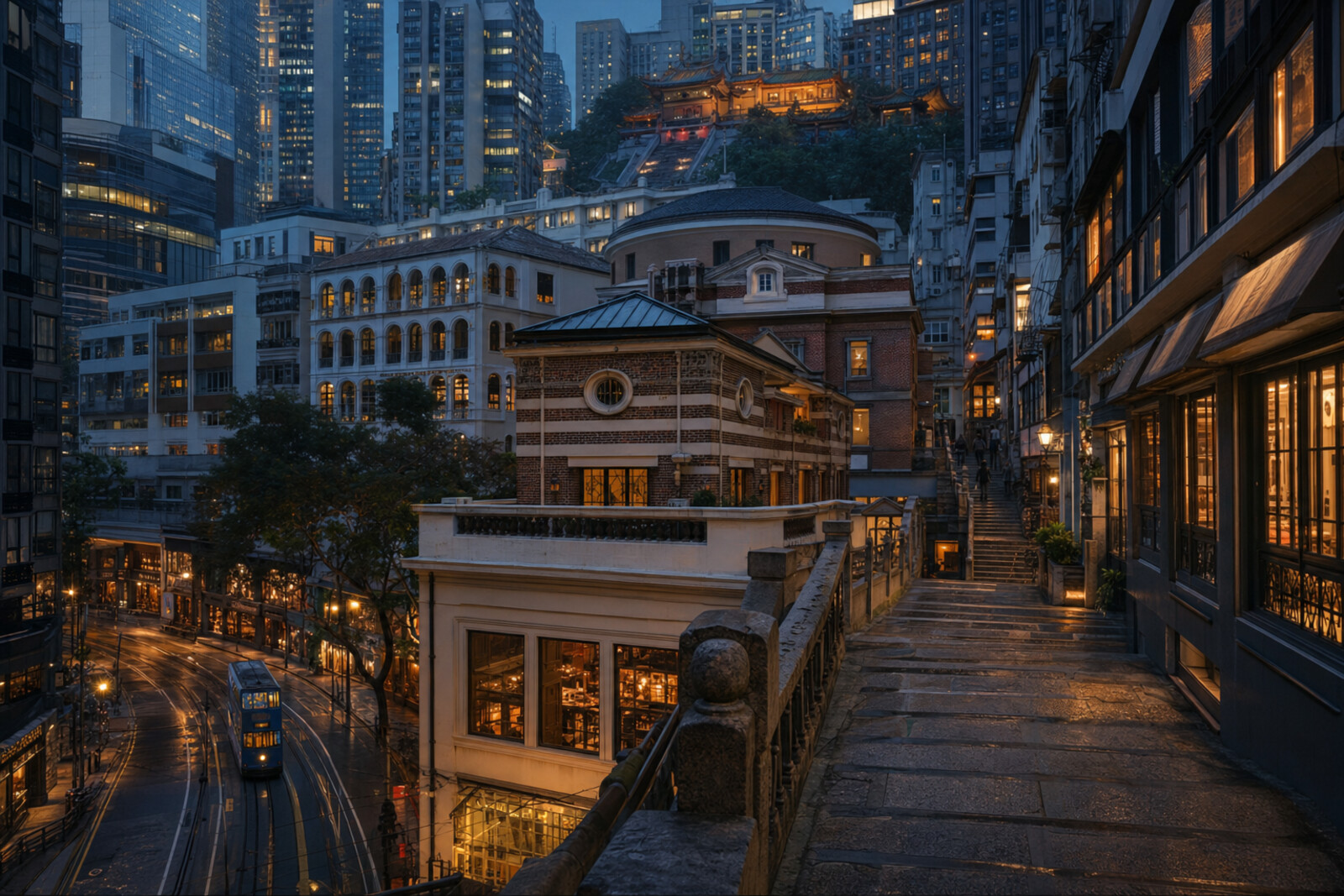
You will cross old Central from bottom to top, then descend again toward the former shore. You will begin at a market from 1939, step onto granite stairs, and climb toward Hollywood Road. At the top, a prison, a court, police quarters, and a temple will stand close together—a place where a trade dispute followed very different rules. The finale comes at a second market, built of red brick and now stripped of its last fabric stalls.
This is a story about how young Hong Kong assigned places: who got a stall, who was responsible for cargo, where a prisoner was held, how a family received a room. At every stop, there is one human choice and its cost. Why did a market tenant remain in debt? How did uneven paving help people earn money? Why was a prisoner's death announced ahead of time? The answers remain inside the stops.
You will leave with a different map of Central: the shore will have moved away, buildings will have changed their purpose, and the old rules will still be legible in stalls, steps, cells, and kitchens.
Why this order
Central Market sets the route's lower commercial layer and its former waterline. The granite staircase comes next: porters carried materials up from the shore to the prison and the court. At the top, Tai Kwun shows where that climb led and how police, courts, and cells operated side by side. The neighboring PMQ carries the police story beyond service, into corridors, kitchens, and a courtyard. From there, Hollywood Road leads to Man Mo Temple: after the colonial court, another place becomes clear, where merchants settled disputes by oath. The final descent to Western Market returns the route to waterfront trade, while the story of relocated fabric stalls brings it back to the first market's question: who controls a place, and what happens to those who must give it up.
Those who want to understand how early Hong Kong worked Those who care more about human stories than a list of architectural styles Those who enjoy reading a city's history through ordinary buildings and streets
Those looking only for skyscrapers and harbor views Those who find steep granite steps difficult
Before you go
Wear shoes with good grip: the granite slabs on the slope are uneven and become slippery after rain. Do not replace the climb up Pottinger Street with the escalator if you are able to walk it—the street's surface matters more here than the view. Access to individual rooms in the former police complex and PMQ may depend on exhibitions and events, so treat the interiors as a bonus rather than a condition of the walk. At the temple, speak quietly, do not linger in front of the altars, and follow local photography rules. Western Market is closed for renovations, and the final stop is designed to be viewed from the street.
When to go
Start in the morning or soon after noon, so you can take in accessible interiors without rushing and reach the temple well before it finishes its daytime hours. In hot weather, allow extra time for the climb and short breaks.
Backup plan
In heavy rain or if you are tired, use the covered escalator connection for the main climb and view the granite steps from below, without stepping onto the wet ledges. If the interiors of the former service complexes are unavailable, continue along the open courtyards and facades: the route's logic remains intact. At Western Market, do not try to enter behind the construction barriers. If scaffolding blocks the close view, look at the building from the opposite side of the street, where you can see both the red brick and the tram line.
Route conditions
Surface. Paved — 889 m (data covers 43% of the route)
Stairs. Flights: 9, 127 m in total
Access. Wheelchair — no; stroller — limited (stairs)
Facilities. Toilets — 10; drinking water — 2
Elevation. Ascent — 92 m; descent — 67 m
OpenStreetMap extract of June 18, 2026: database data, not a check on the ground. Data © OpenStreetMap contributors, ODbL licence
Walk plan
Open in maps ↗- 1
Central Market
This is where the route’s main question begins: who received a trading space, and on what terms. - 2
Pottinger Street
The steps connect the waterfront trade with the institutions on the hill and show what this climb cost a porter. - 3
Tai Kwun
The complex shows how the police, court, and prison converged at one point—and where a prisoner found a way out. - 4
PMQ
Here, an institutional reform becomes the story of families who shared corridors, kitchens, and a courtyard. - 5
Man Mo Temple
The temple shows how the trading community settled disputes beside the British court. - 6
Western Market
The finale returns to the merchants and shows why relocating shops does not necessarily preserve a street.
Route features
Everything you need stays in the browser
Progress, saves and your trip plan are stored on this device.
Add Guide On Map to your home screen so the walk opens outside the browser.
How we handle sources, maps and corrections: our editorial standards