 Guide On Map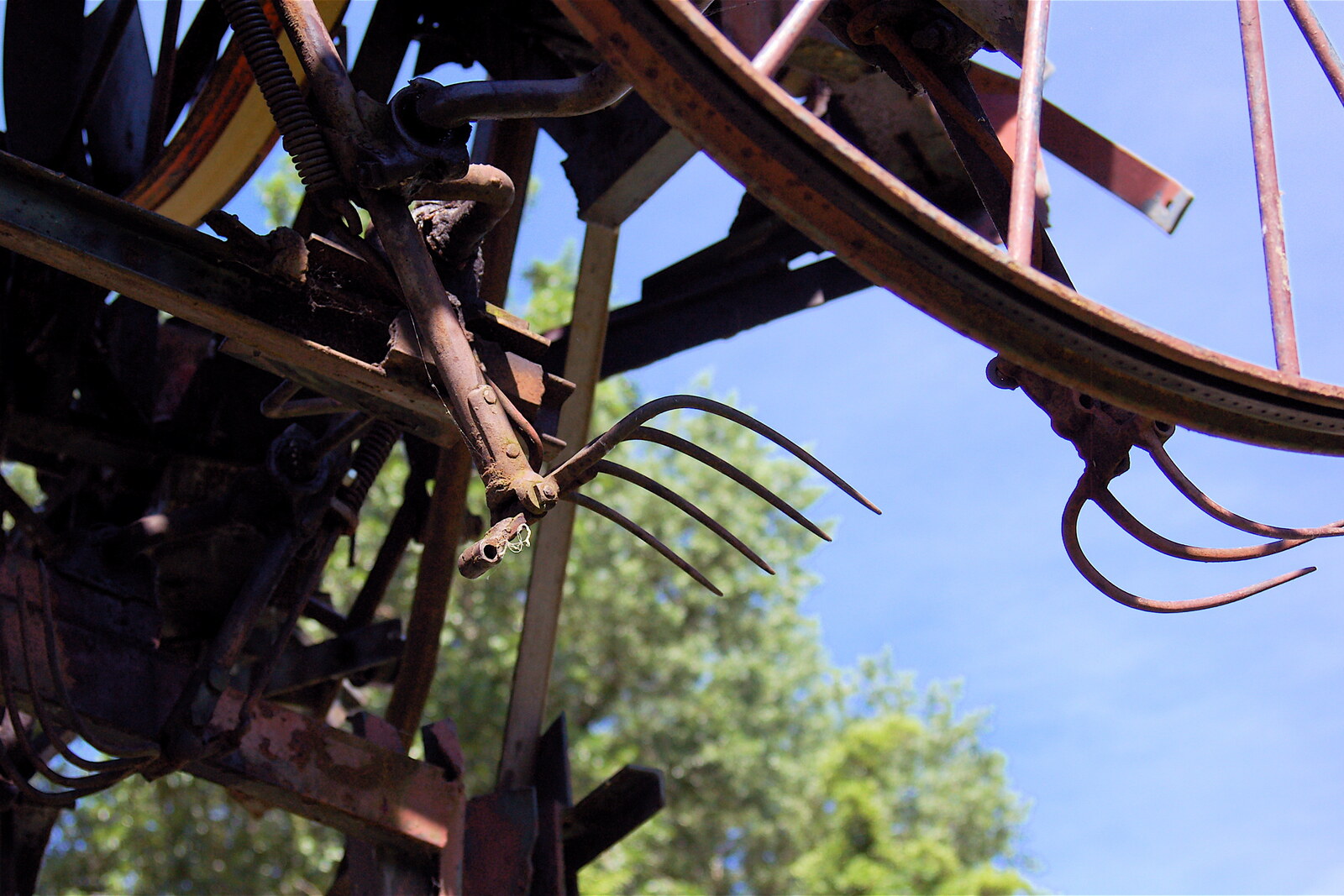
Look around first
What to notice
- Seven-meter black structure
- Wheels and rods
- Five moving units
- Swaying metal parts
The story of the place
Turning wheels, rods, and swaying metal parts are assembled here into a tall black sculpture. Five motors move its parts independently of one another, but all this machinery does nothing and transports nothing. After the exhibition ended, the sculpture was bought for the city, yet a permanent place for it could not be found for a long time: officials considered fifteen sites, while residents were troubled by the possible clatter and the heap of black metal itself. From April through October, the mechanism is switched on three times a day and left running for eight minutes.
Jean Tinguely, a Swiss sculptor of moving machines, received his first major commission for an outdoor space in the winter of nineteen sixty-three. The organizers of the Swiss National Exhibition in Lausanne needed a monumental signal tower for the military department section. Tinguely spent six months building a seven-meter black structure that gave no signals to anyone.
Five electric motors drive five separate units. Wheels turn, rods rise and fall, metal parts sway and move back and forth, but the machine manufactures nothing and goes nowhere. The name “Heureka” means “I have found it” in Ancient Greek. According to legend, Archimedes exclaimed this after making a useful discovery. Tinguely later explicitly called the name a joke: an inventor’s positive exclamation had gone to a mechanism with no useful purpose.
At the exhibition, Heureka became one of the most talked-about structures and brought Tinguely recognition in his homeland. After the pavilions closed, Zurich industrialist and collector Walter Bechtler bought the machine and offered it to the city for permanent display. The sculpture was dismantled and stored in Bechtler’s factory yard. Zurich officials considered fifteen possible sites—outside Kunsthaus Zürich, near the Hallenstadion, and on Saffa Island. Each time, residents objected either to the expected clatter or to the heap of black metal itself. The purchase had been made, but there was nowhere to install it.
A solution was needed by film director Ernst Heiniger. He was making a three-part film about Switzerland for Expo 67 and wanted to show Heureka operating in the section on contemporary art. The dismantled machine would not do for this. Heiniger began pressing city officials for an immediate installation. For the filming, they agreed to assemble the sculpture on a lawn at Zürichhorn by the lake—for just three years.
Heiniger filmed Heureka in motion, the film was shown in Montreal, and in nineteen sixty-eight the director received the Zurich Film Prize for it. The three-year period passed, but the machine was not removed from Zürichhorn. When it was sent to an exhibition in Amsterdam in two thousand eleven, neighborhood residents were already demanding that the sculpture be brought back.
From April first to October fifteenth, Heureka is switched on at eleven, fifteen, and nineteen hundred hours—each time for eight minutes. The five motors again set a purposeless mechanism in motion. The temporary site chosen for Heiniger’s camera has remained its address since nineteen sixty-seven.
Useful on site
The park is freely accessible; Heureka usually operates daily from April to mid-October at 11:00, 15:00, and 19:00 for 8 minutes.
Checked: June 27, 2026. Check the official source before visiting.You may view the sculpture freely, but the mechanism does not move continuously—do not count on catching it in operation. Do not approach the parts too closely or try to set them in motion.